
Copyright © Ivan Brown 2023, 2024, 2025
All rights reserved.
Reprint and Terms of Use. Oh, the Things I Think About may not be reproduced, copied, transmitted, or stored, in whole or in part, in electronic, paper or any other form or by any other means, without the express permission of the copyright holder or his agent(s), except as provided by Canadian and international copyright laws. For permission to use parts of the text or the illustrations, and fee information for such use, contact: ivanbrown95@gmail.com
About the content. Oh, the Things I Think About is a series of humorous and fictional stories. Although parts of the tales might have emerged from real events in the author’s life, the events and people referred to in these stories are fictional except where written permission has been given. Every effort to respect accuracy and privacy has been made, but information to correct any oversight is welcome.
Disclaimers. The points of view and all materials in this book are solely those of the author and do not necessarily represent the policy, endorsement, or opinions of any publisher, printer, or distributor. The author and copyright holder has made every reasonable effort to ensure that the information in this book is accurate and safe within the context of humorous fiction writing. The content of this book shall not be considered as advice. The author and copyright holder cannot accept liability for any injury, damage, or loss to persons or property that may result from any part of this book.
BK Books and Creatives bkbooksandcreatives.ca
Contents
The first 48 stories have been compiled into a book entitled If Oscar Wilde Had Only Known My Great-Great-Grandfather: A year of humorous stories
1. Why Can’t Anyone Cut Keys That Work?
2. Since Being Angry Is So Trendy, I Decided to Be ANGRY Too!
3. Solved: St. Valentine Had Multiple Personalities
4. Why Can’t Dogs Have Their Own Washrooms?
5. I Really Want To Be Called “Beloved”
6. Why Can’t Parliamentarians Have A Fanciful Name, Like Animals Do?
7. So … Now My Brother Drinks Goat’s Milk …
8. My New Bestie, The “Happiness Engineer”
9. I Think I’m Abnormal – I Don’t Pandiculate
10. Let’s Celebrate Climb A Tree Like A Koala Day
11. Stop Telling Me To “Navigate To…” On My Computer !
12. Mabel Starts A New Church Trend
13. How My Food Attained Equality With My Ad Blocker
14. What If You Don’t Know Your Friend’s Name After 52 Years?
16. If There Are Two Doors, Why Is One Always Locked?
17. I Can’t Figure Out Why I Am A Baseball Fan
18. Let’s Put Some Magic Into King Charles
19. Marian Drives To Her Pickleball Club
20. My Gardener Hears About Homophones and Homographs
21. Catherine Enjoys a Glass of Cherry Brandy
22. My Left Leg Gets Pay Equity for Predicting the Weather
23. How I Got Over My Fear of Santa
24. Marj Keeps Her New Year’s Resolutions
25. Jason Becomes Virtuous and I Do Not
26. Bradford Is Proud Of His Accordian Of Chins
27. Stella Thinks the World Might Be Curved After All
28. Where the Devil Are My Winter Slippers?
29. How St. Patrick (and Friends) Chased the Snakes Out Of Ireland
30. How I Cured My Neighbour Al of His Love of Numerology
31. I Am Not Really Sure Where My Knuckles Are
32. Aunt Marie Goes to Her Octogenarians Bridge Club
33. At Last, I Fully Understand the Higgs Boson
34. Why Can’t I Be As Happy As People In Finland?
35. How To Get Over Being Obfuscated
36. Vernon Hits A Home Run For His Octogenarian Baseball Team
37. Hairy Harry Marries Merry Mary
38. If Oscar Wilde Had Only Known My Great-Great-Grandfather
39. Why Young Career Women Jog With Pony Tails
40. How I Became An Olympic Flagpole
41. My “Triathalon for The Lazy” Becomes a Success
42. Shelley Brooks Is Awarded An Honourary Plaque
43. Should People Who Are Equinely-Inclined Have Their Own Country
44. Darwin Has His Own Version Of Evolution
45. Shelley Brooks Gets A Job At The Bank
46. My Adventures In Ticklish School
47. Santa and the Elves Teach Modern Children a Lesson
48. Why I Gave Up On Scientific Discoveries
2025 Stories
49. Doreen Goes To A Wine-Tasting Class
50. Herb Coaxes Wiarton Willy Out Of His Hole On February 2
51. What Does One Do With Old Professors?
52. Darwood’s Teeth Wear Sunglasses To Their Dental Appointment
55. Shelley Brooks Wonders If Deer Are Stupid
56. Joanne Has An Itchy Shoulder
57. Ambrose Plans to Put His Ashes In Vinyl
58. Dorothy Has A Fly In His Fridge
59, Clifford Has An Adventure At Age 40
60. Are Squirrels Smarter Than I Am?
61. The Alien Who Found Photos In The Clouds
62. My Second Toe Is Longer Than My Big Toe
63. Candi and Bambi Lead Unidentical Lives
64. Herb Gets A Job Watching A Door
65. Should Women With Big Hair In Theatres Be Fined?
66. Benny Designs T-Shirts For Coffins
67. Willy Shakespeare Tries To Write Stories About Elves
68. Doris Sits On A Discarded Toilet
2026 Stories
69. Elsie Gives New Meaning To New Year’s Resolutions JAN 11
70. I Expand My Horizons In An Effort to Be 95 Some Day AN 25
71. Benny Has Competition For His T-Shirts To Wear In Your Coffin Feb 8
72. How My Toothbrushing Problem Restored My Love Of Valentine’s Day Feb 22
73. Why Do People Brush Their Teeth In The Movies? Mar 8
74. Ann Picks A Name For Her Newborn Son Mar 22
75. Edmond Asks A Philosophical Question April 5
A new posting added every 2 weeks!
LEAVE A COMMENT ON THESE STORIES
Why Can’t Anyone Cut Keys That Work?
by Ivan Brown
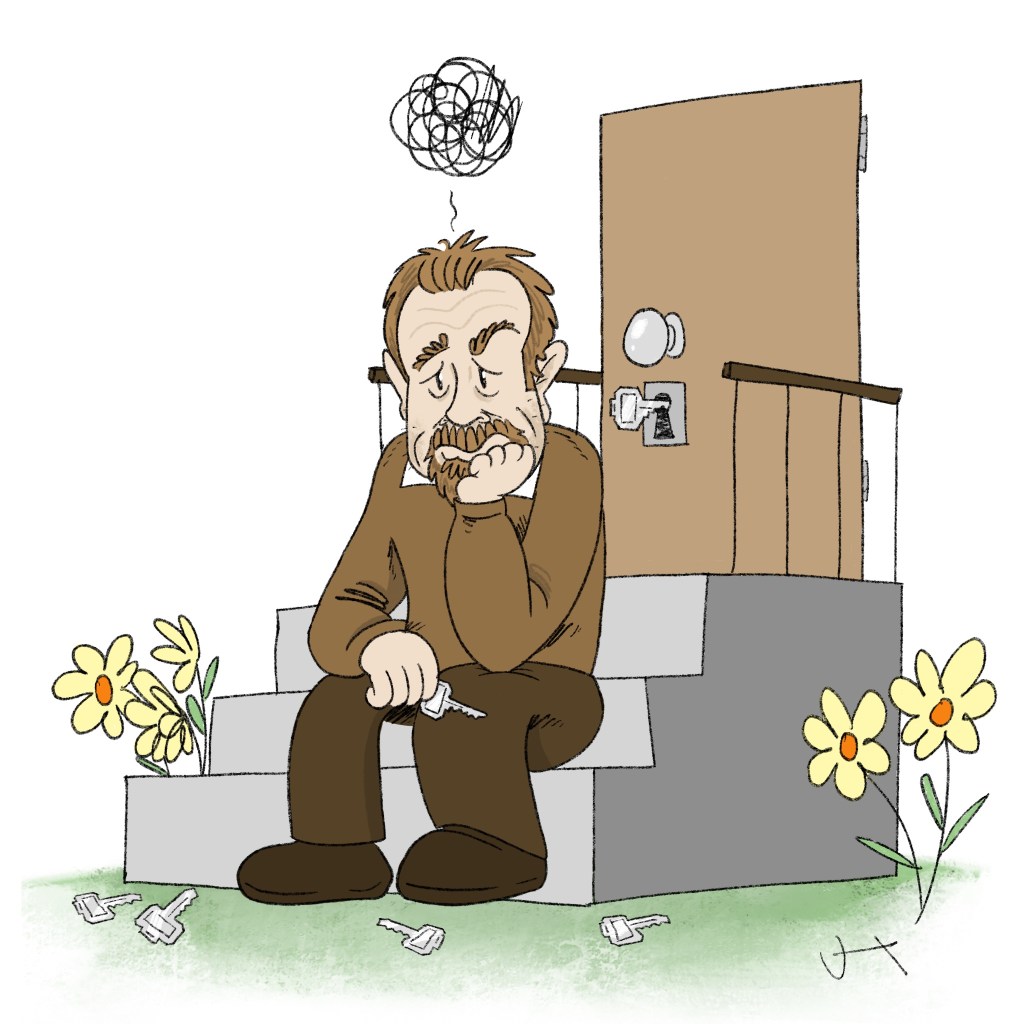
Yesterday, I had six keys cut as “extras” for guests to use on the front, back, and basement doors of our house. How many of the six keys do you think actually worked?
Four.
And don’t think I didn’t try. I took those two faulty keys firmly in hand and I pushed, yanked, jerked, and twisted them for the longest time. I even thought of getting out the hammer or maybe the pinchers. It was no use. They wouldn’t budge in the keyholes.
I can’t understand it. It’s 2023, and no one can figure out how to make keys that work 100% of the time. I’m no mathematical expert, but I figure four working keys out of six is only about a two thirds success rate. In my mind, this just doesn’t cut it. What would you say if you ordered a coffee, and you were served only two thirds of a cup? What would your boss say if you announced you were only going to do two thirds of your work today? Trust me, no one would be smiling.
Students who get two thirds of the questions right on a test get a mid-C grade. A pass, but please try harder next time. I am toying with the idea of telling my key-cutter that. I think she might have gone to school. Maybe even got some Cs.
I got my first apartment in 1970 and I had to go back to have my extra key recut the first week. Same in the 1980s, 1990s… every decade since. Now here we are 53 years later, and my new keys will still not unlock my front door.
I can’t figure out why engineers can’t work on a remedy. I read in the Toronto Star that engineers at the University of Waterloo invented a urinal that doesn’t splash so much urine on you. Who knew this was a problem? I’m shocked I never knew. But I always knew cutting new keys accurately was a real problem. Why can’t they fix that?
I mean, how hard can it really be to get two little pieces of metal to be the same shape? I can store 7 million photos of things that have faded from my memory on my phone. I can send warmest birthday wishes to people I once saw on a tour bus in faraway lands just by clicking Send. I can share my innermost thoughts with my 537 close friends on Facebook with a quick flick of my mouse. But I can’t get into my own basement for love nor money.
The new key won’t turn.
So today I have to rummage through my recycling bin for the receipt and make a special trip back to the store to have the two defective keys recut. I’m annoyed, and I don’t want to go. Yesterday I had to stand in line more than fifteen minutes waiting for other people to have their keys not cut properly either, and I’m afraid my mood might be dampened if I have to spend that much time there again. Especially pretty much knowing that the results have a very good chance of being less than satisfactory.
Why should I have to be bothered taking those keys back to have new ones cut anyway? Honestly, is it too much to ask for somebody to invent a machine that makes a key that actually lets me in my front door when I am too lazy to walk around to the back door!
Oh, yeah. I can’t get in there either.
Copyright © Jon Klassen 2023
Since Being Angry Is So Trendy, I Decided To Be ANGRY Too!
by Ivan Brown
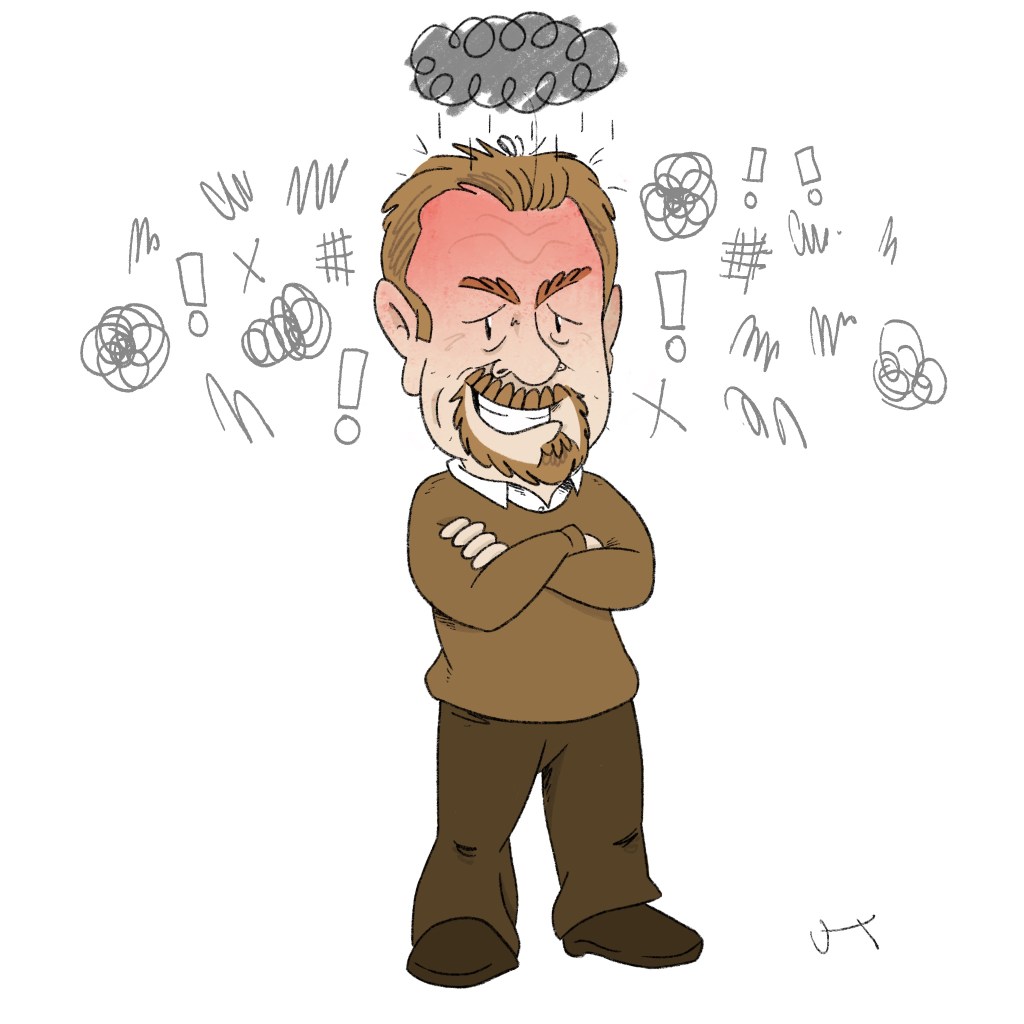
Grrrrrrr.
Everywhere I look these days, people are angry about something major. Freedom. Governments. Inflation. Relatives. The colour of people’s hair… I could go on, but you know what I mean. People are spouting off about anything and everything, totally exasperated.
It’s just so trendy.
Oh yes, it is so trendy to be angry these days that if you are not erupting in ire several times a day you are simply not normal. It doesn’t matter what it’s about. In order to fit in, you really have to get your dander up and cast venomous aspersions in all directions a great deal of your waking hours to be thought of as sane. It is expected these days. It’s normal behaviour.
Close friends ask me how I am, and I say fine. They peer into my face, sympathy abounding through squinting eyes, “Are you… okay…?” they ask, doubtfully. They know nobody is okay in today’s world unless they have surpassed their boiling point of indignation. It’s so abnormal to be “fine”. And it’s just so “in” to be hopping mad about everybody and everything.
To be honest, I don’t think the vast majority of them are really angry. I think they are just faking anger to be fashionable. Just pretending so they can be popular. Can they really be so worked up about the price of lettuce that they are beet-red in the face and dripping sweat like a marathon runner all over my rug? I think not. All they know is that they can’t show their faces on their favourite social media sites unless they are huffing and puffing over some perceived offense. Nobody would read their posts. They wouldn’t get any likes at all. They have to do it to be normal.
Yes, being angry is the norm now. The problem for me was that I just didn’t fit in. Being an un-angry person by nature, I was facing a dreary life ahead of me that smacked of existing as a mere social nobody.
There was only one thing to do: I would have to become ANGRY too! And that’s exact what I did. But the question was: what should an un-angry person like me be angry at?
I decided, as a start, to be angry at people with big heads. After all, I know a woman who has a head that seems about three sizes too big for her petite body. Why not flare up in heated resentment over that? So I started a social media group called GreatBigHeads where I ranted and raved angrily about why heads can’t match bodies, size-wise, and the site immediately got 273 likes. I was popular.
That spurred me on to my next spate of anger: fuming at people who sneeze like a cat. You know the ones I mean. They feel a sneeze coming on, turn their heads to the side and down, and purr out a little “ah-choo” into their elbow that is so meek it would not waken a sleeping mouse. I found that whenever I got steamed up about this that everyone within earshot began nodding vigorously in agreement. They all loved my rants about people who sneeze like a cat so much. They liked angry-me so much.
It’s so great.
Now that I am an angry person, my friends and family have all begun to see me as normal. I really fit in. My popularity is soaring, and I am so happy.
Copyright © Jon Klassen 2023
Solved: St. Valentine Had Multiple Personalities
by Ivan Brown
I was watching a Netflix documentary a few weeks ago on historical religious figures – I know, I know – and the historian who was narrating said the story of Moses may not have been about just one person, but rather an amalgam of stories about several people. There might have been several escapes from Egypt under several leaders, and there may have been several wanderings hither and thither through the desert on the way to the Promised Land.
Whoa! I was shattered. I had to sit down, blood draining rapidly from my face. Moses? Several people? It couldn’t be.
But as I sat there, ashen and shaken, something else occurred to me that was all the more reason to be fainting quietly away. You see, I was watching this on February 14 and it occurred to me to raise the question in my enfeebled mind of whether St. Valentine might, too, possibly not have been just one man, but an amalgam of several men. Is it possible that this could really be?
Yes.
A quick internet search, which always reveals the truth, proved my suspicions correct. There were at least two St. Valentines and maybe as many as twelve. I suppose I might be forgiven for not knowing that because the two “for-sure” guys were Italian so naturally they both slid under my radar by calling themselves San Valentino. Such deception!
In any case, it got me thinking. Was St. Valentine actually two men fused together as one person and, if so, how did the fusing together take place? Was it the earliest historical documentation of conjoined twins, or did it occur spontaneously as a miraculous event? That really made me ponder. Or, perhaps there was actually only one St. Valentine after all, but he was reincarnated several times in different time periods, assuming the same name each time so as not to confuse people unduly. That sounds reasonable. Or, another possibility still, was he simply one person with multiple personalities, all called San Valentino? Again, so as not to confuse people unduly.
What a dilemma.
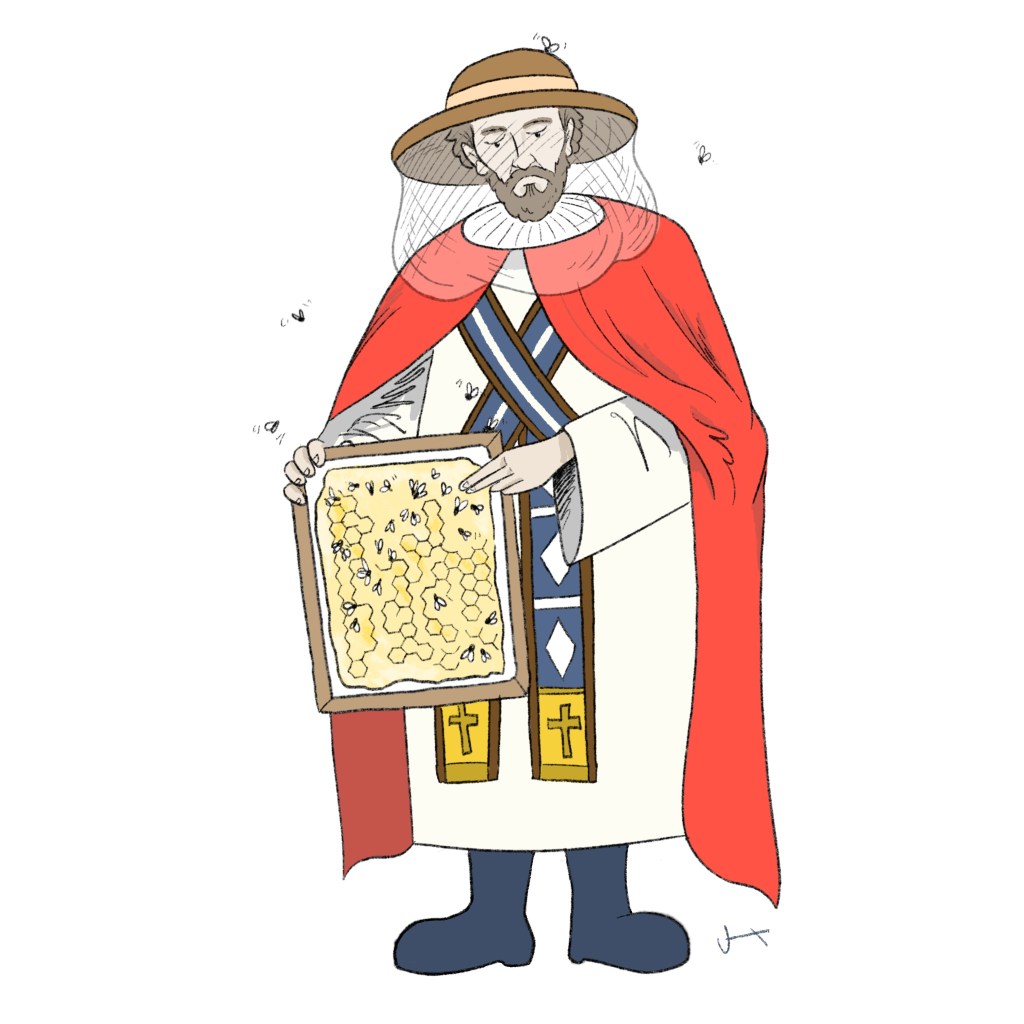
The answer, of course, comes from historical fact. St. Valentine, as recorded in history, is the patron saint of beekeepers and epilepsy, presumably because all beekeepers have epilepsy and because all people with epilepsy are beekeepers. I believe this. Who wouldn’t? But beekeepers would be unlikely to be fused together because, if they were, they would have no idea whose hive to gather honey from, so that fused-together theory is out the window. And a beekeeper who is reincarnated with a new body would not necessarily have epilepsy, so the reincarnation option is totally irrational too. That leaves just one reasonable theory.
St. Valentine had multiple personalities, and he called them all San Valentino so as not to confuse us. So thoughtful.
Now that that dilemma is solved, I can breathe easy again. The truth always makes both body and soul relax. I am still worried about Moses, though. I feel unsettled not knowing if his story was just about him or if it could possibly be about a few people who all, somehow, perhaps miraculously, got themselves all rolled up together into one. Whatever the answer, I do suspect that those stone tablets, all chiselled with weighty commandments, would be really too heavy for one old man to carry by himself, stumbling down the rough mountainside strewn with pebbles and rocks, so…
Another dilemma to solve tomorrow.
Copyright © Jon Klassen 2023
Why Can’t Dogs Have Their Own Washrooms?
by Ivan Brown
My dog pooped on my neighbour’s front lawn again yesterday. And again, I felt very embarrassed. Oh yes, I dutifully stooped and scooped the “number two” into the little bag I was carrying. But I still felt so ashamed to be doing this in the middle of my neighbour’s lawn that I pulled my hat down as far as I could over my face so he would think I was someone else.
Of course that was useless, since I am the only one in our neighbourhood with a little white dog. He knew who’s dog pooped there.
I don’t know how my dog does it, but she never seems to think to do her business discreetly behind a bush or in the wild grass that grows along the alleyway. You’d think she would, at the very least, have the common decency to wait until we get around the corner and “eliminate” on the lawn of somebody I don’t know. But, oh no. Her favourite place to “go” is in plain view and as centre-stage to my neighbours’ picture windows as she can get. It doesn’t matter which neighbour, as long as it is somebody who knows me well enough to call me by my first name.
It’s just so humiliating. Especially in the summer when the neighbours are sitting on their front porch, looking right at us, trying to enjoy their hotdogs.
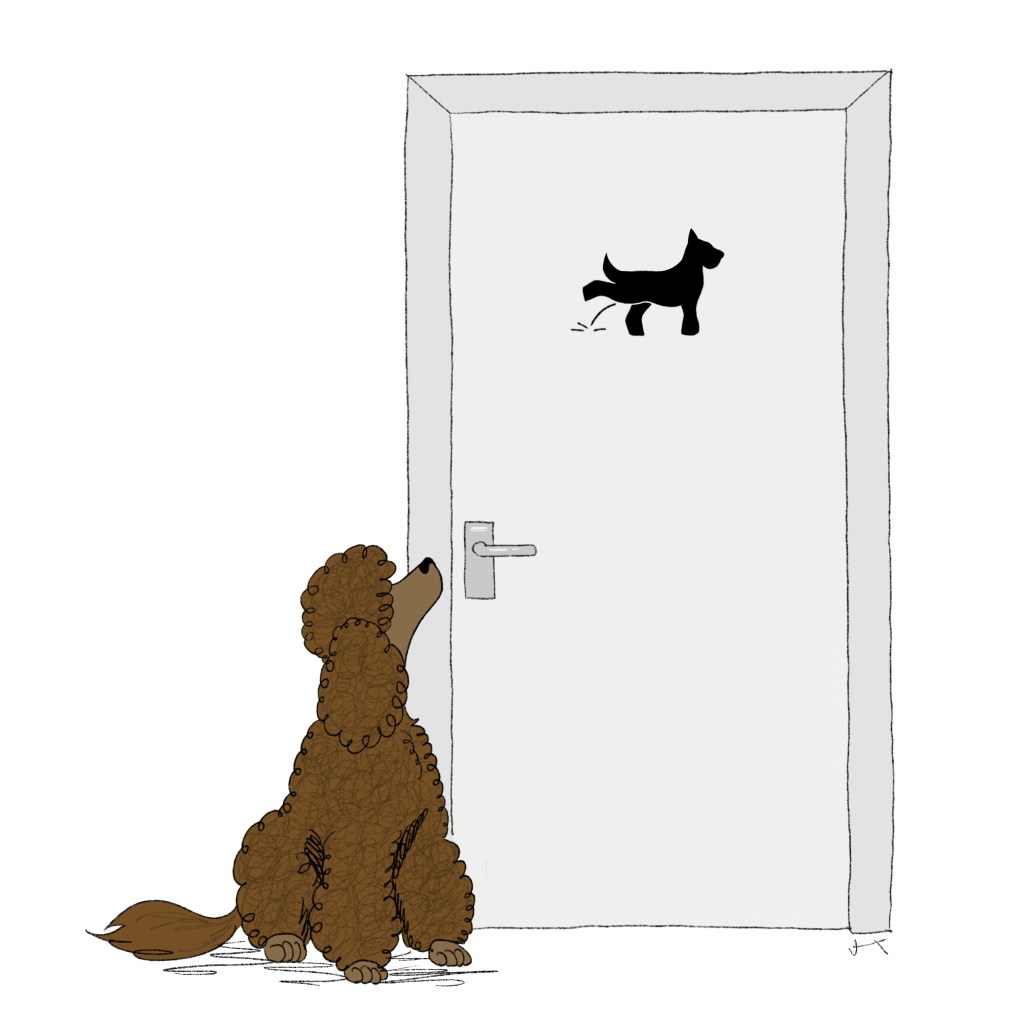
Perhaps my dog is trying to make me think of the obvious question: people have bathrooms, and cats have litter boxes, so why can’t dogs have their own washrooms?
Dogs seem to have almost everything else. They have their own parks. They have their own stores. They have their own clothes. They have their own toys. They have their own bathtubs in some carwashes. They get way more gifts in their own Christmas stockings than I do. But when it comes to the call of nature, we are still in the stone age. Or should I say the grass age. They simply do their poo on the neighbour’s grass because they don’t have any designated place to go.
It’s not fair. Dogs need their own washrooms.
If the mayors of our cities were up to par, they would have thought of this. They would have installed dog washroom stations here and there, conveniently located on corners and in parks, discreetly hidden within little gardens of cosmos and zinnias that feature statues of noted politicians, both famous and infamous. Little packets of doggie treats could be conveniently stored in a handy dispenser for training dogs to use their very own, and very convenient, washrooms. A heated hose could be conveniently installed for dog owners to rinse the refuse down a drain that is conveniently connected to a convenient sewer system.
Dog washrooms would just be so suitable.
It would cost cities a bit to install and maintain dog washrooms, but it would be well worth it. They could get a provincial endorsement. They could get a federal grant. Maybe even an international animal-rights commendation!
I can’t think of any urban planning issue that is more important or more urgent. I’m sure my neighbours would agree, but please don’t ask them. I don’t want them to catch on that it was my dog that pooped on their front lawn yesterday. Again.
Copyright © Jon Klassen 2023
I Really Want To Be Called “Beloved”
by Ivan Brown
Did you ever notice that if someone or something is sort of nice and lasts a long time they become “beloved?”
I was reading a magazine article the other day that referred to “the beloved movie Mary Poppins.” To be honest, I am more than a little ticked off that Mary Poppins can be called beloved, but I can’t. I was around well before 1964. Sure, only the hardest of hearts doesn’t love Julie Andrews and Dick van Dyke. And there’s that nice supporting cast, the catchy tunes, and the cute story. But beyond that? Really, beloved? They surely haven’t heard me singing along to the Oldies station while I am driving to the mall to buy new socks. I don’t see why I shouldn’t stand a pretty good chance at becoming a beloved Oldies crooner.
Then I was reading a newspaper article that called Margaret Atwood “Canada’s beloved author.” Oh? When you think of it, does she really merit beloved? Not even 70 books yet, some stories billed as short that are not actually nearly as short as mine, and the odd poem now and again. As far as anything I have heard to the contrary, she doesn’t even sing. Honestly, has she rooted 12 red, pink, and purple geranium slips in a jar of water on the windowsill of her porch? I have. Why can’t I be called “Canada’s beloved geranium-rooter?”
It doesn’t seem fair.
When my cat caught a mouse, I lovingly placed the creature in a shoebox and, even more lovingly, I drove it to High Park and found a nice comfy spot under an old fallen log to let it go. It ran into the grass instead, but, hey, I am sure it returned to the log and said thank you in its prayers that night. Shouldn’t I receive accolades as a beloved animal releaser?
I believe I should.
I have a long list of things I could be highly lauded for, the sum of which is surely at least beloved. I once saw a beautiful tulip in my neighbour’s garden near the sidewalk and I didn’t pick it – until well after dark, that is. So respectful to wait! A woman asked me to help her push her car out of a snowbank, but I said so sorry, can’t, I have arthritis. Such an advocate for disability! I absent-mindedly ran my grocery cart into a cross old woman who tripped and was able to sue the store for a small sum. What a financial supporter of a deserving senior in her declining years! Yes, add them all together and there is no doubt in my mind that I give more than a bit of extra punch to the term beloved.
In fact, I think it behooves us all to consider me beloved.
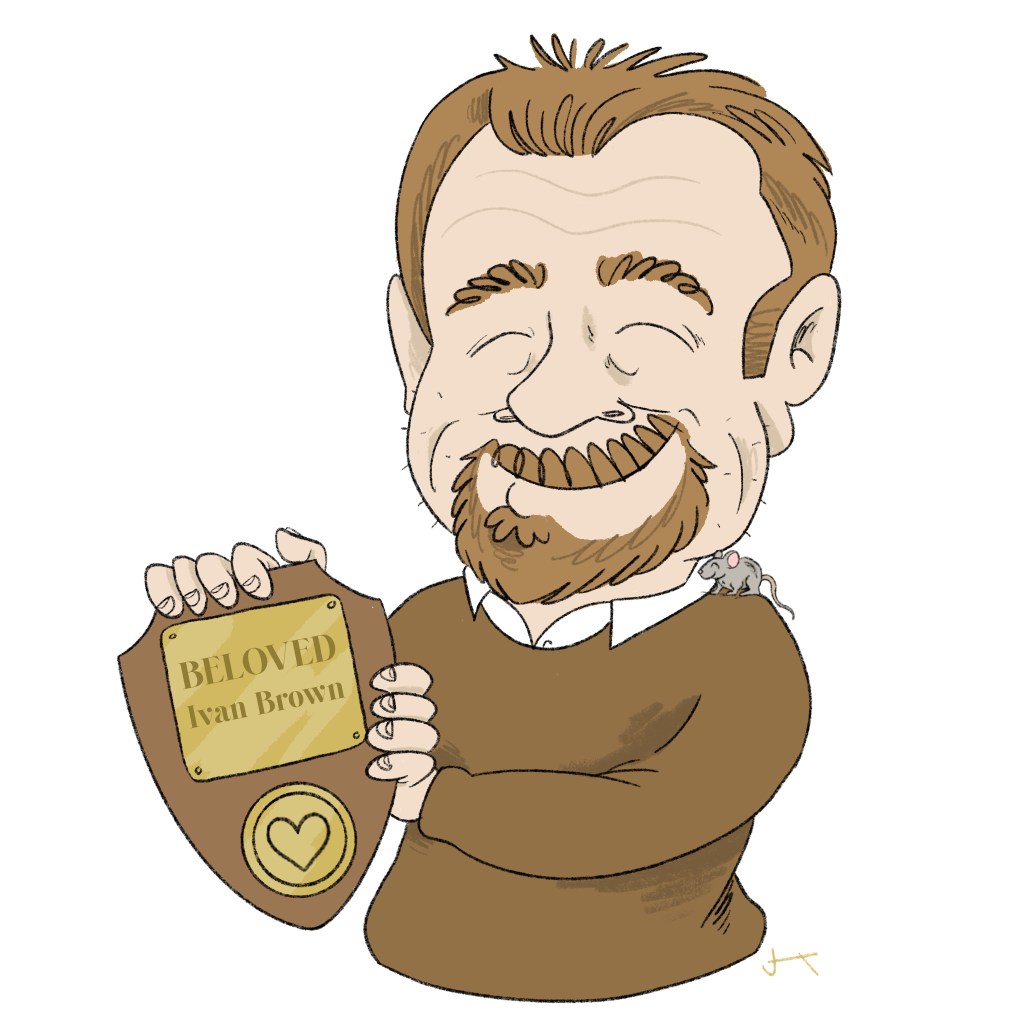
I am sure you agree that I should get a plaque that reads: To the One who Deserves to be Called Beloved. Or… oh? really?… Is that what you are actually thinking? That it should read: To the One who Barely Deserves to Be Loved?
That would really get my ego scurrying, alongside the mouse, back under that old fallen log, wouldn’t it?
Copyright © Jon Klassen 2023
Why Can’t Parliamentarians Have A Fanciful Name, Like Animals Do?
by Ivan Brown
I have always liked the fanciful names that groups of animals have. You know. A school of fish, a pride of lions, an army of ants. You may even know a paddle of ducks, a gaggle of geese, or a murder of crows.
So fun.
I love the imagery of a tower of giraffes, a parade of elephants, and a shiver of sharks, although for the life of me I can’t quite get my head around a wisdom of wombats. I have been to Tasmania and seen wombats nosing around for food among the grasses, but it never occurred to me that they had much wisdom to share other than to wisely remain in Australia.
And what about this one: a parliament of owls? It doesn’t take an over-active imagination to realize that a row of sleepy owls who are lining the branch of an old dead tree are at least as clever and hoot-hoot with as much sense as many of the elected officials who bedeck the halls of our government buildings. But if owls can be parliamentarians, why can’t parliamentarians have their own fanciful name too?
It’s only fair.
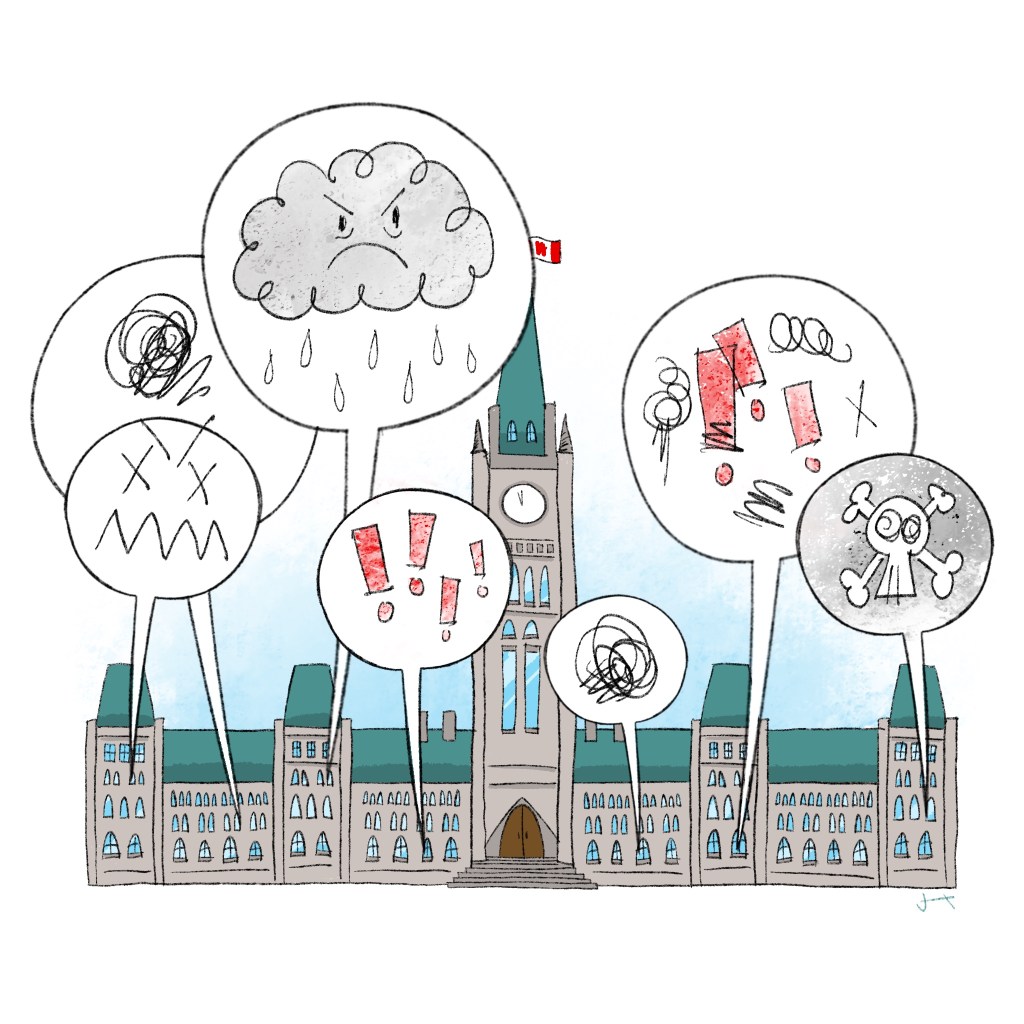
I know you’ve seen Members of Parliament on television making their speeches about some point that is about as clear as a cloud of locusts, and “debating” a point by arguing everything but the subject at hand in a tone that is about as friendly as a quiver of cobras. But what fanciful name is worthy of our honourable parliamentarians?
At first I thought a posse of parliamentarians might be suitable, since they are a group called together by the wisdom of our ballots to make and uphold the laws that suggest our moral fabric. But no, a posse is a group of do-gooders chasing those who are up to no good out of town, and that wouldn’t work because we can never seem to figure out which parliamentarians are the do-gooders and which ones are up to no good.
Then I thought of a sloth of parliamentarians, as it seems to take them forever and a day to get anything done, but that suggests that their slow movement is deliberate and goal-oriented and that’s not quite right either. Better to go with their main occupation and what they are best at: bickering.
A bickering of parliamentarians. I like it.
Once the term “a bickering of parliamentarians” is officially passed as an Act of Parliament, subsidiary terms for the various parties would simply fall in line. The governing party would no doubt have its natural right to condescension recognized and be referred to as the Bickering Belittlers, while His Majesty’s Official Opposition would, naturally, be called the Bickering-Backers or, for short, the Bicker-Backers. The smaller parties – always yearning to be included in the fracas – would demonstrate their obvious moral and ethical superiority by upgraded from these rather debasing “B” terms to a higher-caliber “A” term: the Argumentative Also-rans.
Yes, I think a bickering of parliamentarians is highly appropriate. I feel certain it will catch on.
Oh I know it will never be as popular as a cackle of hyenas or a pandemonium of parrots. Hey. Wait a minute. A pandemonium of parliamentarians… Hmmm…
Copyright © Jon Klassen 2023
So… Now My Brother Drinks Goat’s Milk…
by Ivan Brown
or many years, my brother loved his morning coffee. He would line up dutifully, like so many others, at that well-known coffee shop that’s on every street in every city and town in the country, and buy an extra large double-double to help clear some of the cobwebs from his brain. But now, that has all changed. He has given up coffee and, for reasons that seem a little beyond the borders of human comprehension, he has taken to drinking goat’s milk instead.
Yes. Coffee is out. And the output of a nannygoat is in.
This goat’s milk thing seems to be changing my brother in so many ways that I can hardly keep up. He has really gotten into the swing of this back-to-basics thing. In fact, he’s gone ultra retro and it is confusing me.
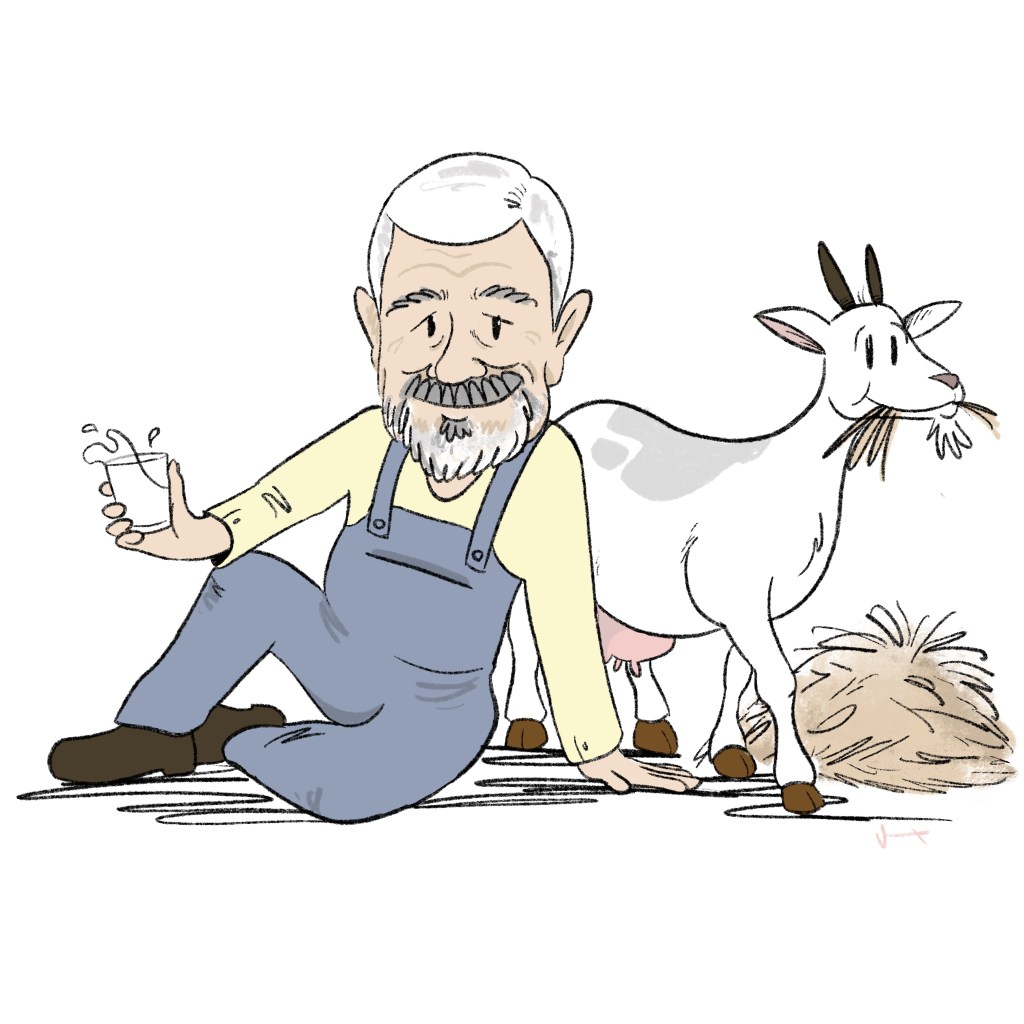
Goat’s milk is more expensive than coffee so, to save money, he bought six goats and installed them in a little barn he built beside their house. Most summer mornings, he can be seen venturing forth in his newly purchased old-fashioned overalls to reap the grass that grows amply and freely along the roadsides, which he then dries to make the hay that his goats will munch on throughout the winter. Of course he and his wife can’t use the basement of their house now, as it is entirely filled with hay, but they don’t mind a bit as it is for such a worthwhile cause.
For better or for worse, his wife has really got with the program too. She is embracing the goat’s milk trend like a faithful wife of yore. She has taken to rising from her bed at 4 a.m. to bake 10 loaves of homemade bread by candlelight before dutifully setting out with a wooden bucket to milk the goats just as the sun is peeping over the horizon. My brother stetches and yawns in his bed to the sound of the first rooster crowing before he leaps up, dons his plaid shirt and overalls, and patters downstairs to a hearty breakfast of hot oat bran porridge swimming in warm goat’s milk, all lovingly prepared by his wife. They nod and smile in agreement that this is, indeed, such a pleasant way to start the day.
When their grown children come to visit on weekends now, they have to park their cars discreetly behind some bushes some distance away, hide their phones and other devices under the car seat, and cover the last bit on foot, being careful to look so weary when they arrive that their parents will be convinced they have walked all the way from Kitchener. Instead of spending their weekend surfing the net and streaming raunchy movies from Spain, they engage in the more wholesome activity of forking hay into goats’ mangers and occasionally getting out the wheelbarrow to clean the stalls. It is all so very rewarding.
My brother decided to spread his enthusiasm and, as an aside, to capitalize on his new-found calling by giving goat-milking lessons. And have people responded! Long lines of eager pupils can be seen daily in his laneway, with the wisest of them getting there well before dawn to camp out and secure their spot in the lineup. There is much animated chatter all up and down the line about the proper and improper ways to coax milk out of a goat’s udder and into your pail. Among the would-be pupils in the waiting line is a healthy smattering of horses and buggies, driven there by old-order Mennonites who have forgotten the olden ways of milking goats and need a refresher. While waiting, the men spend their time productively carving little animal figurines from nearby pine branches that they offer to share for a moderate price, and the women bake home-made pies over open fire pits to sell to those who have been waiting so long in line that they have grown faint from hunger.
It is a scene that would make Currier and Ives beam with pride.
I’m getting a little concerned, though. Where will it all end, I wonder. What will happen to the world of domestic bliss my brother has inspired if he wakes up one morning and decides to give up goat’s milk as suddenly as he gave up coffee? Will we all have to adapt to yet another of his interesting trends, like boiling emu eggs in sea-salted limewater, or barbequing yak steaks smothered in home-grown garlic and blueberry marinade?
I’m worried it might happen, and so is his family.
Copyright © Jon Klassen 2023
My New Bestie, the “Happiness Engineer”
by Ivan Brown
Yesterday, I got stuck on how to sync an app on my laptop and I had to seek help. Like most of you misinformed readers, I suspect, I did the first thing that popped into my head. I looked up my host’s website to contact their Customer Support.
No.
There is no such thing. Their Customer Support people have changed their name. They are now called Happiness Engineers.
Huh?
I thought engineers were people who build bridges, or invent machines to drill wells, or something. Oh, now I remember: engineers are people who drive trains. Well, whatever they do, it never occurred to me that they create happiness. But apparently they do.
I’m not sure if the term Happiness Engineer is unique to this company or not, but my guess is that other companies probably have their own names for Happiness Engineers. The Mirth Manufacturers. The Elation Enhancers. The Rejoice Representatives. I’m sure they exist. And the opposite, of course. You know, the ones who purposely bring more sadness to your already-sad day when you ask them to help you and they purposely turn the problem back on you. The Bitterness Bearers. The Dour Designers. The Angst Artists. If those names don’t already exist, they should. There’s a market for that in the internet world.
My Happiness Engineer was named Angelo. I told him my sad problem in the saddest tone of voice I could muster, and then, thinking to boost his spirits so he could carry out his calling, I said it would make me ever so happy if he could solve it. He told me to do this and do that, but I couldn’t do any of them because I am sort of tech incompetent and he didn’t tell me exactly how to do them. I said, “I am not feeling the happiness, Angelo. I was so hoping for jubilation, or even a bit of sprightliness, but if you could go step by step maybe we can at least settle on gladness. Yes, I think gladness would be a suitable goal for today.”
I guess he was not amused because his tone turned sour, then the line went silent.
But a miracle occurred. During his long silence, I accidentally stumbled on what he wanted me to do. My problem was solved and a wave of gladness swept over me instantly. His mission of merriment had been accomplished. I was happy after all. We were both happy.
So now we are close friends. We became Besties and we even made up appropriate best-pal names for each other. He calls me Hivan (Happiness + Ivan) and I call him Hangelo (Happiness + Angelo). I like it. He likes it. We are both euphoric. He requested that I call him if ever I should have another problem. I promised, as any bestie would.
Of course I would love to chat with my bestie again, but the adventurous side of me is kind of wanting to go on to other sites and try out their versions of Happiness Engineers. I am even feeling like I can’t wait for my next serious internet problem to occur, like maybe tomorrow, so I can branch out. If I’m lucky, I will have occasion to call up their formerly-named Customer Support and ask to speak with their Bliss Begetter or, if they say he or she is too busy begetting bliss to other people, I will settle for asking to at least let me speak with their Glee Giver.
Yes, I feel certain that, by tomorrow, I will be happy to get a chance at receiving a dose of glee.

Copyright © Jon Klassen 2023
I Think I’m Abnormal – I Don’t Pandiculate
by Ivan Brown
I read in a magazine today that it is completely normal and healthy to pandiculate when you first wake up in the morning. I was shocked and, frankly, flabbergasted that I have been an adult all these years and no one every told me I was supposed to be pandiculating every morning.
All people, my dictionary tells me under the listing pandiculation, stretch and yawn when they wake up in the morning to rouse their dormant muscles from their torpor. All people, that is, except me.
I did not pandiculate this morning when I woke up and, much to my embarrassment now that I know, I do not ever recall having pandiculated any morning. In my whole life.
I think I might be abnormal.
I don’t actually recall every having seen the word pandiculation before I read the magazine article. If I had, I probably would have assumed it was some old practice, a century past its expiration date, that was guaranteed to make hair grow on the palms of your hands, or something. But no. Pandiculation is a real thing. Sadly, no one ever told me I was supposed to be stretching and yawning.
The news hit me like a meteorite that forgot to disintegrate. The blood drained from my face. The little blood that was in my muscles drained too, in sympathy I suspect, and left my legs weak and shaking. It slowly dawned on me that I am – I feel so mortified to admit it – an abnormal non-pandiculator. I just wake up, sit up on the side of my bed for a minute, then pitter-patter off to the bathroom without pandiculating. Can I honestly hope to have even the semblance of a normal day when I haven’t started it off properly with a good healthy pandiculation?
No. Non-pandiculation is just plain abnormal, the article inferred. And my dictionary concurred.
Even cats and dogs pandiculate, according to the magazine. Of course I am not a cat, so I have that excuse at least, and, as for being a dog, I think a few unsavoury friends might have occasionally referred to me as the offspring of one, but I may have misheard them.
I guess if pandiculation is a normal healthy thing, I am just going to have to start doing it. No one likes to be abnormal for too long. Maybe I could resolve to pandiculate in a restaurant when eating with my friends in an earnest effort to convince them I am not as abnormal as they always thought. I could possibly pandiculate while riding on the subway when complete strangers are crowded closely together to demonstrate that there is absolutely nothing abnormal at all about me. I might even perhaps pandiculate now and again during a staff meeting when my boss asks for creative ideas for the new project as a heartfelt affirmation that any idea emerging from my head will most certainly not be an abnormal one.
Yes, I am going to have to make the effort to pandiculate wherever and whenever I can. The more I think about it, the firmer my resolve gets. I have to make up for all those lost years when I could have been enjoying a good pandiculation every morning.

Copyright © Jon Klassen 2023
Let’s Celebrate
Climb A Tree Like A Koala Day
by Ivan Brown
We all know a few special days of the year – Halloween, April Fools, Mother’s Day. I expect a few sons and daughters even occasionally remember Father’s Day. Those are the standards, but when I was perusing the calendar on my phone recently, I noticed there are many other days that I often fail to observe. This year, to my absolute horror, I totally missed National Best Friends Day on June 8.
What will my best friends think? Or those who imagine themselves to be my best friends? I remembered no-one.
In my defense, I actually did not know that National Best Friends Day existed. I searched the internet for some Best Friends cards to send belatedly, but alas not one was to be found. As is so often the case, the commercial world has failed in its duty to point out the important celebrations to me.
I don’t like to be caught off guard, so I decided to be proactive and look up the special days that should be so meaningful to all of us, then mark them off on my calendar. September 8 is Make A Hat Day, so yes, we will definitely have to mark that occasion in our house with a flurry of old fabrics, colourful buttons, and stick-on logos. May 26 is National Paper Airplane Day, a definite yes for my workplace, where the rule will be anything that might usually be in an email will instead be written on paper, folded into an airplane, and shot across the office, for the most part missing the older staffs’ heads. And the one I will wait for all year long, every year: December 8, Pretend to be a Time Traveler Day. This year I plan to re-enact time travel on my front lawn by building a miniature Medieval European village. I will be sitting happily amid the softly falling snow, strumming a jig on my lute while local children will portray quaint villagers dancing around a pig roasting on a spit. Next year it’s the whole family re-enacting life in the 17th-century Scottish Highlands, where we will – again on our front lawn – whine on the bagpipes from early evening until the wee hours, taking only brief recesses to attend classes, in a drafty little snow castle that I will hastily erect, to master the arts of kilt making and haggis baking. I just love December 8.
Still, there are lots of days on my calendar that are not marked as “special” days. November 17, for example. I mean, who wants to get up in the morning, look out the window at some gray clouds, and sadly mutter, “Today is November 17, a Nothing Special Day.” No one wants that.
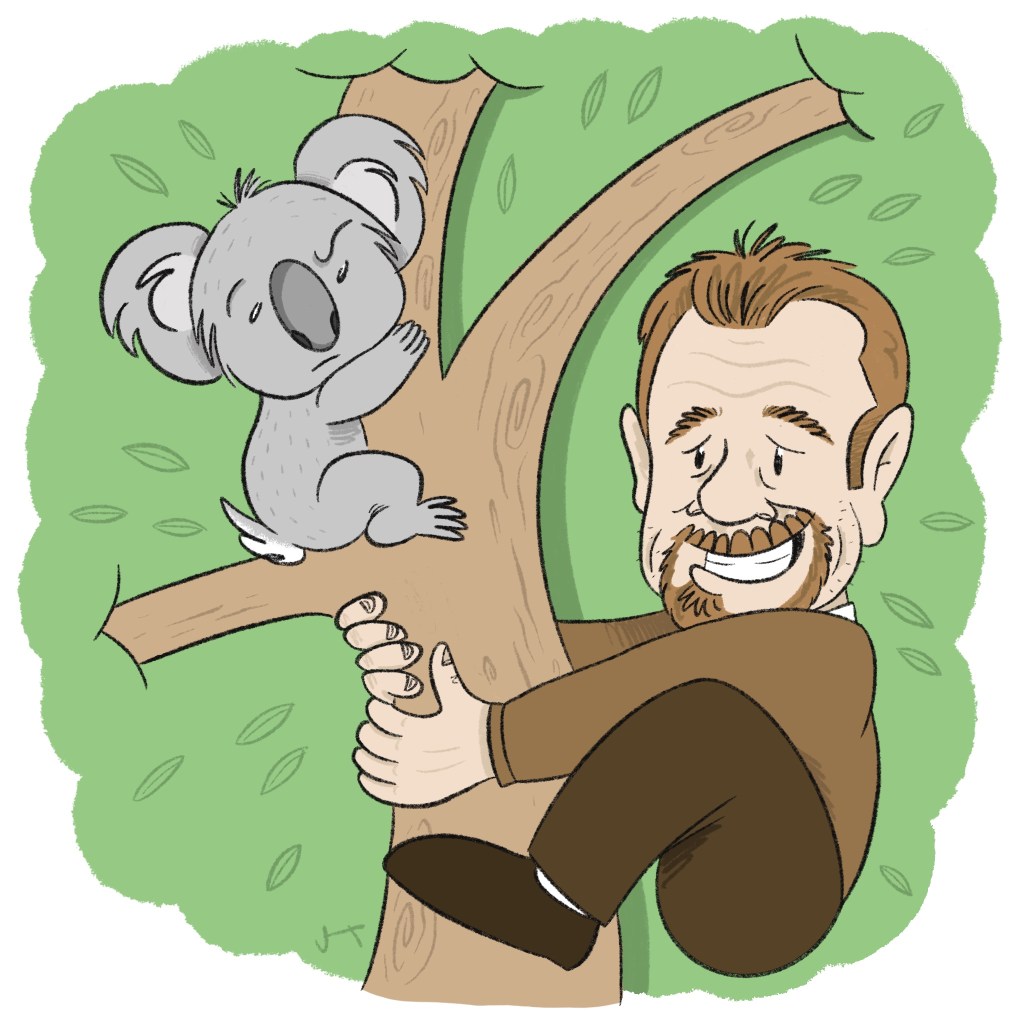
So I decided to declare November 17 Climb A Tree Like a Koala Day.
My Aussie friends will be thrilled. Finally, a day when you can legitimately shinny up a tall tree in the outback and chomp on eucalyptus leaves. Such fun. It will be a school holiday, and the teachers will lead the way, demonstrating to their eager students the correct way to climb like a koala while still respecting its innate dignity. Leaders from all walks of life – shopkeepers, lawyers, farmers, stockbrokers, nurses in uniform, dentists of every description, and clergy decked out in full regalia – will all be dancing around the eucalyptus trees, celebrating with enthusiasm and glee. And climbing slowly up those trees like real koalas.
There will be best eucalyptus-chewing and eucalyptus-spitting contests, three-legged races in full koala costume, and, the day’s highlight, a prize for having the most koala-like face. There will be a parade. A feast will be laid out, featuring a slice of that famous eucalyptus pie à la mode. Swaying about in slow koala-like dance motion on conveniently-placed branches will follow, lasting from dusk till dawn.
The rest of the world will rush to join in the celebration. In Japan, also on a national holiday, people will hurry to their local park, scurry up those little trees in koala fashion, and munch on cherry blossoms as eucalyptus substitutes, even if they are well out of season. In northern Finland, beyond the tree line, they will scamper atop local reindeer and nibble on their ears, pretending they are real eucalyptus leaves. In Tibet, they will wend their way up a remote Himalayan mountain path, select a wind-blown Pagoda Flower to perch upon, and meditate there while slowly chewing the flowers, as a koala would if it lived in the Tibetan mountains. There are many others, of course. No culture will be left out.
It’s so wonderful.
I’m so looking forward for Climb A Tree Like a Koala Day to roll around that I am glad that I saved up my energy for it by ignoring National Best Friends Day on June 8, and I am almost tempted to rush right past Make A Hat Day on September 8 for the same reason.
Oh. Except, maybe I could get my best friends together and we could all make koala hats to wear to the parade on November 17.
Copyright © Jon Klassen 2023
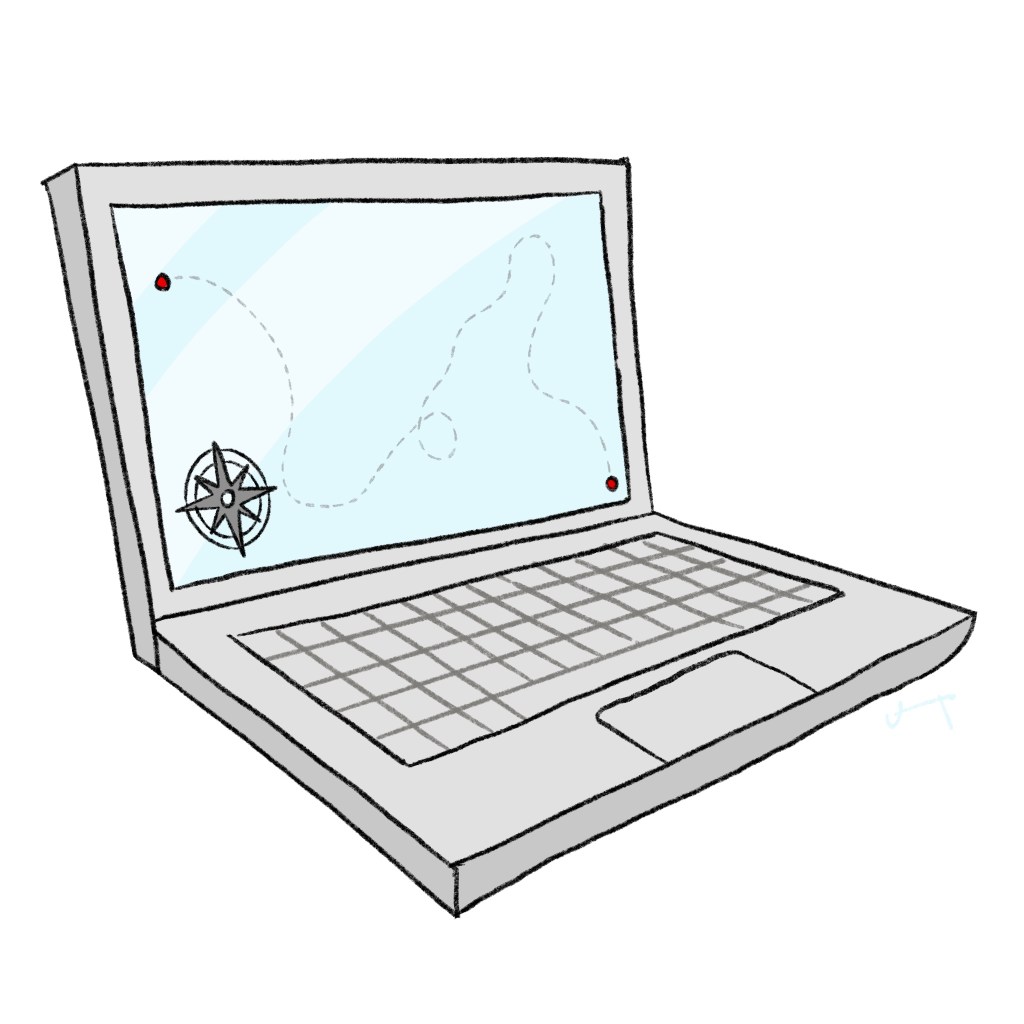
Stop Telling Me To “Navigate To…”
On My Computer !
by Ivan Brown
Like you, I mostly know how to work all the basic things on my computer. From time to time, though, there’s a setting I can’t find or an app I can’t get to work, and I need to look up the solution. Whether I search in Help or on the internet, the first instruction I seem invariably to get is “Navigate to…”
Whaaaaat? If I knew how to “navigate to” the place, I would not be asking how to get there!
Oh, I have tried many times to “navigate to” somewhere on my computer with no detailed instructions, but honestly I end up just clicking on stuff randomly with very little idea of where I am going. And I have certainly navigated to some strange places! Once I ended up with someone trying to sell me women’s blue high-heeled shoes when all I was trying to do was figure out how to get my Tasks To Do app to stop sending me notifications about things I was too lazy to do.
“Navigate to…” was not helpful. It never is.
When you just tell me to “navigate to” somewhere on my computer, I really have no idea how to proceed. I might as well be a sea captain trying to steer his nervous ship through a thick fog. I am, honestly, no better off than a dog-sled musher trying to urge her bewildered huskies through a dense blizzard. I am about as hopeless as a cattle rancher trying to round up a bunch of frisky steers in a blinding rainstorm. When the instruction only says “navigating to…” I’m just like all these navigators. They don’t have a clue where they are going, and neither do I.
What if I invite my co-workers for a coffee and I say, “Navigate to my favourite coffee shop and sit at a table.” Who knows what coffee shop they would end up at, or what chair they would be warming for hours while I wait at a completely different place? What if my friends from Denmark want to come to visit and I say, “Navigate to Canada, then knock on my door.” There might well be some rather surprised person peering through a half-open door in Kamloops wondering who these strange people are!
In 1492, Spanish Queen Isabella and King Ferdinand half-opened their wallets to help Christopher Columbus “navigate to” India to access its treasure trove of spices by crossing the stormy Atlantic Ocean. They said something like, “Navigate to India and bring us back spices.” Like me on my computer, Columbus had no idea how to get there, really, but he and his crew found an island in the Bahamas and gave the natives a pile of European diseases that wiped out the vast majority of them. In return, they didn’t give Columbus any spices, but historians say they did give Columbus’ randy sailors a ghastly new brand of syphilis that, on return, they joyously spread among the merry-makers of Europe. So that “navigate to” worked out well.
I really did try not to be a quitter, but after many attempts I was reaching the end of my “navigate to” rope, and I had practically abandonned any hope of ever being able to get where I want to go. But, as you know, out of utter despair a solution often emerges. In this case, it came to me in a brilliant flash of inspiration that, I feel certain, almost bordered on divine intervention. Instead of asking a question and being told to “navigate to” somewhere, I would go right to the core of the issue: I would ask my internet browser how to navigate to “navigate to”. I considered this solution to be clever beyond the capability of human words to express.
When I asked my browser this obviously clever question, it did respond right away. Lamentably, though, its response was such that it set me right back on my heels once again. You see, it simply asked me, “Where do you want to go?”
“I…have…absolutely…no…idea,” I mumbled softly into my chin, slowly lowering the lid on my laptop, slinking off to my easy chair, and pouring myself a stiff scotch.
Copyright © Jon Klassen 2023
Mabel Starts A New Church Trend
by Ivan Brown
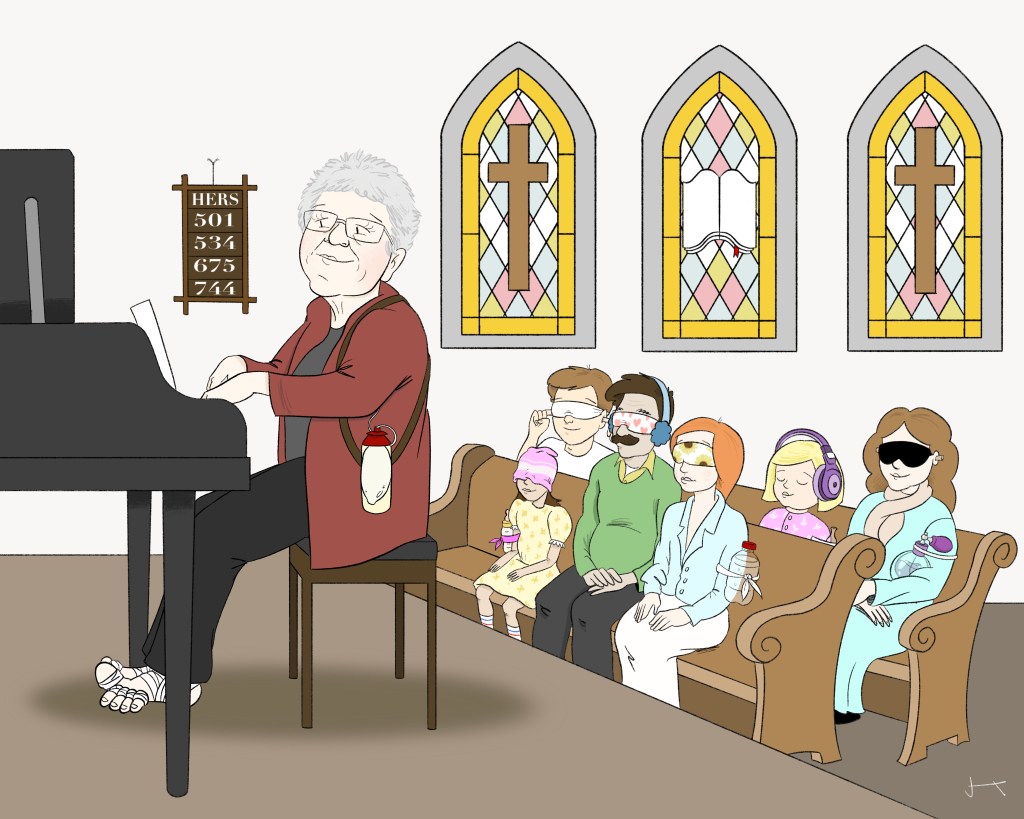
Mabel has always been a whiz on the piano. Now nearing 80, half deaf and half blind, as long as she knows the tune in her head she can still tickle the ivories like nobody’s business.
Oh yes. Even her church people know this. They keep asking her to play the hymns at their Sunday morning services although, in that not-very-modern way that church people have but try so hard to be adept at, they promote gender equality by slying referring to the hymns as the “hers”.
So, there Mabel is, of a Sunday morning at 11:00 a.m., sitting on the piano bench in her little country church, pounding out the “hers” like there is no tomorrow.
It’s all going so well.
Except Mabel is now on chemo, so she has to wear a chemo drip bottle on her arm while she is playing. Plus, she has ingrown toenails that required minor surgery, so all the toes on both feet are bandaged up. But Mabel plays on.
To be frank, it is really quite a sight to behold.
But, right from the beginning, the kind parishioners perceived it in quite another way. In their view, Mabel was making a fashion statement unparalleled in the history of modern church-going. The very next Sunday, several ladies strutted into their pews sporting bottles of various kinds strapped to their arms. There were water bottles, pop bottles, and a daring few had wine bottles. One elderly lady in a puffed-up perm even boasted an empty shampoo bottle nestled into the flab of her former biceps. She beamed with pleasure. Oh, the immense pride that radiated from all those ladies demonstrating their new-found fashion was enough to make one wonder that Christianity hadn’t thought of this decades or even centuries before.
The gentlemen were, naturally, not to be outdone. Church men can’t do what the ladies do, of course, no matter how many times they smiled a bit when the hymns were called “hers”, so they picked up on the more manly fashion of bandaged toes. The very next Sunday, half the men in the congregation had given up their Sunday shoes and hobbled into church with both feet well bandaged. It looked ever so smart. In fact, it was so very sporty that before long all the men were doing it. You just weren’t in your Sunday best if your feet weren’t bound up in white cotton and you had to waddle up for communion as gracefully as an overweight penguin.
Both genders heartily embraced half-deafness and half-blindness. Now they all wear ear plugs and dark glasses, certainly as a fashion tribute to Mabel, but with the added bonus of hardly being able to hear or see the minister. After all, one does not want to have one’s morning nap disturbed unduly by a sermon that lingers on a little too long.
I hear the trend is now spreading like wildfire to religions of all stripes. Worshippers who formerly sat like sedate ladies and solemn gentlemen are so caught up in their arm bottles, bandaged feet, ear plugs, and dark glasses that they can think of little beyond trying to outdo each other in the fashion of it all. It hardly matters if they are in a church, a mosque, a temple, or a synagog, as all are united in a singular trendy pursuit. Interfaith harmony has never been so robust.
Still, you do have to worry. This fashion thing may really have gotten a bit out of hand. Ladies are now vying with one another to see who can wear the most expensive perfume bottles on their arms — perfume that they can ill afford on their seniors’ pensions. The gentlemen are bandaging their toes in the most colourful and costly fabrics imaginable, and the competition that is raging among them to don rare imported fabrics seems financially unsustainable. On top of that, the dark glasses are getting so extravagant that even Elton John would surely shudder in reproach.
But all is not lost. Amid the storm, Mabel herself remains steadfast, hobbling in Sunday after Sunday in her same get-up, now looking remarkably drab, to settle calmly on her piano bench.
Mercifully, her anchor has held.
Her fingers continue to fly over the eighty-eights as nimbly as ever, and she pounds out those “hers” as she has always done before.
Copyright © Jon Klassen 2023
How My Food Attained Equality With My Ad Blocker
by Ivan Brown
I have had an ad blocker app installed on my phone for quite a while now, but I was still getting a lot of ads. After some investigation on the internet and in app stores, I discovered the reason: my particular ad blocker has posted a notice that reads “contains ads”.
Really?
What is an ad blocker for if it gives you more ads, which, I presume, it does not block. Do I have to install another ad blocker to block the ads in my first ad blocker? But then that one probably “contains ads” too, so I guess I would have to install a third ad blocker to block its ads. And on and on and on. I am going to end up with 273 different ad blocker apps on my phone, and that will not even solve the problem because the last one will still probably “contain ads”.
I really had to put my thinking cap on to know what to do about this one.
I figured I probably wouldn’t get anywhere trying to fight the big international tech companies that own ad blocker apps, so I had to tackle this one from another angle. After weighing the issue carefully in my mind, it occurred to me what this thing was really all about: equal rights for other products. Yes, it only seems fair that if ad blockers can have ads – something they pretend they are trying to cut down on – why can’t other products have stuff that they claim they are cutting down on too?
It’s an ethical question concerning equal rights!
I decided to start small and stand up for the equal rights of those who provide us with the food in our fridge. In our house, we buy low-fat mayonnaise to support our sad cholesterol level goals. If ad blockers can contain ads, shouldn’t our mayonnaise be able to say it is low-fat, but then have a small label on the jar that says “contains a bunch of high fats”? I think so. If I were low-fat mayonnaise, I would go to court about this. What about those expensive eggs we buy that are laid by free-range hens? Why can’t they have a little label on the front of the carton that says “contains some eggs from totally cooped-up hens”. That’s reasonable. Free-range egg sellers should protest in the streets about this. And what about those organic apples in our fruit drawer? I can’t see why each apple shouldn’t be allowed to have a nice little sticker, shaped like a smiling apple, that reads “some apples contain pesticides that definitely harm birds”. That would sure be a big feather in the hat of equal rights.
I emailed the mayonnaise, egg, and apple producers to share my excellent ideas with them, and they immediately all agreed. Now, they all have labels on their products along the lines of what I suggested. They wrote to me expressing their deep gratitude, saying they feel so free now and are so happy to at last be on equal terms with the ad blockers.
You can’t imagine how delighted I felt when I began to email my congratulations back to them, and up popped an ad. It was advertising free-range eggs. A banner running across the bottom of the ad read: “contains some eggs laid by hens freely ranging inside their 30 cm by 30 cm pens”.
I’m feeling so proud now. I really know how to stand up for the rights of the little guy and put those ad blockers in their place.

Copyright © Jon Klassen 2023
What If You Don’t Know Your Friend’s Name After 52 Years?
by Ivan Brown
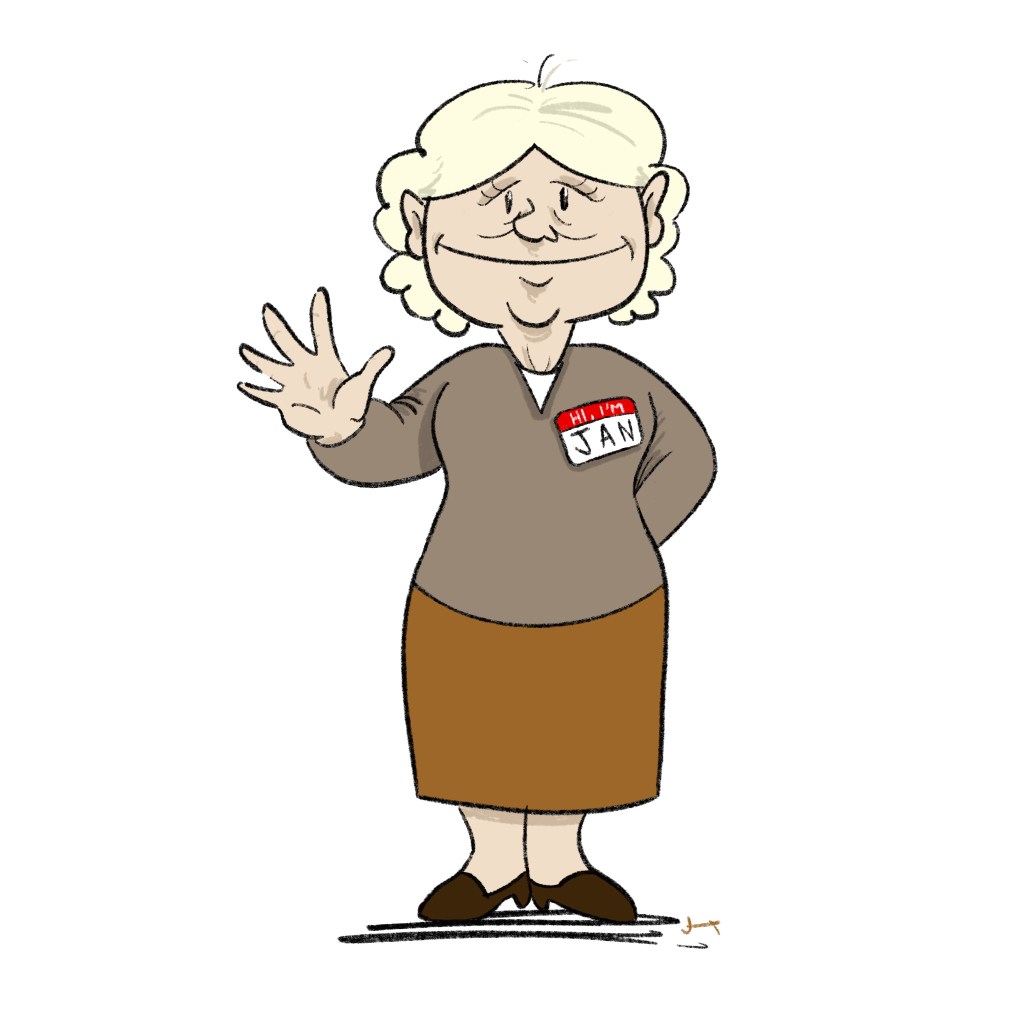
I have a very good friend named Jan. We have known one another now for 52 years. I was thinking about her one morning when I was suddenly struck by a strange thought: Jan must be a nickname of some sort, I suppose, but I don’t actually know what her real name is.
In 52 years of friendship, I forgot to ask her.
Jan is usually short for something like maybe Janet, or perhaps Janice. Jana is popular for girls, and she might have thought Jana was a bit long, so she shortened it to Jan. Or is it Jane, and she thought to knock off the silent e at the end since it is not pronounced anyway, then realized she had to change the vowel sound from long to short a. There are other possibilities, but why go on? They all lead me down the same path of ignorance. They all lead to a bunch of name dead-ends. I still don’t know.
Jan and I go back a long, long way. We have gone to the same dinner parties, we often dined with mutual friends at medium-priced restaurants, and we always showed up at each other’s houses to celebrate birthdays. We have gone to movies together, shopped at malls, and taken little day trips here and there. Yes, we have more than half a century of precious shared memories.
But I still have no idea what her name is.
The trouble is, there has been so much water under the bridge over the years that I am now totally ashamed to ask. I mean, after more than five decades of sharing stories and laughing over each other’s jokes, you can’t just turn to your really good friend and say, “So, what is your name again?” That just doesn’t cut it.
Of course, I can always hope that her name really is Jan because her parents emigrated from some Eastern European country where Jan is a popular girl’s name. Maybe. If that is the case, though, it would surely be pronounced like “yawn” and this presents a bit of a problem too. What am I supposed to do if we are at an intimate dinner party for eight and she tells a nice little anecdote to the group over coffee and dessert? Do I turn to her and say, “Oh Yawn, that was so interesting!” No, that wouldn’t do at all.
I thought to play a little game recently when Jan and I were both included in a gathering of friends. It was called “How Your Mother Used Your Full Name When You Were Bad”. I started the game to set the example. I said my mom exclaimed in a horrified voice, “Ivan Alexander Brown, don’t you ever bring a dead frog into this house again!” Everyone enthusiastically took their turn. “Karrie Marie Fernandez, if I told you once I told you a hundred times, you may not braid spaghetti into your hair!” and “Brian Adam Wong, stop batting that tennis ball on the wall behind my head while I am trying to watch I Love Lucy!” Then it was Jan’s turn: “Jan, Jan, Jan,” she said, “if you slurp any louder on your soup, I am going to have to put on my earmuffs!”
Hmm. Hmm. It seemed like Jan wasn’t really with the program.
At least that’s what I initially thought. Upon reflection, though, the truth occurred to me: her mother didn’t actually know her real name either, so she just repeated Jan three times as a coverup. My suspicions were confirmed when I asked Jan if she had any old pictures of her high school graduation. Yes she did, and there she was holding up her certificate, beaming with pride, while her mother was peering over her shoulder – in a vain attempt to read the name on her daughter’s certificate!
It must have been so embarrassing for her mother to never have remembered your own daughter’s actual name. I expect she is still trying to find out what it is. But I don’t care, though, because I sure feel a lot better now for not knowing. After all, her mother has known Jan, or whatever her name is, for a lot longer than my mere 52 years.
Copyright © Jon Klassen 2023
Shirley Flosses Her Toes
by Ivan Brown
A few months back, Shirley went to a new chiropodist. It turned out to be a recent graduate who, in that zealous way of young graduates who have just memorized the entire textbook for their finals, was very keen on the importance of drying between your toes after you shower. The main benefit, she claimed, is to avoid a fungal infection that, to give it some class, is referred to as athlete’s foot.
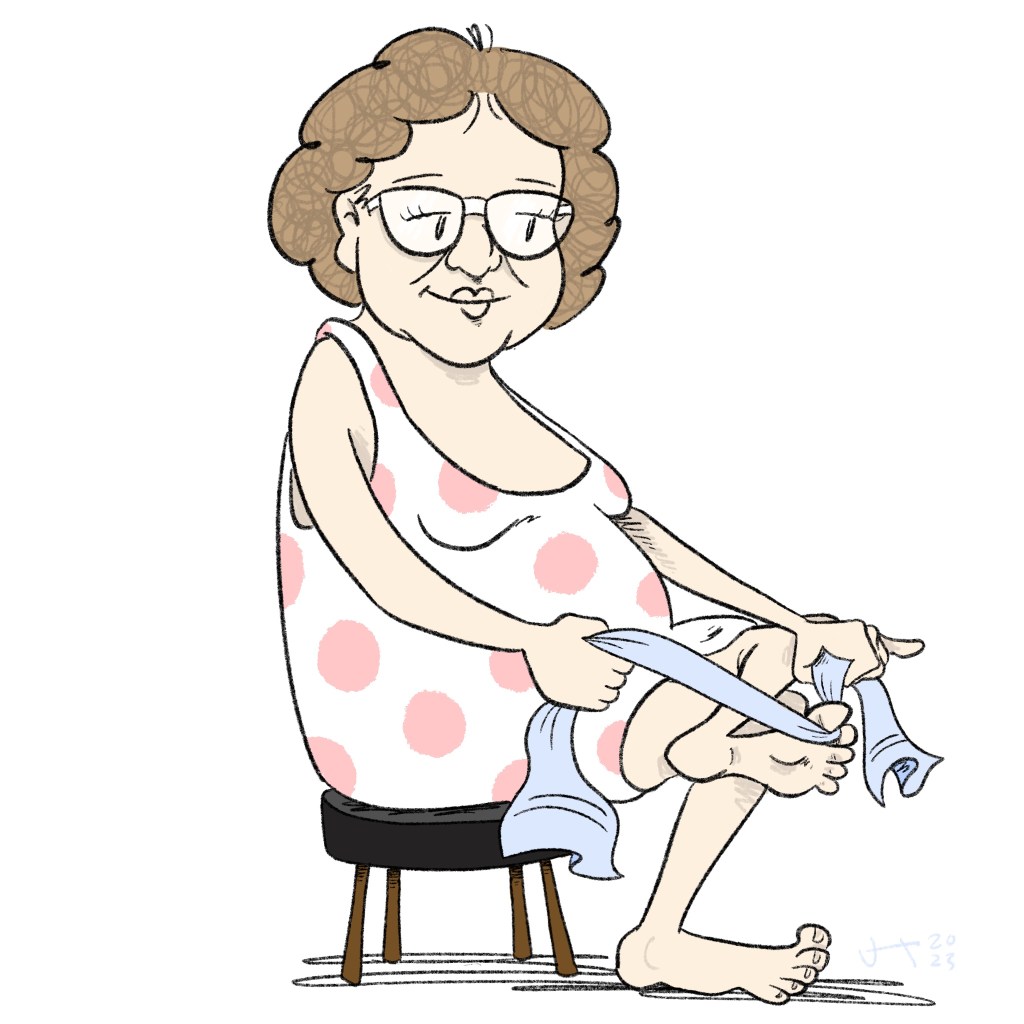
Now as Shirley is an ardent ponderer of the English language, she naturally realized after only a week of deep thought that we do not actually have a word to describe the human act of see-sawing a little cloth back and forth to wipe the moisture from between your toes. She even consulted the several credible sources on the internet that deal with these matters. But the internet, and her whole row of dictionaries and thesauri for that matter, offered nothing. There is simply no word for it. So, following her next shower, as she bent over diligently to dry between her lowest digits, Shirley invented a phrase to suit the occasion: flossing your toes.
It is entirely appropriate.
I, of course, always floss my toes after showering, but I wondered if this were a common practice among my neighbours. After all, one does not wish to live on a street where people might be subject to acquiring athlete’s foot, does one? So, the next day I thought to take a little survey of my neighbours on the subject. Out into my front garden I pattered and stood near the sidewalk to greet all those ambling by with their dogs and strollers, in that order of importance. “Good morning,” I sang out cheerily to each and every one, “tell me, did you floss your toes this morning?” I watched, bewildered and agape, as most of my formerly friendly neighbours rushed away ever so rudely, yanking dogs and babies behind them, in that order of importance, in all manner of disorderly chaos.
It dawned on me at length that flossing your toes is perhaps a private matter, and certainly not something one would openly debate on a residential sidewalk in a respectable neighbourhood such as ours. Not in front of one’s cockapoo in any case.
Dejected, I lowered myself into my muskoka chair with my morning coffee to ponder toe flossing in greater depth. It is all well and good for a chiropodist to give advice about toe flossing to humans, I mused, but what about animals? Who tells them how to floss? Dogs and cats, and perhaps gerbils, can lick between their toes, but doesn’t that just add to the moisture? Is there such a thing as pet’s foot? I guess so. And how about cows, and bison, and elk – all of which have those two-part cloven hooves? It cannot be the easiest thing in the world for them to pull a little hand-cloth back and forth between their two hoof halves after crooning an off-key tune during a rural rain shower. If they don’t floss their hooves after showering, don’t they get elk’s foot? I think they must.
As I mused thusly for some weeks, Shirley starred in and produced a little video explaining how to floss your toes properly, and it immediately went viral. I had misgivings, but flossing your toes quickly became a fad that caught on like crazy among human trend setters, and blossomed into a popular phrase to toss about at work and social events. Flossing your toes soon became the “in” topic of conversation in beauty salons, kick-boxing gyms, and bank tellers’ lunchrooms. Keynote speeches on the topic are now delivered at teachers’ conventions and accountants’ reunions.
You are just not anybody unless you are talking about flossing your toes.
Now even Shirley’s dentist boasts that he flosses his toes. And to help promote the cause, he has invented an eco-friendly toe flossing product, constructed from dried-up maple leaves and bits of bark from fallen maple trees, all molded together by sticky gobs of old maple syrup, to form a sturdy cloth-like product. His invention is so successful that he no longer advises people to floss their teeth, and, in fact, he has totally given up dentistry altogether and has now opened his own shop and is practising as a faux chiropodist. His fame has spread far and wide and his toe flossing product has grown to be so renowned that almost nobody goes to a real chiropodist any more.
Last I heard, Shirley’s newly-graduated chiropodist had decided to try her luck elsewhere and has enrolled in dental school.
Copyright © Jon Klassen 2023
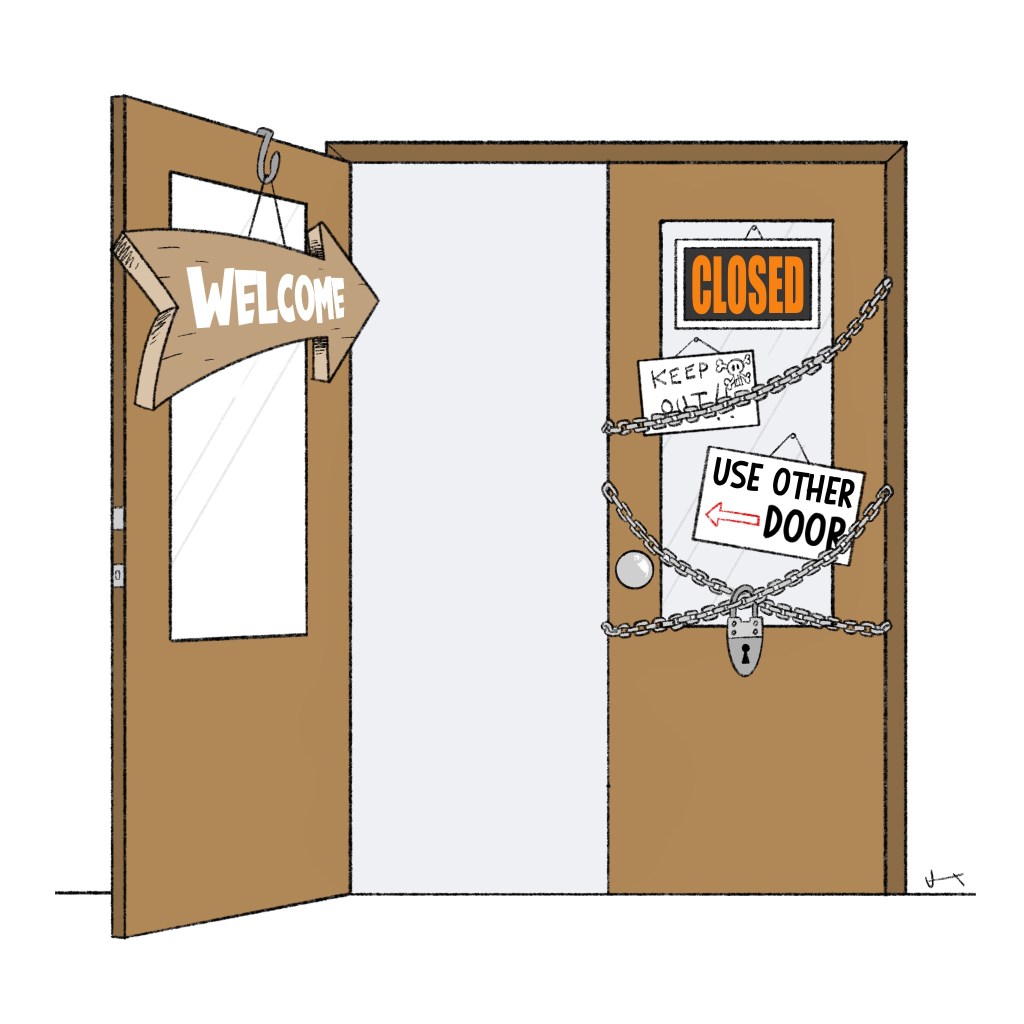
If There Are Two Doors, Why Is One Always Locked?
by Ivan Brown
Once again, I tried to go into a café for a rest and a snack only to find the door I pushed was locked. You see, there were two doors: one on the left and one on the right. I pushed the one on the right, but it was locked, so I had to use the one on the left to get to my eagerly-waiting croissant and coffee. This has happened to me about a million times in about a million stores, office buildings, and condos. There are two doors, but one of them is locked.
I can’t get it through my head. Why would you install twin doors and always keep one of them locked?
If you had twins in your family, would you make one go out to work but insist that the other one sit, unmoving, at home on the couch? No. If you got a pair of gloves for your birthday, would you sport one cheerily on your left hand, but stand firm on having the right-hand one rest passively in your pocket? I doubt it. If your True Love sent you two turtle doves on the second day of Christmas, would you let one fly happily around the room but have the other one sit like a statue on its perch? I think not.
And what about chopsticks? If it is considered wise to use only one chopstick while the other reclines, unused, on a nearby napkin, how are you supposed to graciously pick up your rice? I can’t think of a way.
Using only one of a pair of anything hardly makes sense.
So, as a public service, I decided to start a media campaign. I immediately launched it on the internet, under a clever title I coined myself: “If You Have Two, Use Them Both”. However, that resulted in a barrage of invitations from websites that seemed, in my view, to be rather unsavoury, so I abandoned that title and went with one that had a considerably more respectable tone: “Don’t Stay Locked – Open Up!” I thought that was much more suitable.
I decided to use email as a way to get my message out and, simultaneously, to avoid the humiliation of negative feedback. It took a week of concentrated effort, but I emailed my campaign to every store, office building, and condo in my city, and it really began to pay off. Businesses and residences everywhere started unlocking their second doors, and many have taken the opportunity to initiate assertive advertising campaigns with brilliant slogans, such as “Use Your Right, Use Your Left”. One shop, using a different strategy, offers a “door prize” of a nice set of two padlocks to the one millionth person who uses the formerly locked door. Such shrewd promotion!
My campaign seemed to be working to perfection.
I decided to celebrate my success by treating the whole family out to dine at a nearby Asian restaurant. Sadly, my email must have ended up in their junk mail folder, because the right hand door was locked when we got there, and we all had to squeeze in through the left hand one. The evening was a disaster. Oh, we all got seated nicely and were served some fine food, which we tucked into with relish. But to be honest, we all found it extremely tedious, and more than a little time-consuming, to get through our meals.
Using only one chopstick each.
Copyright © Jon Klassen 2023
I Can’t Figure Out Why
I Am A Baseball Fan
by Ivan Brown
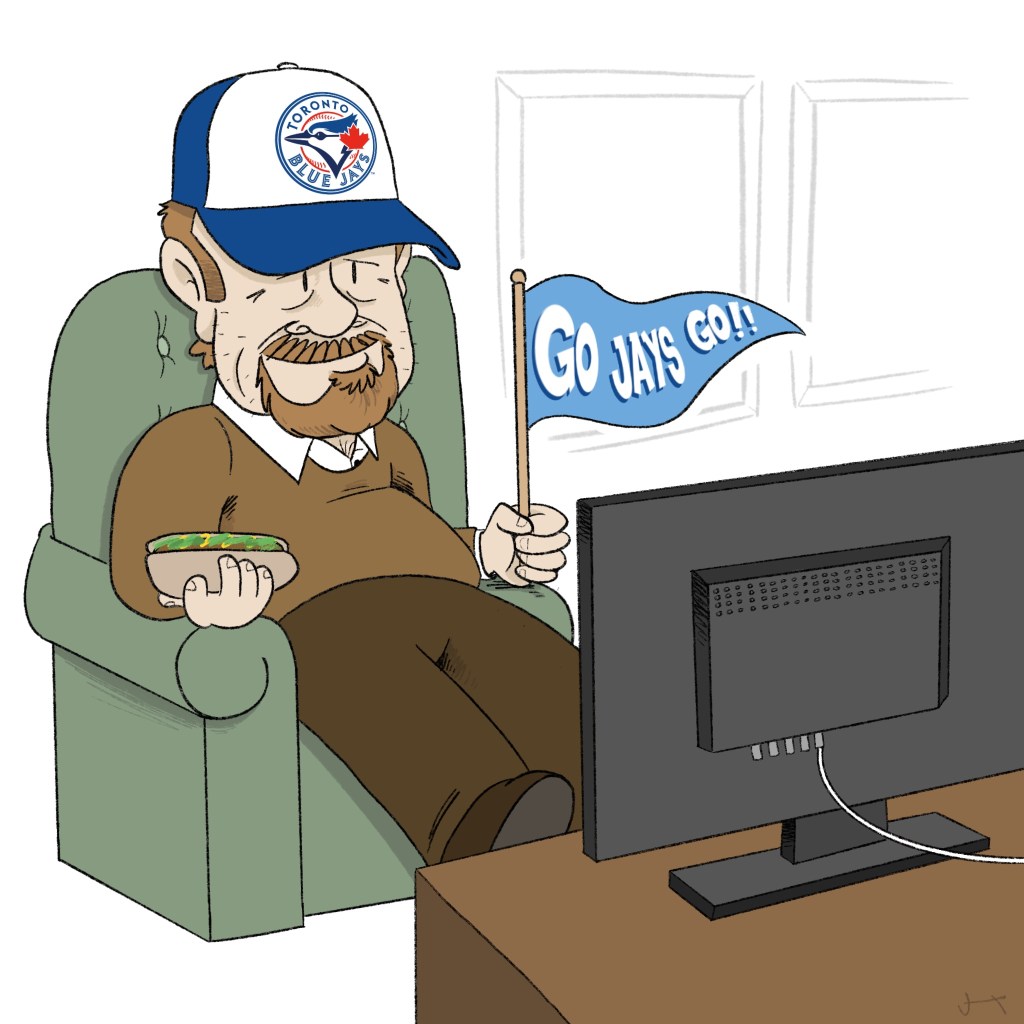
I have been a baseball fan for many years now, and I am still trying to figure out why. For reasons that remain obscure to me, I love my local team, the Toronto Blue Jays, and I even cheer for specific players on other teams.
I just have no idea why I do it.
Getting myself all steamed up over a game doesn’t make any sense because, for me, once it’s over, it’s over. Who did the Blue Jays play last week? No idea. What was the score in the game last Saturday? Whaaat? My memory of games fades faster than a closer’s changeup. As soon as there are three outs in the bottom of the ninth, all my fervour is gone with the last bite of my hot dog and I’m right on to “what’s for dinner tonight?”
But for some unfathomable reason I still care.
I know it is probably ninety percent mental and the other half is irrational, but I have still tried and tried to find a cure. I have argued with myself, pinched myself every time I got the urge to watch, and paid myself large sums in bribes to forget about it. I have tried every behavioural strategy that B. F. Skinner ever invented. I even tried meditating for 30 minutes a day using the mantra no ball…no ball…no ball… but it has all been in vain. I’m still a fan. There is just no way I can get to sleep at night unless I know the Blue Jays score.
What makes my dedication so ridiculous is that there is not one thing about the game that a couch potato like me would want to do if I were a player. To be honest, I am really a little bit on the lazy side, and I would rather not go to the bother of catching a ball than to catch one. I would be perfectly happy just letting it sail past my ear. And why would I stand at home plate – in harm’s way – trying to whack at something rushing past my elbow at 92 m.p.h.? It would give me much more pleasure to just stand well back of the plate, smiling contendedly and not even attempting to hit the ball, although I would, naturally, be spitting every so often. To me, that seems much more civilized.
I honestly don’t get why professional baseball players – grown men, some of them almost mature – even want to catch the ball. It doesn’t make sense. Why would the first baseman stretch to catch the ball when he could just stand there and not catch it? There is no logical reason to expose himself to the possibility of a hamstring injury when he could more easily stand aside politely and watch the pitcher reposition his cap another 27 times. That would be nice. And why does the outfielder run like a gazelle being chased by a hungry lion just to catch a fly ball? My view is that it would be much more pleasant to just stand there and let it fall. Wouldn’t that be better? The ball would be safely on the ground where he could simply pick it up quietly, and he would not be so winded that he hardly has the energy left to adjust his jockstrap properly. I believe that would make much more sense.
My way has another bonus. If nobody ever tried to catch any of the balls, the game would be more exciting for the fans because the score would probably end up being 167-143. I am not sure why the players never think of that before they start bouncing around the infield like a jack-in-the-box gone wild trying to make that third out. They could observe a lot by watching how I do it!
I can think of almost nothing about baseball that is logical. Players get a “walk” when four balls are called by an umpire who can’t really see anyway because he is hiding behind the catcher, but they always trot to first base. Why don’t they walk sedately to first like the rules say? And when players hit a home run, they always trot around the bases. I can’t see why, because nobody is chasing them. If it were me, I would stroll, or better still amble, around the bases, merrily lifting my cap and happily waving an upraised hand at every turn so the crowd would have a lot more time to cheer for me. I won’t go on, because I think you get my point. But when you think seriously about it, as I have obviously done, there is really almost nothing about the game of baseball that makes much sense at all.
Oh. So sorry, gotta go. The Blue Jays game is about to start.
Copyright © Jon Klassen 2023
Let’s Put Some Magic
Into King Charles
by Ivan Brown
To be completely honest with you, I used to think of King Charles sort of like I think of a packet of old yogurt that has been hiding at the back of the fridge too long — well past its “best before” date and never really that appetizing to begin with. I had always thought that, if Charles and I were semi-close friends, I might well have a pile of laundry to do on the night he invited me to join a small dinner party at the palace.
That’s how poor my attitude toward Charles was. And I do mean was, because all that has changed now.
While reading the newspaper the other day, I discovered the actual reason for my poor attitude: the monarchy has lost its magic. According to the article I read anyway, some 19th-century English historian named Walter Bagehot wrote: “The monarchy’s mystery is its life. We must not let in daylight upon magic.”
Ah-hah! So Walter got it right all those years ago. Charles is not mysterious enough. He gives us stodgy, when what he really needs to give us is magic.
Desperately.
We want to believe in royal fairy tales and all the beautiful magic that comes with them, and not let the daylight in.
We love the magic in the story of the royal-to-be, Cinderella, going to a ball and meeting a handsome prince who was so be-smitten by her beauty that he searched his kingdom high and low for a maiden who had her exact shoe size. We want to believe that in those golden days every fair maiden magically had her own private shoe size. But, we don’t want the daylight to reveal that she was so intimidated by her mean step-mother that she sobbed herself to sleep every night, no matter how graciously she might have done so. Just don’t tell us that, please. And as for the fairest-in-all-the-land, the beautiful Snow White, we want the magic of her being so charmed by the kiss of her handsome prince, even though she was in a deep coma at the time, that she springs to life – stars dancing merrily in the air all around her – to live happily ever after in his manly arms. Please spare us that part where her handsome prince, as he bent over ever so handsomely to kiss her ever so ruby lips ever so gently, accidentally broke a bit of wind but thought it unnecessary to excuse himself because, after all, Snow White was in a deep coma at the time. Let’s cover our ears for that part, no matter how handsomely he broke his wind. That’s just letting way too much daylight in on the magic. None of us wants to hear that.
We just want the magic.
The way I figured it, it was not too late for Charles, so I wrote him a nice hand-written piece of advice. I said he could take a few lessons in magic on the internet, and apply his new-found talent as he goes about his royal duties. As I expected, Charles readily agreed.
A month later, you could not imagine the difference! There he was, standing in front of a few dozen sleepy gray-heads delivering the dullest speech in the history of human oratory, Camilla dutifully smiling by his side, when suddenly a slight flicker of his finger on a well-placed string triggered a magical enactment, with Camilla mysteriously disappearing into thin air amid a thick cloud of smoke. Just like that! The magic was back! The mystery had returned! And Camilla was not to be seen for the rest of the day, except in her private drawing room enjoying a cocktail. You could not imagine how this jerked the audience out of their slumber and restored a shot of much-needed mystery to Charles’ persona.
Then at a royal walkabout, whilst begging reluctant children to give him their bouquets of flowers, Charles pulled off another of his mysterious magical tricks. Pushing a little button near his left elbow, he suddenly sprouted spike hair, all coloured in red, white, and blue to match his British-flag socks. Then his socks magically flew off his ankles and fluttered hither and thither throughout the crowd, causing the children to gasp audibly at the marvellous spectacle and to lose their firm grips on their bouquets, which Charles and Camilla hastily grabbed. Then, adorned in an overflowing of florid petals, Charles posed for photos and selfies, wowing his loyal subjects with his mystique and leaving them agape in wonder at his majesty.
The mystery of it all just worked so wonderfully. The magic was back.
As for me, come to think of it, I might go to that small dinner party after all. Now that Charles has started shutting out the daylight and has restored himself to mysterious wonder, who knows what other charming magic he might have up his sleeve. Yes, the dinner party should be fun. I really do think I might go.
If I’m invited.

Copyright © Jon Klassen 2023
Marian Drives To Her Pickleball Club
by Ivan Brown
Three mornings a week, almost regularly, Marian gets in her car and drives to her local community centre to exercise. The community centre is less than a block away from her house, but nevertheless she drives. In the small town where Marian lives, she always drives everywhere she goes.
Once there, she joins a group of other seniors hovering around the doorway, still trying to outdo one another with anecdotes about the back pain and arthritis they accumulated overnight that kept them from a good night’s sleep. They have long since downed their morning coffee and toast, having arisen at 5:00 a.m. with the chirping of the birds, and they are now ready to socialize and pursue their modest fitness goals. The community centre has a “walking track” all around the outside of the far-more-important hockey arena, and the seniors in this group have set the admirable goal of walking 10 laps around this track before breaking to gossip over more coffee, accompanied this time by donuts.
They all consider this a goal worthy of their time.
On this particular morning, the group set off at their usual pace that measures somewhere between saunter and stroll, eager to think they are improving their physical and mental well-being in important ways. Marian, blending into the centre of the pack, paraded proudly along with the rest who, wisely, went slowly enough that they still had sufficient breath to mention the awful price of milk these days and what a shame about Joe Simpson toppling over dead in his back yard before his hamburgers had even finished cooking on the barbeque. Thus, the group completed the first two laps.
But as she rounded the corner to begin her third lap, Marian stopped suddenly in her tracks. What she saw took her fancy so strongly that her exercising for the day was over. Even her appointment with the coffee and donuts faded quickly away. There, on a nearby bulletin board that she had not noticed until now, was a large sign with bold red lettering:
PICKLEBALL CLUB
Tonight at 7:30 p.m.
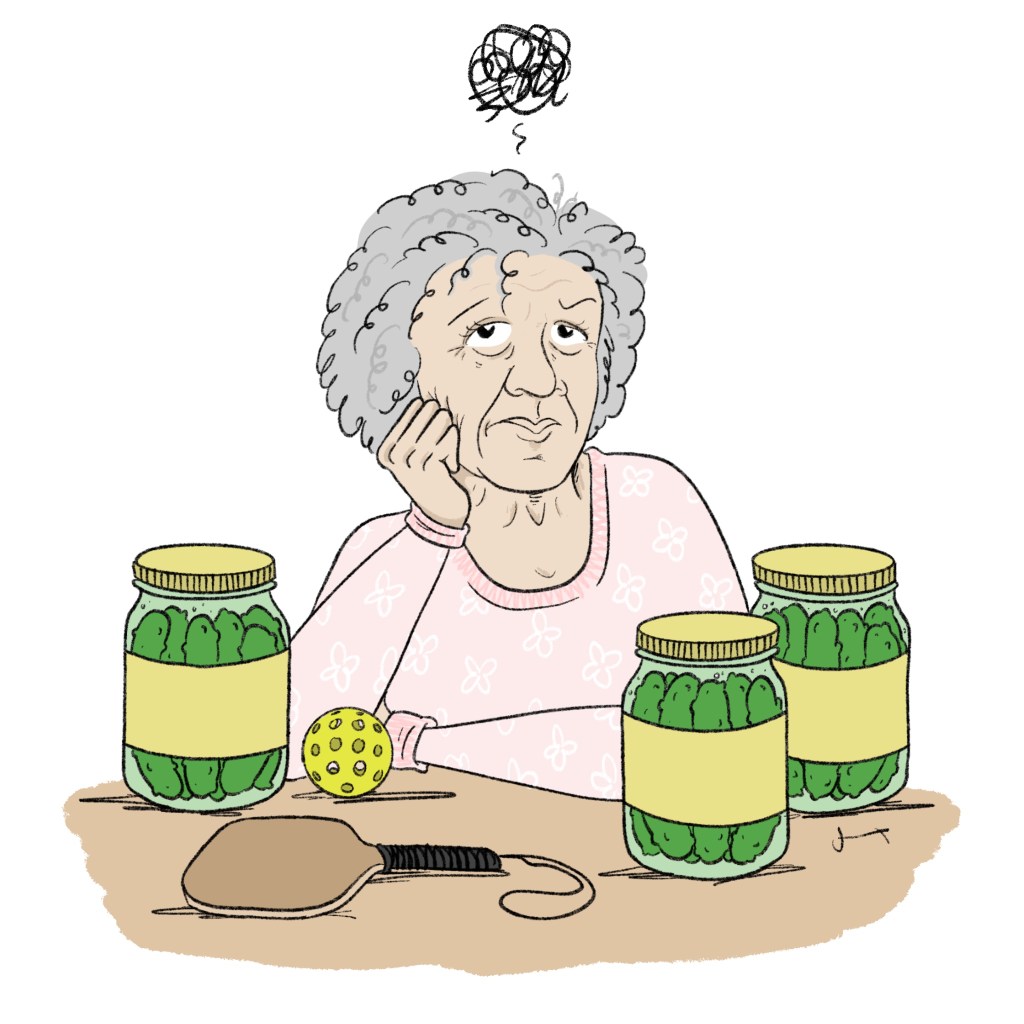
Now, Marian had no idea what Pickleball was, and she certainly had no idea how that could be a club, but she was struck with the thought that it would be very fun indeed to join. After all, she grew quite a large patch of cucumbers in the garden behind her house, and she always preserved 20 or 30 jars of pickles every August. Pickles? Of course she knew all about that! Yes, this club might be just the thing.
So at 7:25 p.m., Marian retrieved three large jars of pickles from her fridge, and drove the nearly one block to the community centre to join her pickleball club. If you happened to be walking your dog on her street at the time, you might have noticed, as she drove by, a decidedly pleased look on her face.
Well. I needn’t tell you what a disaster the evening was. Oh yes, there was quite a little crowd gathered, but not one person in the “club” seemed interested in its actual purpose. There was no call to order, no president or secretary, and not even the semblance of a roll call. What kind of club could be so lacking in organization? More than that, Marian was the only one that night who saw fit to bring along her own pickles from home. The rest of the club members seemed to be so lacking in interest and talent that pickling never even entered their conversation unless she brought it up. To top it all off, they didn’t even stay in the club room to discuss the merits and demerits of how long to soak your cucumbers in vinegar or what seasonings to add. No. They grabbed some rackets and rushed off to hit a little ball back and forth over a net in a nearby room. That’s how uninterested they were!
Marian grunted with disgust. All the excitement and the fun she had anticipated having this evening had filtered away. Pickleball club! What did any of them know about pickling?
She marched over to the table, grabbed her three jars of pickles, drove the nearly one block back home, and carefully placed her pickles back in her fridge. From now on, she vowed, she would be having her own pickleball club right here by herself in her very own kitchen. She would be preparing her own cucumbers and placing her own pickles in her own jars in the future, she muttered, just the same way she had done for many an August before.
Copyright © Jon Klassen 2023
My Gardener Hears About Homophones and Homographs
by Ivan Brown
My gardener, Edgar, is from Mexico. He speaks English very well, but almost every day we encounter subtleties in the English language that I have to explain. And I must say, modestly of course, that I am very good at explaining these things.
The other day, for instance, we were transplanting some strawberries and I explained that they are ever-bearing berries. “Bearing? Is that like this?” he asked, pointing to his bare arm. “Noooo…” I said, “Ever-bearing is B-e-a-r, and your uncovered arm is B-a-r-e.”
“Ah! You mean B-e-a-r like the big animal!”
“Noooo…” I said. “B-e-a-r and b-a-r-e are homophones because they sound alike but are different words, and b-e-a-r and b-e-a-r are homographs because they look alike but are different words. But, either one might be referred to as a homonym.” I felt fully confident that my straight-forward explanation was abundantly clear, although I couldn’t help but notice that Edgar was still sporting a facial expression that, in my opinion, leaned consideraby toward bewilderment.
Hmm. I would have to think of another way to explain.
“Let me tell you a little story so that you will understand exactly what I mean by homophones and homographs,” I enthused. I felt ever so certain that I could make up a little story that would explain everything very nicely to him. “Just bear with me,” I said, “because this bears explaining. You are a bright guy, so I am sure you will bear up, and my explanation will bear fruit in the end. Here is my story…”
His head turned sideways.
“Once there was a peasant of bare means who barely had enough money to buy the bare necessities of life. It was his burden to bear, but he was known for his ability to bear up under the strain. Now, his wife was about to bear their first child, so he decided to build just a bare little house, to which they, together, would bear title – a house that would bear his own handiwork and that would bear the inclement weather of their region. He erected walls, with his bare hands, that would bear the weight of the roof, barely finishing before winter was about to bear down upon them.
“He planted a mulberry tree in front of a bare wall, thinking it would bear fruit before long. Not bearing this result did not bear thinking about. He would have to bear the consequences if the tree died.
“Meanwhile, his wife was bearing up at her overbearing mother’s house and the peasant couldn’t bear to be away from her. And he knew that his wife couldn’t bear to think of him barely managing alone. So, bearing this in mind, he set out, bareheaded, to bear forth and visit her, bearing a gift of her favourite cranberries. He would bear due north, bearing left at a fork in the road. If you could have been there, you would have see him — a man of considerable bearing — bearing himself with dignity and aplomb along the bare road.
“Night fell as he was bearing himself along, but he was guided by the stars, notably the Big Bear and the Little Bear. His mood was bearing considerable strain, but he thought, ‘No, I can’t be a grumpy old bear. I must bear up for the sake of my wife.’
“Thus he approached the house of his overbearing mother-in-law, a house that would bear a close resemblance to the one he had barely finished building, though this one was barer. But he barely had time to think about that, because his heart swelled sadly like a blueberry – no, a strawberry – upon seeing his wife living in barest poverty, a fact laid bare by her threadbare dress and downcast bearing.
“’Bear with me, my darling,’ he said, as a kindly tear rolled down his bare cheek, ‘I shall bear you home.’
“And thus they would bear southward to their home, with the winter wind bearing from the north pushing them along. Once there, they could be seen bearing up and living happily on and on, eating mulberries. One thing, though, bears mentioning: never once did either of them meet the big animal you thought they were going to run into, and barely escape from, in this story – a bear.
“The end.”
I felt ever so proud about my wonderful story. “Now do you understand homophones and homographs, Edgar?” I asked, looking over in his direction. But I was more than a bit puzzled by the new look on his face which suggested, not that he now had a total understanding as I had fully expected he would, but rather that he well might have just had a befuddling encounter with an alien being. I am sure you will agree with me that it is more than a little surprising that a bright guy like Edgar would have failed to grasp the full nature of homophones and homographs from my exceptional explanation, replete with so very many clear examples.
My surprise was doubled when at last my gardener spoke, but now, oddly, on a completely different topic. “You asked me to put some cow manure on the zinnia beds,” he said. “What is manure? I do not know the word manure.”
“Ah,” I said, “now manure is something I can explain in just one… short… word.”
Copyright © Jon Klassen 2023
Catherine Enjoys
A Glass of Cherry Brandy
by Ivan Brown
Catherine is the first to admit that it takes a while for her “senior’s brain” to get going in the morning. Most of us have a few cobwebs to clear most mornings, but Catherine’s brain – before 10 a.m. – is cobwebbed like a creeky old attic that no one has set foot in for the past 37 years.
But by nighttime, Catherine’s brain is a clear and crafty thing, and almost a wonder to behold. She carefully lays out her clothes for the next day on a chair before going to bed, and she lines up in a tidy row on her bathroom counter each one of her required morning toiletry items – soap, shampoo, washcloth, towel, toothbrush, toothpaste, and dentures. When Catherine joins her little group of close friends for a nip or two of sherry in the afternoons, all of them ooh and aah and shake their heads in wonder at how organized and prepared she always is to get the better of her morning cobwebs.
This particular morning, however, was different.
For some reason, that we can only begin to imagine, Catherine had broken with tradition the evening before and decided to indulge in a small glass of cherry brandy before preparing for bed. Due to some arthritis in her serving wrist, we have to assume, she had poured quite a lot more into her glass than she had, perhaps, originally intended. And being of a generation when wastefulness was a sin indeed, she thought fit to sip slowly on her large cherry brandy until every drop had disappeared.
Catherine was tipsy.
Off she shuffled to bed and immediately fell into a deep, if somewhat drunken, slumber. She had not set out her clothes for the next morning nor had she lined up any of the toiletries she would need. She dreamed of cherries swirling around and around, and she woke up with a mess of cobwebs aching throughout her head. It was going to take a lot to get things on track this morning.
Catherine was of an age when having Type 2 diabetes is a matter of personal pride and certainly a fashion not to be missed when chatting with your friends. She managed to pull out of her drawer her diabetic socks, which she had wisely purchased because they are so loose-fitting that they pull on with little effort. Unnoticed by her today, though, both socks were upside down so the heels were on top of her feet. She pulled on some sweat pants, but she didn’t notice that they were backwards so that the seat bulged out in the front. Reaching into her drawer for a top, she accidentally pulled out a t-shirt her friend Amy had given her for her birthday last year – the one with big letters that said “I’m with stupid” and featured an arrow that was meant to point to your husband walking beside you, even though Catherine’s husband had gone on to his greater glory some years ago. But she got the thing on all crooked so that the arrow ended up being positioned precisely on top of her right breast and pointing directly into her “stupid” left one.
This was all very unfortunate, as you can imagine, but Catherine was not yet of a mind to notice.
She pitter-pattered off to the kitchen and began to prepare herself a bowl of cereal until she realized she did not have any milk in the fridge. She would have to make her way to the little food store on the corner. She grabbed her purse and headed out the door, but her head was still not clear enough to notice that she was carrying her purse upside down and the zipper was partially open. So, as she trudged down the sidewalk toward the store all the contents of her purse slowly dibbled out in a long line behind her. Naughty children playing in the street grabbed all the coins and tossed the rest aside. When she got to the store, they were out of milk so she thought to buy some bread instead, but found there was nothing in her purse to pay for it. She tried to explain to the man beind the counter, but it seemed he did not understand English. Or maybe it was her English, as her disobedient tongue was really not behaving as it should. She plodded back home. She looked at her bowl of dry cereal and decided to munch on it anyway. Then she spent the next hour searching all over her house until she finally found her headache pills.
Why is it that some days it is just so hard to get the morning cobwebs out?
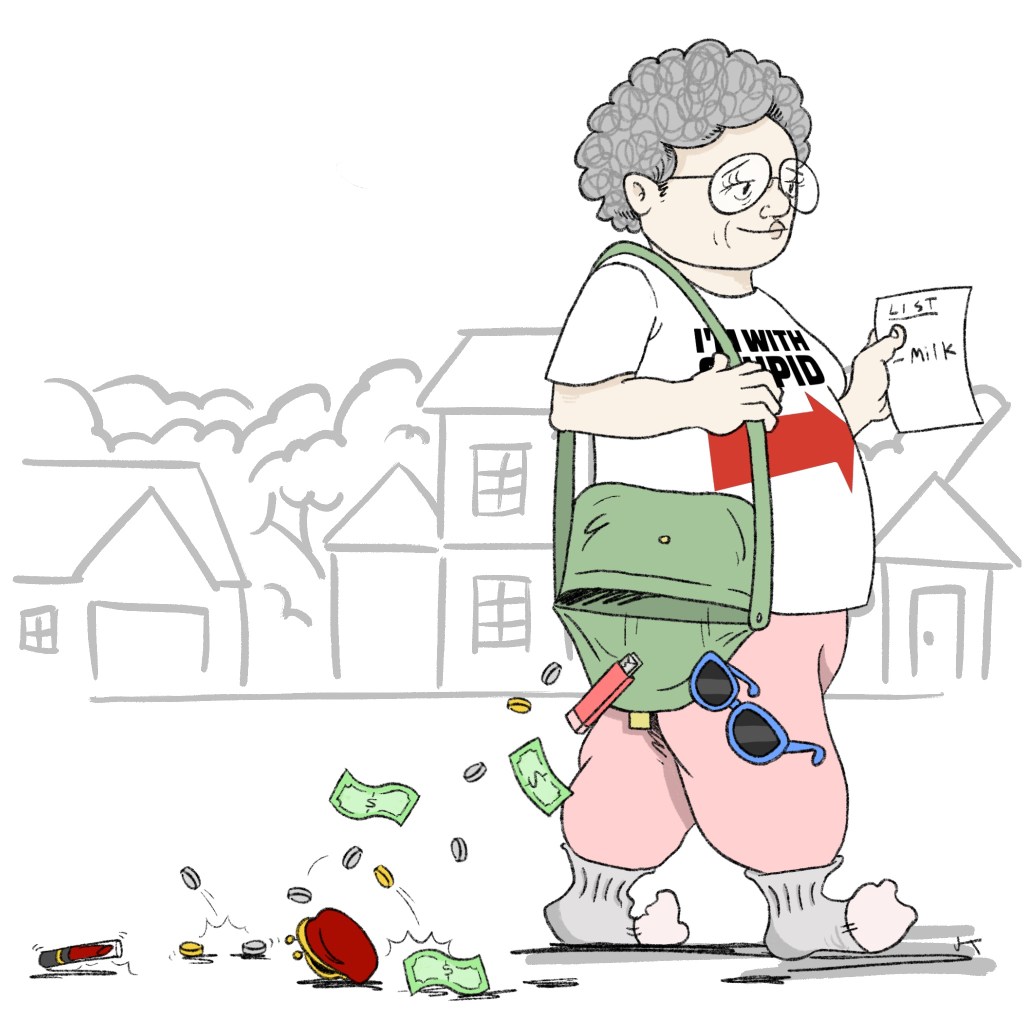
Copyright © Jon Klassen 2023
My Left Leg Gets Pay Equity for Predicting the Weather
by Ivan Brown
A couple of months back, it was raining cats and dogs. I recalled that the woman who was doing the weather forecast on television the night before had said there was a 60% chance of rain, but I knew 100% that it would be raining the next day. I have a sure-fire way of always knowing if it will rain or not: my left leg.
You see, about 8 years ago, I had a hip replacement where the aching joints of my left hip were replaced by some titanium mechanism. It is anchored in the middle of my thigh bone, with the tip about half way down, and the day before a rain it always hurts a little bit there.
Unlike the professional forecasters, my left leg is never wrong about rain.
When I mentioned my special talent to my rheumatologist, she harrumphed, “Oh, there is nothing to that!” I didn’t argue, but I knew she didn’t have a leg to stand on. She may have four degrees and three medical specializations, but she doesn’t have a left leg like I do with more accurate predictive powers than the three witches in McBeth combined.
But she did get me to thinking. Maybe I should try to market my leg’s talent. So, the next day I marched into the office of the manager of our local television station and said, “I would like to forecast your weather.” “Oh? Do you have special qualifications?” “No,” I said, “but my left leg does. It has a bunch of titanium stuck into it. It can predict rain like nobody’s business.” The junior office staff all tittered and rolled their eyes, but the wise manager leaned forward. “We have a place for you, right here in our television family,” he said. “You’re left leg is hired. Welcome aboard.”
“How much will it earn?” I asked.
“You leg will start out at minimum wage, like everybody … everything … we hire. But if it can prove itself, we eventually might … ” I didn’t hear a word of the rest, because my leg was rushing out of the room to grab a quick shower and a change of pants – the weather report was due to start in an hour.
My left leg shone that night. The weather woman predicted showers in the morning with partial clearly in the afternoon, but my left leg interrupted her and said, “No. No rain. I do not even feel the tiniest twinge.” My leg was correct, of course, and there was no rain. Fan mail and messages of all sorts poured in the next day, addressed to L. Leg. There was such a flood of messages that my leg had to hire its own secretarial staff just to sort and file all the enthusiastic responses. The day after that, my leg opened accounts on all the social media, and its postings quickly went viral, circling the globe in no time from Latvia to Madagascar. At our local television station, my left leg gained so much popularity that it was soon assigned its own game show, where people spun a wheel to see what weather they would land on and, if my leg did not agree with where their needle landed, they got dunked into a tub of water. The show was so popular that there was little else talked about in beauty parlours, at construction sites, and late into the night at homeless shelters across the city for weeks on end.
Seniors with arthritis and all manner of artificial limbs smiled and nodded in their easy chairs at home. They had never felt so included and appreciated.
The station manager was ecstatic. His station’s ratings rose from the cellar, as viewers from far and wide, and even from some remote age brackets, tuned in to see what my left leg would say about rain.
But with all this success, my leg was still only earning minimum wage, and apparently it began to think this was just not fair. One night, right in the middle of the weather report, my left leg went silent. Mute. It seemed that it wanted pay equity – the same pay as the woman who delivered the mostly-inaccurate nightly weather report. Yes, my leg was staging a strike. The weather woman was stunned. The station manager was open-jawed. Viewers, ardent fans to the core, were flabbergasted. But my leg stood solidly on principle, and at last the station manager rushed out onto the live set and offered to triple its wages. Some heated bargaining ensued, right on the air, and after some time they compromised on a ten-fold increase to match the wages of the weather announcer.
Pay equity had been attained.
The on-air incident caused my leg’s popularity to soar even more wildly to formerly unimagined heights. It was named Employee of the Year by a major weather network, it was awarded the Order of Canada, and it received honourary doctorates from four universities. In the recent election for city major, it came in a very close second. Now it is seriously considering a favourable response to the groundswell of unprecedented pressure to run as a member of our provincial legislature.
I’m cheering it on. I predict it will perform every bit as wisely, if not much more so, than most of the politicians who currently bicker and strut about in our provincial legislature.

Copyright © Jon Klassen 2023
How I Got Over My Fear of Santa
by Ivan Brown
When I was young, most kids loved Santa Claus. But not me. This big loud stranger who came tromping in at the end of our Sunday School concert with his big black boots, carrying an enormous sack over his shoulder, was just plain scary. And wearing weird red oversized pajamas, and laughing Ho-Ho-Ho eight times too loudly scared me half to death.
I was terrified of the horrible creature.
But I seemed to be the only one. In those happy long-gone days, other kids jumped up and down in excitement as they lined up to get their pictures taken with Santa at the mall, but my mom’s photo album had not one image of Santa and me. They didn’t exist. There was just no way I was going anywhere near that scruffy old geezer who hadn’t taken the time to shave in the past 197 years. When all the kids in my class wrote letters to Santa asking him for stuff in their stockings, I was the only one who asked him to buy a razor kit for himself and have a nice shave. I still don’t really understand why Miss Hall was doubled over laughing.
I may not have been the most astute egg in the carton, but even in those halcyon days of yore, when sexual predation was something women only whispered about to each other behind their hands and men only cursed about to each other when they were well out behind the barn, I knew enough not to sit on a stranger’s knee. Yet, here were mothers and fathers and even hardly-demented grandparents pushing their youngsters forward to sit on the knee of a eccentric old gaffer who had been holed up at the North Pole all year long making toys with a bunch of elves and consorting with a flock of flying reindeer. I ask you, honestly, would you sit on the knee of someone like that?
No, Santa was just not for me.
Our small town always held a Santa Claus parade around the beginning of December, where every local group and business co-opted a tractor and wagon to join in the fun. Every other float was decorated with children bundled up against the cold and singing carols off key, while alternate floats featured respectable business people dressed with tea towels tied over their heads to look sort of like shepherds abiding in the fields, or with Grandma’s old housecoat turned inside out and Grandpa’s old felt hat adorned with little apples tied to it to kind of resemble wise men coming from the east. They had to balance carefully on their wagons as they waved at the enthusiastic crowds cheering them on, always careful to mind that the cradle in the middle did not rock itself right off the side of the float. It was all so grand. The very last float, naturally, was always reserved for Santa himself. He was perched inside the rickety old sleigh that sat the rest of the year by the back door of the skating rink, and he merrily waved his reins as he drove his eight stuffed reindeer of various sizes that had been drafted for temporary use from neighbours’ lawns. It was the highlight of the parade. Mothers and fathers alike pretended to gasp in surprise that Santa had taken the time to show up in our town. Excited shouts of “Hey look! There’s Santa!” rang up and down the sidewalks as most children leaped about uncontrollably in utter joy. Not me, of course. I was hiding behind my dad, inside his coat.
By this time, even through the golden glow of those bygone days, I suppose it is obvious to all of you that I was not exactly the bravest kid in our small town. But I had, most assuredly, been blessed with a substantial gift: a keen old-fashioned detective wit. Peering out from among the folds of my dad’s coat, I could easily see that behind Santa’s big white beard, which kept falling to the side and had to be readjusted time and again, was the face of someone who looked remarkably like Alan, my dad’s friend who lived just up the road from us. I slowly came to the conclusion that this might actually be Alan and not the real Santa and, further, I cleverly deduced that the reindeer he was driving might be pretend reindeer and not the real ones that fly through the air to deliver Santa’s toys. It was all a ruse. Santa didn’t come to our town after all.
This realization changed everything. After the parade was over, I lined up with all the other kids to get my candy cane from “Santa” and was able to take it, yes, directly from his hand, look him right in the eye, and say politely, “Thank you Alan.”
And thus my fear of Santa, whom I had formerly thought was a horrid old codger, dissolved and it seemed that my problem was solved. Flown away like the down of a thistle.
But I still couldn’t figure out how the real Santa knew just what I wanted. It is still a mystery to me how he somehow managed to stuff that paint set and toy truck into my stocking, the little stocking I had hung by the chimney with care on Christmas Eve.
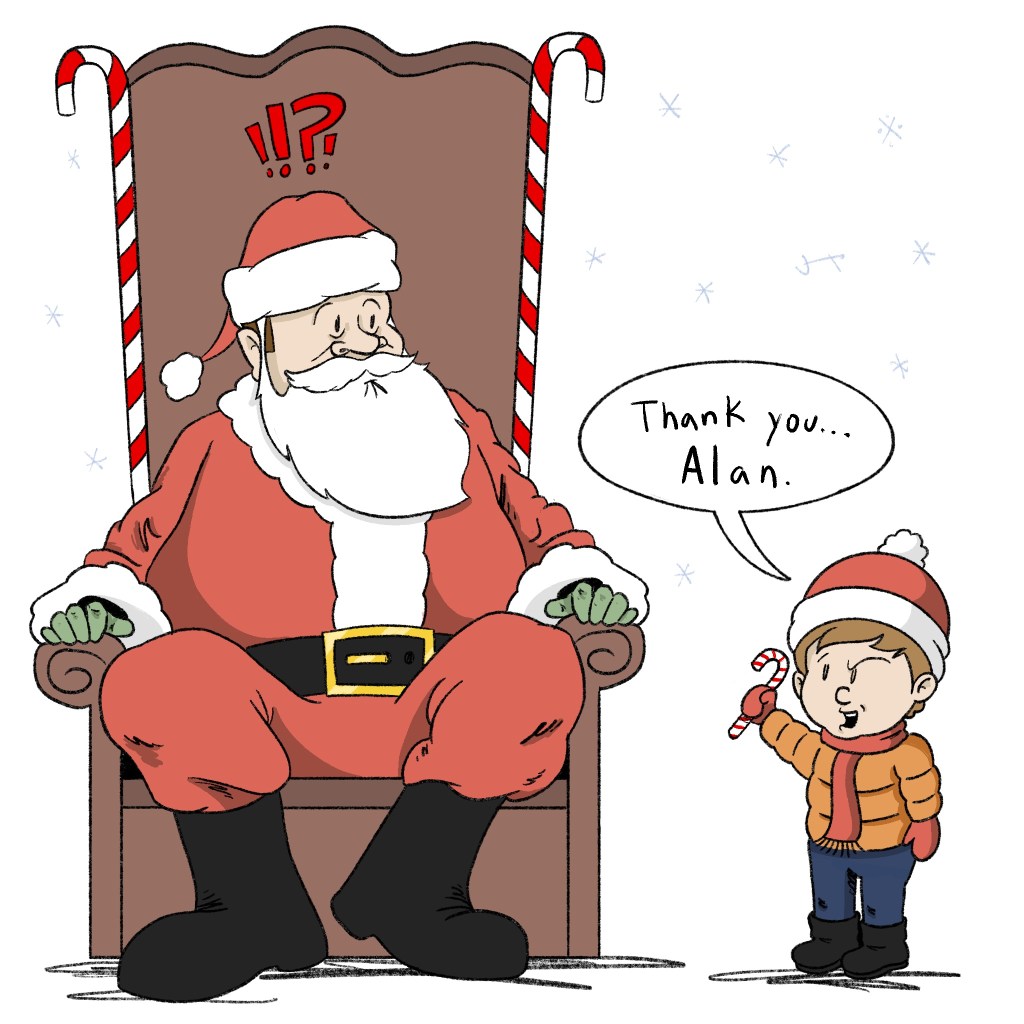
Copyright © Jon Klassen 2023
Marj Keeps Her New Year’s Resolutions
by Ivan Brown
Every year on December 31, Marj writes down a list of resolutions that she will declare the next day, New Year’s Day, to better herself. She firmly intends to keep every one, but of course she has never succeeded. You see, she is a woman who has solid convictions regarding the goings-on of her husband, her relatives, and her neighbours, but when it comes to improving her own manner and daily habits Marj has remarkably less resolve.
Things would be different this year, though, she vowed.
Marj’s number one resolution, right at the top of her list, which she wrote almost clearly in her own handwriting, was: 1. I resolve to keep my resolutions for once. Her other three resolutions followed in a curt, but neat, column. 2. I resolve to shower a wonderful compliment upon my slovenly husband, although this one might be difficult. 3. I resolve to provide that scoundrel cousin of mine, Edmund, with a nice dinner sometime this year, but I will have to lock up all the booze before he gets here. 4. I resolve to help my poor aged neighbour, Stella, work up her garden ready for spring planting, if I can get past all the weeds and last year’s leaves that always leave her garden the ugliest on the street.
Marj was so pleased with herself for drawing up such a wonderful set of resolutions. She sat down and drank a cup of tea, and munched on two of the oatmeal cookies she had baked yesterday in case company dropped in.
But as she sipped and chewed, she was bothered by her first resolution. How was she really going to keep her resolutions? She would have to think up some clever method that would work, she reasoned, because after all she couldn’t start doing number 2 if she didn’t do number 1.
And since no company dropped in, she had plenty of time to think. And finish the oatmeal cookies.
The plan she came up with was ingenious. Oh, it involved a bit of trickery and deceit, that much is certain, but that was of no concern to Marj. The very next day, she marched into her neighbourhood liquor store and purchased 36 small bottles of various kinds of liquor, which she charged to her husband’s account. That evening, after the moon was fully hidden behind thick clouds, she put on her sunglasses, pulled her son’s old ball cap well down over her eyes, grabbed a little shovel, and tiptoed into Stella’s horrible so-called garden. She planted each of the bottles here and there among the weeds and dead leaves until she had buried some in every part of Stella’s garden. She rose early the next morning, drank some coffee, then composed a series of 36 notes which she mailed, one each day, for 36 days.
Edmund was surprised when notes began arriving daily in his mail, directing him to the garden of some unknown person. Each note promised some treasure that hinted at his favourite drink, and Edmund was not one to pass up such an enticing opportunity. Night after night, as the notes directed, he would sneak into a garden – which you have already guessed was Stella’s – and clear a little space of weeds and leaves and dig up the earth until he found a small bottle of treasure. Then he would go back home and enjoy its contents. Edmund happily obliged for 35 dark nights, at which time the garden was almost fully cleaned up and the earth worked nicely and ready for planting.
But on the 36th day, as the final note directed, Edmund was to go at 4:00 p.m. rather than wait until after dark. Stella had received an enigmatic note in her own mailbox that very morning suggesting she prepare a nice dinner for the mysterious man who had so kindly volunteered to work up her garden. Stella prepared a meal that did ample credit to the skills she had honed over her 87 years, and invited Edmund in to share it – after he had finished his final garden work, of course.
By some strange coincidence, Edmund had received that very morning a phone call from someone with a hoarse voice suggesting that it was Marj’s husband who had left the treasures under the earth in Stella’s garden. So, after he ate his fill at Stella’s, Edmund dropped by and said to Marj’s husband, “Honestly, I can swear on my life that you are the most generous, most humble, most thoughtful man I have ever met.”
And so Marj’s clever plan worked. Stella’s garden was worked up, Edmund had been provided with an ample dinner, and her husband had been showered with a wonderful compliment. She had kept all her resolutions – without having to keep any of them herself.
Marj was so pleased that everything had worked out so well that she made herself a cup of tea, which she sipped as she ate a little pile of oatmeal cookies. Oatmeal cookies she had baked in case things went awry, but that she would not have to serve to Edmund after all.
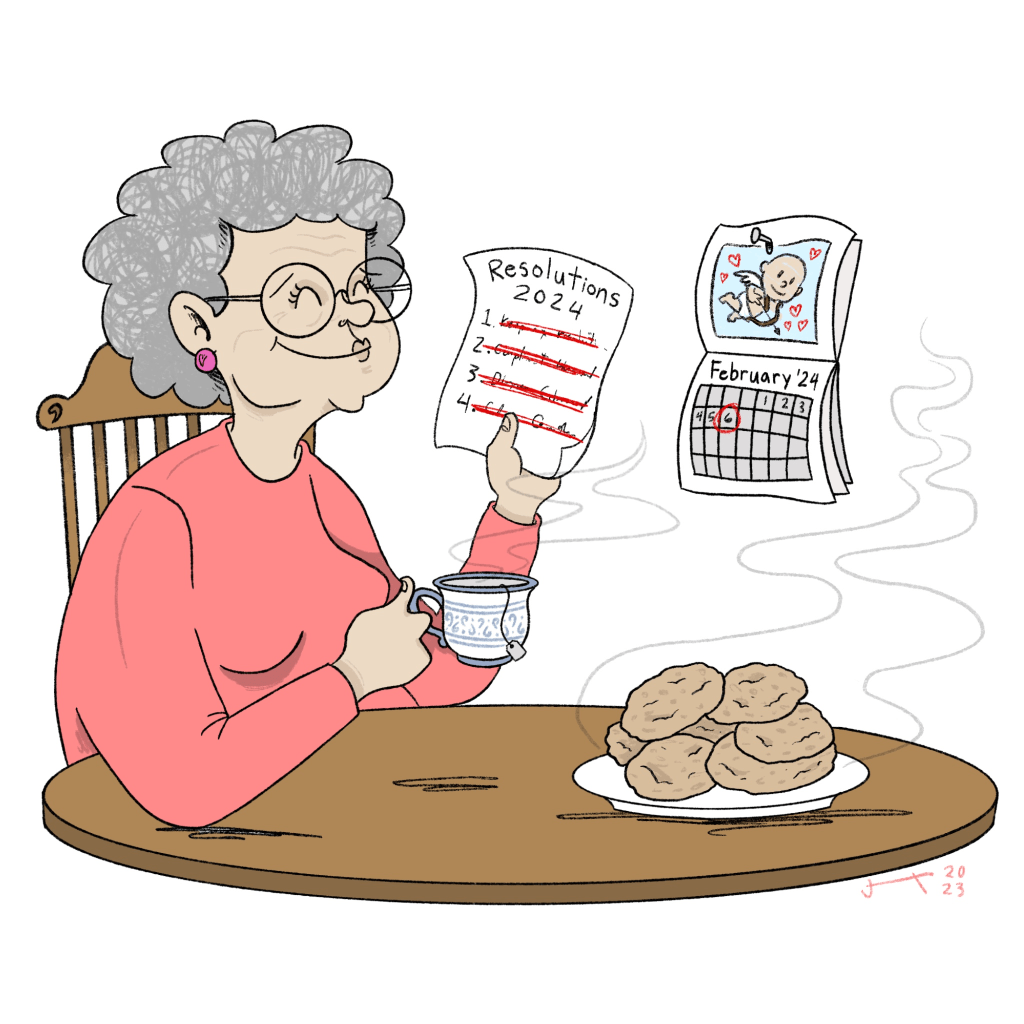
Copyright © Jon Klassen 2023
Jason Becomes Virtuous and I Do Not
by Ivan Brown
At lunch last month, my long-time friend Jason challenged me to say what happiness is. To him, happiness was having an hour all by himself with nothing to do but eat a granola bar. All I could think of at the moment was happiness is when you push your reading glasses up to your eyebrows to look across the table but then, when you have to read the menu, you wiggle your eyebrows a bit so your glasses fall down and they fall exactly in the right place on your nose. For sure. That’s what happiness is. At least, I said, I have never read that Aristotle or Jean-Paul Sartre ever said anything to the contrary.
Happily, Jason agreed right away so we were free to dig right into our club sandwiches.
But later, I got thinking. I recalled that Plato taught if you devote your life to knowledge and virtue you will be happy. Or something like that, as I don’t actually understand Greek all that well. Could Plato be right? I had to think. I felt pretty confident that I already have the devotion-to-knowledge thing down pat since I google things quite a bit, but I might have to sort of downplay the virtue part. That is not really going to be much of a winner for me.
But maybe, I pondered, it might not be too late for me to become virtuous, and thus happy. It was certainly worth a try. I immediately researched what virtues actually are, but I got confused because different people seem to think different things are virtuous. In the end, I decided to go with the virtues that are opposites in the list of the seven vices Pope Gregory I proposed in the year 590. Not that I admired Pope Gregory particularly – or Greg as his friends called him, or Greggie as his mother called him – but mostly because I like looking at pictures of those medieval fairs with jesters hopping about and knights jousting madly on horseback whilst a fair maiden flutters her brightly-coloured scrap of cloth in hopes that her handsome lover does not get pierced right through.
I immediately sent the list to Jason and challenged him to observe the seven virtues and to avoid the seven sins for the next month until our next lunch meeting. I vowed to do the same, so we could judge in a month if we were truly happy.
I started in, full of enthusiasm, determined to live up to both the spirit and the letter of each of the seven virtues, eschewing with a determined heart their opposite seven sins:
1. Chastity (lust). Already this is going to be a lot tougher than I thought.
2. Temperance (gluttony). Oops.
3. Charity (greed). Hmmm… Really?
4. Diligence (sloth). Come on now. Aren’t we going a bit over the top?
5. Kindness (envy). As Charles Dickens once said, “The dickens you say!”
6. Patience (wrath). As George Bernard Shaw once said, “Pshaw!”
7. Humility (pride). As William Shakespeare once said, “Zounds! Methinks thou asketh too much, Greg.”
I got off to a shaky start the very first night. I gobbled down a really big meal and shared it with nobody at all, then lounged on the couch for the whole evening with the odd lusty thought crossing my mind, impatiently annoyed that my friends were out having fun without me. And I still felt pleased with myself. The rest of the month went very little better, despite my slight efforts. Actually, the whole undertaking was an utter failure.
But at lunch yesterday, I learned that it was not so with Jason. With great forbearance, he had eaten modestly, not touched a drop of liquor, given generously to the homeless, worked tirelessly at the food bank, rejoiced heartily at seeing his neighbour’s new car, and sat patiently and humbly through his daughter’s long-winded school stories. Best of all, with even greater forbearance, he claimed, he had remained celebate throughout the month. Jason had become virtuous and I had not.
I ordered the beef pot pie with large fries on the side and a beer. Jason ordered a Ceasar salad and water.
“Who is truly happy now?” I grinned to myself.
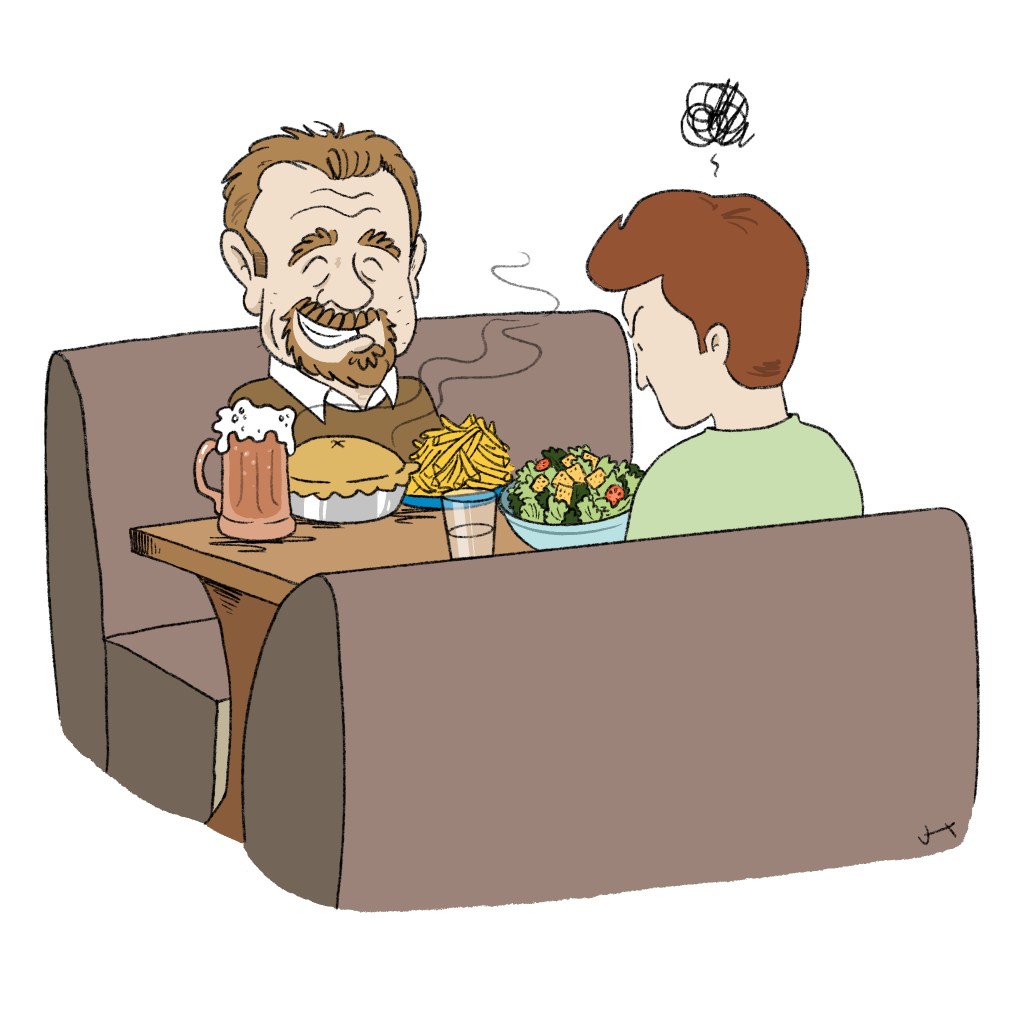
Copyright © Jon Klassen 2024
Bradford Is Proud Of His Accordian Of Chins
by Ivan Brown
Some people have pronounced double chins. We make every effort not to stare at them exceedingly, of course, because that would be really rather rude and, after all, pronouned double chins are all a natural part of human diversity, which we all heartily endorse. People with double chins are people too – for the most part.
There are even a few people who have triple chins. Three big folds under their lower lip. I think you know who I am talking about. But my friend Bradford has even more. Over the years, his chins have proliferated from his lower jaw down his neck and toward his chest, multiplying at a rate that would leave most rabbits’ reproductive endeavours well in the dust. In his own words, Bradford now has an accordion of chins.
This was not a metaphor that arose out of nowhere, I fully expect, because Bradford is quite an accomplished musician himself. He can be heard singing rather lustily in his morning shower – a little too lustily, some have remarked – and he can be overheard from time to time tinkering a bit on an instrument or two that is strewn about his apartment, after he has dusted them off. So, yes, with the number of chins that have evolved over several years, and Bradford’s obvious musical bent, an accordion of chins is an apt metaphor indeed.
You might think that Bradford would be self-conscious about his accordion of chins and that he might refrain from admiring himself unduly in the mirror, but that is certainly not the case. On the contrary, he is proud of his distinctive look and his helpful contribution to diversity.
I have noticed, though, that an accordion of chins can be a bit cumbersome at times, especially when he and I are enjoying one another’s company in a coffee shop and he has to occasionally pick croissant crumbs from between the folds of two or more of his many chins, or when we are trying to enjoy a meal in an Italian restaurant and his lower chins keep dipping into the spaghetti sauce. But Bradford has wisely countered these inconveniences by purchasing a nice leather strap, which he easily found online, that tucks his various chins up a bit and fastens with convenient snaps around the back of his head. It looks ever so smart, he himself has mentioned, especially on the many occasions throughout the year when he sticks on festive decals like valentine hearts, shamrocks, poppies, and mistletoe.
Others have not always seen the glamour in Bradford’s accordion of chins or the great fun in wearing a decorative chin strap. Complete strangers in the subway sigh audibly out of pity, rude teenagers make snide comments that they will sorely regret some day when they are in the nursing home, and kindly old ladies knit scarves for him to wrap around his neck in a vain attempt to camauflage his abundance of chins. Numerous acquaintances who once met him briefly at a party where he displayed his charming chin strap have added an addendum to their wills, bequeathing their well-shaped single chins to him on the off chance that he might opt to undergo a chin transplant at some point in the future.
But Bradford is having none of it. In fact, he has started a club called Proud Accordion Chins. To join, you need to have a minimum of four chins, officially notarized by a practising lawyer of passable credibility, and your application needs to be accompanied by a sworn statement that the enclosed verifying photograph has not been electronically or otherwise altered in any way. Once in the club, members vie to outdo one another in the number and extent of chins they sport between mouth and navel. Although the club has never gained an extensive membership, as having an accordion of chins is not something that is common or widespread, it is a proud little group that enthusiastically champions multiple chin diversity.
And diversity is so important to Canadian culture that I have heard credible rumours that the provincial premiers have drawn together to petition for an accordion of chins to be mentioned in the Canadian Charter of Rights and Freedoms. I have also heard that Parliament Hill is rife with gossip that the Prime Minister is about to endorse a motion for Bradford’s accordion of chins to be featured on a new Canadian stamp.
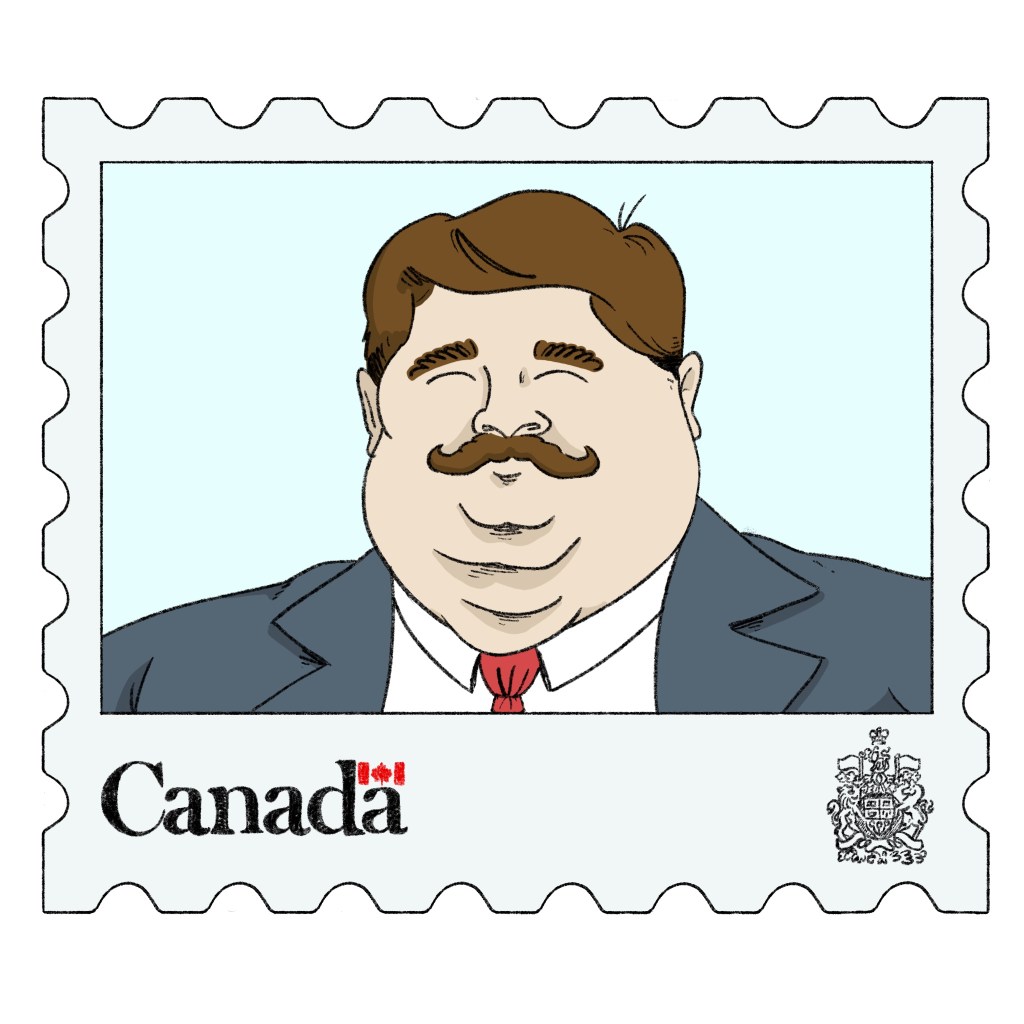
Copyright © Jon Klassen 2024
Stella Thinks the World
Might Be Curved After All
by Ivan Brown
The other day, I read in the newspaper that five per cent of adults in my country believe the world is flat. My neighbour Stella is one of them, and she does not hesitate to tell you so in no uncertain terms. When she sits on her front porch peering up and down our street to see what the neighbours are up to, the world sure looks flat enough to her. She would tell you that any day of the week, should you dare ask.
It may seem odd that so many adults believe the world is flat, but to be honest, when I was young I thought that too. I just couldn’t imagine how it could be any other way.
I remember asking my dad, in my six-year-old way, about the world, and he told me it was round like a ball, and that China was on the other side of the ball. “If you could go straight down under your feet, down, down, down, through the whole earth,” he explained, “you would come out on the other side in China.” Like most kids, I assumed I would then be standing on my head in China, looking at all the Chinese people standing on their heads too. That didn’t quite make sense. How could people balance on their heads without falling over? Surely, the world could not be round like a ball.
Dad tried to explain, by demonstrating on a real ball, that sometimes we are on the bottom of the ball and the people in China are on top. “If they are having their day on top of the ball, we are having our night on the bottom.” But that didn’t ring true either. At night, I am in my bed on my side. I am not sleeping standing on my head. He had no answer.
Now, it doesn’t take an overly intelligent kid to know that if you don’t want to fall off something, you have to stay on top of it. If you try to sit or stand on the side of a barrel, for example, every kid knows you are going to tumble off. And there is simply no way you can sit or stand on the bottom of it. So, if the earth is a ball, as my dad tried to insist, why don’t people just fall off? Explain that to me, would you?
My dad’s answer was that gravity pulls you back to the ground. “But if gravity pulls us to the ground, wouldn’t that mean that, in China where people are upside down, gravity would pull people off the ground up into the air? Try to explain that one, Dad.”
He could not.
A few years later when I was in school, Mrs. McMillan tried again to explain it. She showed us a drawing of the world in a flat state, with boats sailing in the ocean and accidentally sailing right off the side. “Now,” she said, “if the world were flat, as some people thought in those silly old days, why wouldn’t the water just flow off the sides? No, the world is round so the water flows around.”
This was hardly convincing. Have you ever tried to pour water around a basketball? It simply will not flow around. It keeps falling off.
Next, she taught us the rhyme that all school children in those days learned: In fourteen hundred and ninety-two, Columbus sailed the ocean blue. “So,” I wondered to myself, “if the earth is round, as Columbus guessed, wouldn’t the ocean be blue from the sun on one side and almost black on the other side, being in the shadow? Besides, Columbus sailed the Nina, the Pinta, and the Santa Maria from Spain where we assume people stand upright. When he reached India – okay, Mrs McMillan did say this was not actually India at all, but part of the Bahamas, which is about a quarter way around the “ball” – wouldn’t all the people in the Bahamas be standing on a 45-degree slant?” There was no mention of that in our history book.
Of course all this was corrected as I got older and came to understand centrifugal force, gravitational pull, and a bunch of other laws of science. But it seems that five per cent of adults have never been converted to the scientific method. And yes, my neighbour Stella is one of them. To her, the world looks flat, and that is that. I suppose she is just not a woman of science. I suppose she may not have studied physics or astronomy.
But then one day, she surprised me by admitting that she might have been wrong all along about the world being flat. I was in my garden and had spotted her puffing her way up the hill that leads to our street. She was on her way home from buying a carton of milk at the corner store that is down at the bottom of the hill.
“Good morning Stella,” I called out.
“You know,” she panted, as she stopped to catch her breath, “I was thinking you might be right. Just look at the curve on that hill. It’s hard to walk up a curve. I had to bend over forward to keep my balance, just like those people in the Bahamas you told me about who walk at a 45-degree angle. Maybe the world is curved after all.”
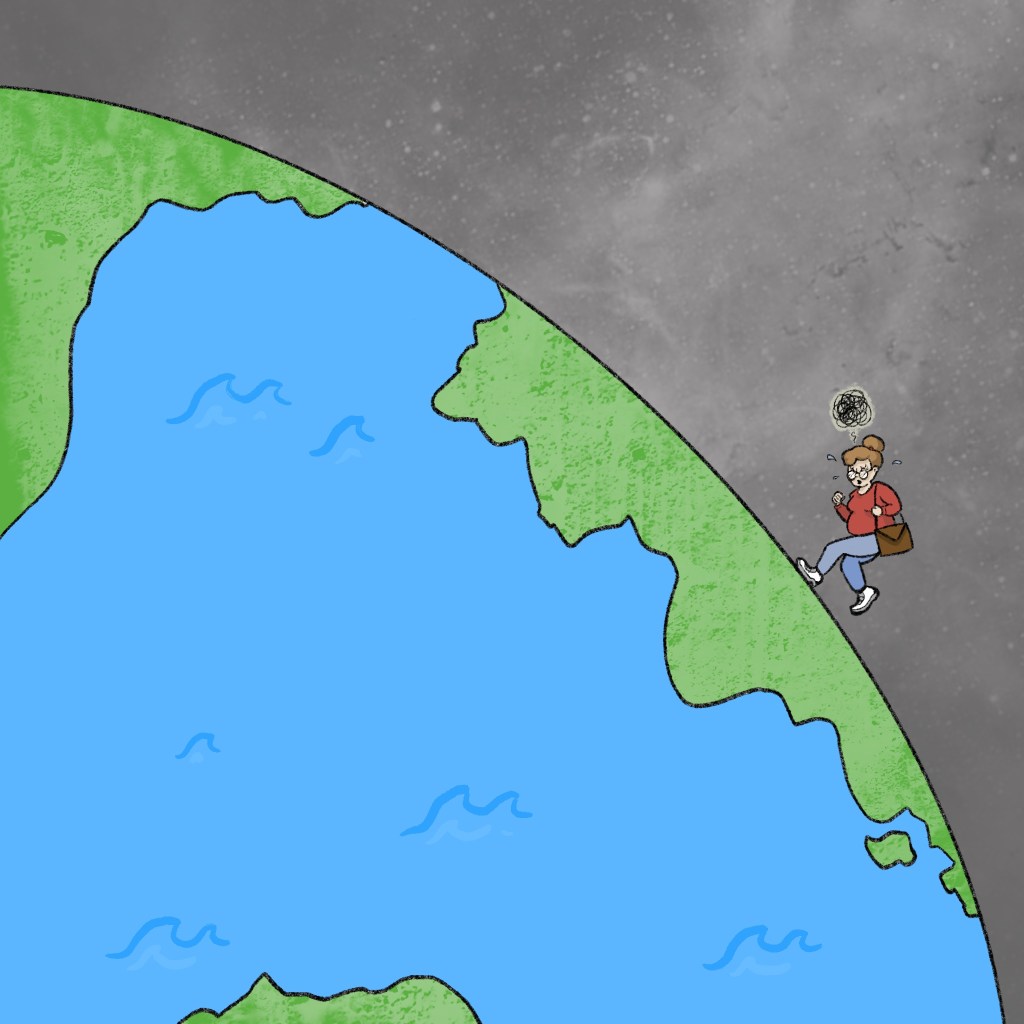
Copyright © Jon Klassen 2024
Where the Devil Are My Winter Slippers?
by Ivan Brown
I lost my winter slippers, and I miss them. You see, last year I bought a beautiful pair of slippers online, at a beautiful price, to keep my feet warm during the winter months. They were a soft tan suede with cushioned soles, lined with furry stuff on the inside that made my feet feel like they were floating inside a warm cloud. They were oh so comfy and oh so wonderful.
But now I can’t find them anywhere.
My niece suggested that the dog probably ate them, as her Husky once ate an expensive pair of dress shoes that she had very foolishly stored on the shoe-tray inside the front door. But our dog is a little white ball of fluff who can’t swallow her kibble unless it is cut into pieces and softened with warm water. So I can’t think how she could gobble down an entire dry slipper. Not to mention two of them.
Naturally, my own instinct was to blame my cleaning lady for the loss, since she always moves things around no matter how many times I ask her to put things back where they were. I think she is forgetful. When she picks up a vase to dust underneath, she seems to forget where it was sitting and sets it down on an end table halfway across the room instead. Someone like that might easily forget to put on her own shoes when she is getting ready to go home, and she might accidentally put on my slippers instead. But maybe not. You would think she would have wondered why she was wearing men’s size 12 slippers on her smallish feet as she trudged through the snow on her way to catch the bus home. It’s not everyone who makes a mistake like that without noticing.
I suppose my slippers could have been abducted by aliens, the same sneaky creatures who apparently absconded with the watering can from my garage, the scissors from our upstairs bathroom, and last night’s leftover meatloaf that I had been hoping to snack on mid-morning today. But I don’t know. Do alien beings even wear slippers? I simply don’t recall whether or not E.T., riding on that bicycle through the air in front of the full moon, was sporting something similar to my furry suede slippers.
My friend recommended, a bit curtly in my estimation, that I just buy new slippers. It’s not that I am a cheapskate by nature, and I do have the money in my bank account, but why buy new slippers when my perfectly good ones are probably hiding behind a forgotten pile of books somewhere. When I find them, I would have two pairs. What am I supposed to do? Keep one pair for Sunday best? Anyway, I think my friend was just tired of my missing-slipper talk and was trying to change the subject away from my tragic loss. Whatever happened to friends being there for you in your hour of emotional need?
I am a big fan of old movies, and the other day I was watching the 1938 version of Shaw’s Pygmalion. To my delight, I discovered that Professor Higgins also lost his slippers and had to call on his protégé, Eliza Doolittle, a street flower-seller, to find them. “Where the devil are my slippers?” he had demanded. Eliza did toss them at his head after he called her a guttersnipe and a squashed cabbage leaf, but he got them back and that led me to an excellent plan of action. I actually had no idea what a guttersnipe was, but it sounded nice to me. I figured it was probably a German word meaning beautiful woman. And as for a squashed cabbage leaf, well, that sounded pleasant too, a tasty bit of green you could cut up and add to your luncheon salad. In any case, if those two words worked so well for Professor Higgins, surely they would work for me.
I rushed to Kensington Market and found a woman who looked a little like Eliza Doolittle selling flowers by the sidewalk. “Where the devil are my winter slippers, you guttersnipe?” I inquired in my fake English accent, trying my best to emulate Professor Higgins. She didn’t answer, so I was really not sure if she didn’t comprehend what a guttersnipe is, or if she just didn’t hear properly. Perhaps she was hard of hearing. I tried again, now much louder and bolder, “Where the devil are my winter slippers, you squashed cabbage leaf?!!” This time both she and quite an accumulation of by-standers heard quite clearly.
The doctor says my two badly-swollen black eyes should clear up in a month, and he is fairly optimistic that I will eventually be able to see properly again. But by then it will be too late to continue to look for my winter slippers. It will be spring, and I will be searching high and low all over the house mumbling to myself, “Where the devil are my summer sandals?”
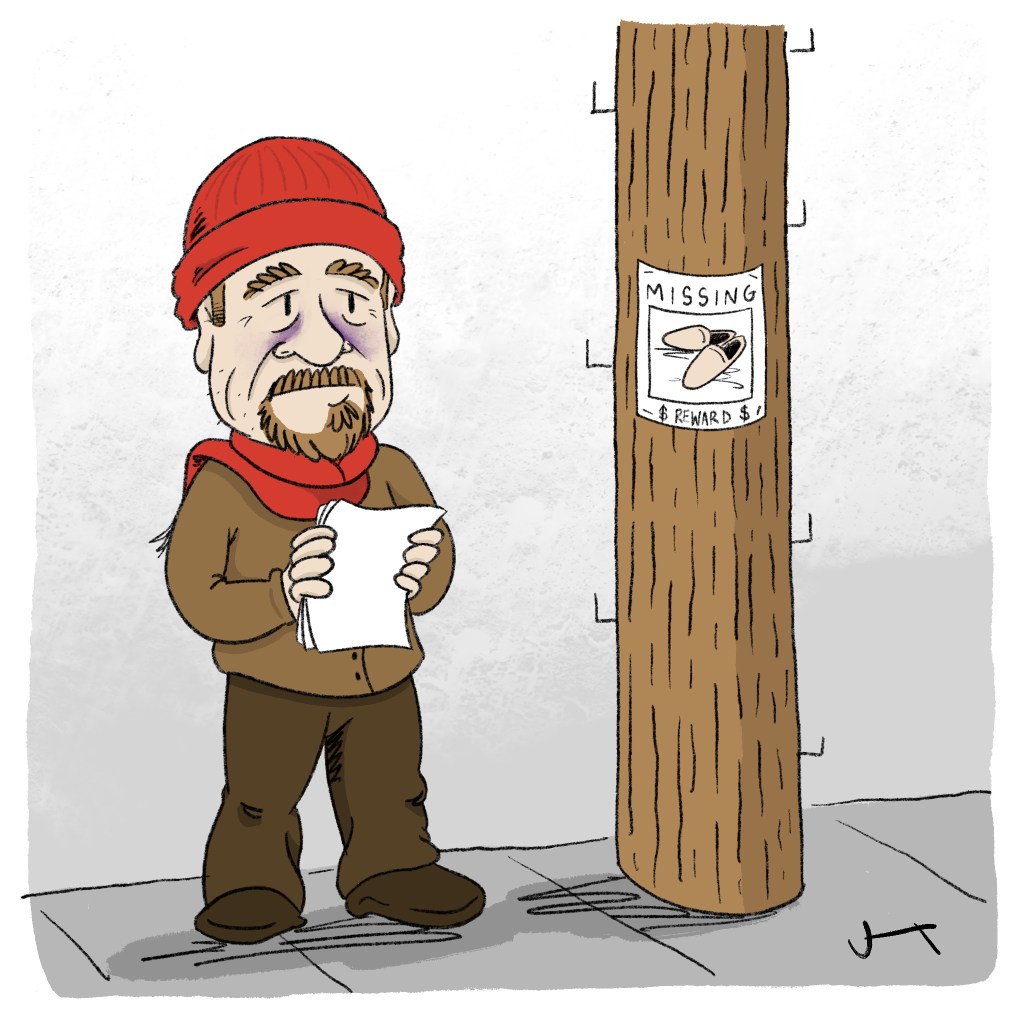
Copyright © Jon Klassen 2024
How St. Patrick (and Friends)
Chased the Snakes Out Of Ireland
by Ivan Brown
“Let’s discuss St. Patrick when we meet for lunch,” my former co-worker, Susan, suggested over the phone. That worried me. I knew Susan was a total trivia nut, and when she used the word “discuss” in reference to St. Patrick, I knew she would come armed with a hundred trivia facts about his life.
I wondered, just this once, if I could match her at trivia. I was not sure, though, as I was starting from a point of severe disadvantage, being too lazy to research very much and too forgetful to recall trivia. Besides, the only thing I really know about Ireland is that it has something to do with shamrocks and leprechauns. I am not even sure what leprechauns are, but I suppose they are happy little creatures who live behind rocks and hedges, munching on shamrock salads and drinking green beer. I know even less about St. Patrick, just that he is the only person in the world who can make me get dressed on the morning of March 17 in that ugly green shirt I got for my birthday.
In the little bit of research I did on my phone, I found out that Patrick was the name he gave himself after he became an adult and a Christian, but his real name was Succat. Hmmmm, I figured. Any boy who grew into early manhood bearing a named pronounced “suck at” was bound for a life of either drunken debauchery or delusions of grandeur. Whichever, Ireland does come to mind.
Ah! I just remembered. I think there is also a story about St. Patrick chasing all the snakes out of Ireland. I didn’t know the details of just how he did that, but I could make up a few and Susan would surely not know the difference. I would start with a little known fact: Succat changed his name to Patrick so people would join him in chasing the snakes out of Ireland, instead of just standing there wondering what in the world his parents could have been thinking when they named him Succat. Naturally, though, the locals thought Patrick was too formal so they called him just plain Patty.
Then I would surprise Susan with other “real” facts:
Patty overflowed with pure hope and an effervescence of human charity when he came to Ireland to convince the locals to abandon their traditional religions and become Christians. On his first day there, he was skipping merrily through a lush field of bright green shamrocks when he was suddenly startled by a snake. History has never made it clear who jumped higher in fright – Patty or the snake – but the result was the same: the snake slithered away as fast as it could and Patty made up his mind right then and there that snakes had no place in this lovely Emerald Isle. He should chase them out.
Patty ran after the snake all the way to the banks of the River Shannon, but along the way they encountered many other snakes who took pity on the one being pursued and joined in for support. Patty, waving a glowing crucifix over his head, ran the growing group of snakes all along the River Shannon, then up to the head of the River Hannon, then down to the mouth of the River Bannon, gathering more and more snakes as they raced along.
When they came to the town of Bally, surprised townsfolk immediately saw Christianity on Patty’s red face and were converted. They ran after him, or jumped on their donkeys, and joined Patty in the chase. The growing group gathered before them all the snakes of Bally, and all those from the neighbouring towns of Hally and Shally. More and more townspeople joined in the chase, on foot and on steed, happily converting to Christianity as they sped along. The number of snakes in the chase multiplied tenfold, then an hundredfold, then an thousandfold. As the group passed farm fields, farmers immediately became Christians, so they did, and they grabbed their pitchforks to join the parade. Milkmaids grabbed their milk buckets and scampered after the crowd, in hopes they might get a swing at a few dozen snakes.
When the pursuers’ legs began to weary, great sheets of fine Irish mist sprinkled refreshment upon their faces, reviving their spirits and their strength. On and on they gave chase, through all the counties of Ireland –KinderDerry, TeenDerry, and on to OldsterDerry – herding each and every snake known to the island as they went. At last, they came to the Irish Sea, where the frightened snakes quickly slithered onto a boat about to sail for Liverpool, then on to Halifax and Boston. There the snakes disembarked, found happy homes, and live on to this day.
Before we even had a chance to glance at the menu, Susan started in. “St. Patrick was not even Irish, you know.” I nodded, as if to say, “Who wouldn’t know that?” “No,” she went on anyway, “Patrick was born in the year 386 in Roman Britain. He was abducted when he was 16 by Irish raiders who made him work as a slave herding sheep until he escaped back home. Later, after training to become a priest, he returned to convert the Irish to Christianity.”
“I’ll have a glass of beer,” I instructed the waiter. “And a large one for my friend here.”
“Now Susan, let me tell you about the astonishing facts I discovered about how St. Patrick drove the snakes out of Ireland. You will be flabergasted, I’m certain.”
“Oh, that old story. That’s rubbish. There were never any snakes in Ireland. Snakes are a Christian symbol for evil, so the story is just about St. Patrick replacing the “evil” of the old religions with Christianity.”
I motioned the waiter over. “Do you have a drop of green food colouring to put in this beer?” I asked, “We need to honour the forgotten memory of the poor deluded townspeople from Bally, Hally, and Shally, and the farmers and milkmaids from every county in Ireland, who only thought they were chasing snakes. But in reality … ”
“Oh?” said Susan, her face beaming with interest.
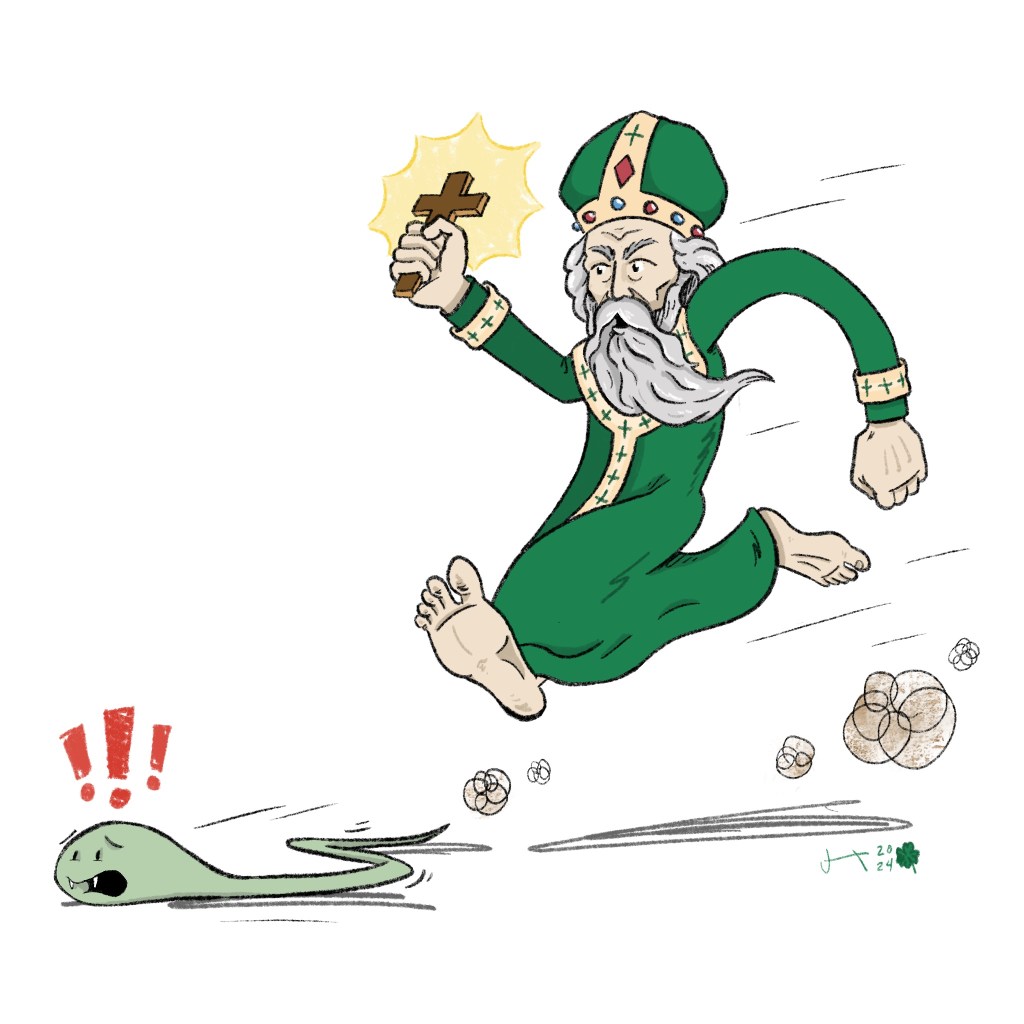
How I Cured My Neighbour Al
of His Love of Numerology
by Ivan Brown
My neighbour, Al, is really into numerology. At first, I wondered what it was he was talking about, really, and I even found that his enthusiastic chatter on the topic was more than enough to encourage me to cross to the other side of the street when I took my morning walk past his house.
I just wasn’t interested.
One morning as I rounded the corner, Al popped out from behind his hedge with a book in his hand. “I thought you would like to learn more about numerology,” he said right off, pressing the book under my arm even though my hand was firmly in my pocket and my arm was pressed tightly against my body. I thanked him and rushed away. But as I glanced back I noticed such a degree of hope on his face that I felt obliged, upon reaching home, to sit down in a chair and open the book. To this day, I am uncertain that Al himself had read it thoroughly, as the pages still smelled a bit new and some of them were kind of stuck together, but I made myself leaf through it anyway. Chapter 1 explained something about Pythagoras, and there was a whole section on Egyptian and Hebrew number systems, but it was all about as clear to me as the cuneiform on the Babylonian clay tablets mentioned in Chapter 4. And even less interesting.
I didn’t really follow any of it, but then again I really didn’t try. I put a few smudges on the other pages of Al’s book so he would think I read it, kept it for a couple of weeks, then returned it with a simple comment: “Interesting.”
But after a few days, I suppose curiosity got the better of me and I found myself purposely paying attention to some of Al’s numerology habits. The first thing I noticed was that he always mows his lawn on the 7th, 14th, 21st, and 28th of the month, and when I asked him about this he looked at me quizzically as if wondering how I could not know. “My shoe size is 7. But with 4 mowing days in a month,” he explained, “I have to add 7+14+21+28=70, then divide 4 to get 17.5. The problem is, though, 4 is unlucky in my wife’s Korean culture, so I have to give $17.50 to a worthwhile charity to avert utter calamity to my grass. You know how it is.” I nodded quietly in agreement, but I actually had no real understanding of the full logic of the thing. Perhaps the ancient Egyptians could explain it.
My head was still reeling from Al’s explanation when, the very next day, he accosted me again. This time, his face flush with excitement, he erupted with news of what he had just learned on the Internet about ancient Aztec sacred numbers. “Huh?” was all I could manage. The Aztecs apparently knew of 13 layers of heaven and 20 signs of something – I wasn’t really listening closely – so their calendar only had 13×20=260 days. You see? I did not see anything at all, but nodded several times anyway. “So…” I ventured, acutely aware that I might be showing my ignorance, “what happened to the other 105 days. You know, 365-260=105.” “Woah!” he almost shouted, jumping back. You can’t mention those days. They’re sacred. Now I will have to eat 105 of everything for my dinner tonight: 105 peas, 105 kernels of corn, my cauliflower and my chicken thigh all cut up into 105 pieces.” I stared blankly ahead. I dared not ask what would happen to his grass if he miscounted and accidentally only ate 104 pieces of cauliflower. Disaster, I’m sure.
I really couldn’t take much more of this. I had to get Al off the topic. Perhaps I could think of a way to best him at his own game. After a week or so of intensive research, I stumbled across a word that made my eyes pop open and that would change my life much for the better: hexakosioihexekontahexaphobia. The deadly fear of the number 666, because it conjures up a close association with Satan. One dare not speak or use the number 666 in numerology circles.
Wow. What a find.
So that very afternoon, the 14th of the month, I conspired to run into Al as he came out to mow his grass. “Al,” I said in a tone so serious that he immediately turned off his lawnmower to face me. “I have just discovered the most amazing thing. Today is the 14th and my belt size is 42. If we multiple these together, which of course we should, we get exactly 588.” Al peered at me, very interested. I continued, “My daughter – can you believe this – was born in 1998, so we have to add 588 + 1998, which you have already figured out is 2,586. I am sure you know there are 32,046 words in the book of Genesis, and if we add these numbers together and we get 34,632. Now. Here is the really astonishing part: How old are you, Al?”
“52.”
“Ah hah!” I nodded enthsuiastically, even as my face grew deadly serious, “34,632 divided by 52 is 666. That’s Satan’s number, Al!”
Without a word, Al turned on his heels and stumbled back into the house, leaving his lawnmower and his oversized grass to fare as best they might on their own.
And I never heard Al mention numerology again.
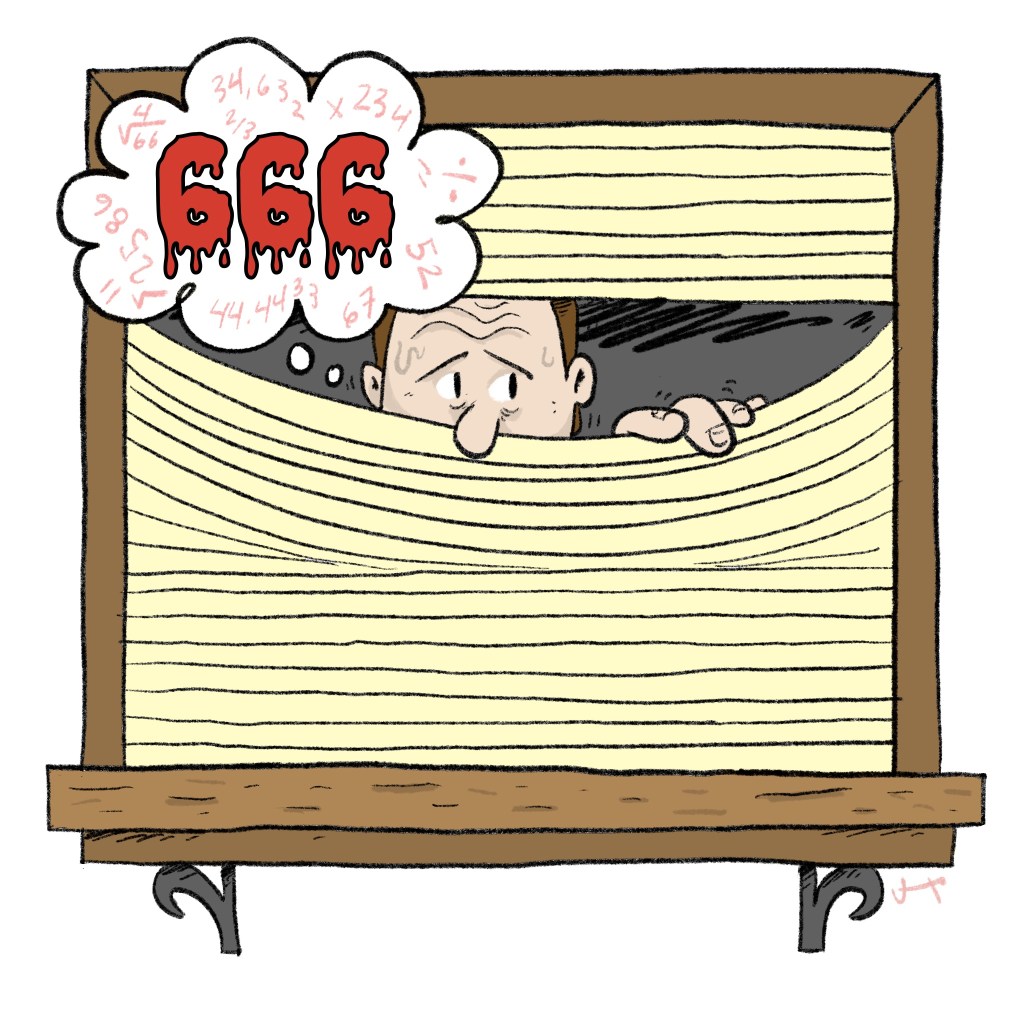
I Am Not Really Sure
Where My Knuckles Are
by Ivan Brown
When I opened my eyes one morning last week, my mind was in its usual foggy waking state. But I was alert enough for an unexpected realization: I do not actually know where my knuckles are.
I looked at the back of my left hand, and I realized I could not say with any degree of confidence exactly which part constituted my knuckles. Then I looked at the back of my right hand, but I was none the wiser. I know knuckles are joints – at least I think … they … are? But are they those joints about two-thirds of the way down your fingers, or are they the joints where your fingers join your hand? Maybe both, or more? I am ashamed to say I have no idea.
But I do think it is fair to ask: if you don’t even know where your own knuckles are, can you hold your head high as a person of standing in your community? What if you meet your city councillor on the street and she inquires politely, “How are your knuckles today?” and you don’t have any idea where to look for the answer? How foolish will you look then?
When we were kids and threatening each other with a punch in the mouth, we would shout, “Do you want a knuckle sandwich?” It never occurred to me that if I were actually called upon to deliver on the goods, I really would not even know what hand or wrist part to insert between the mouthy brat’s teeth.
Then, as I was pulling the covers back to get out of bed that morning a week ago, my eyes lit upon my toes. What about all the joints in and around my toes, I wondered. Should I be calling them toe knuckles? Never once in my entire life had I thought how I ought to be addressing them, should the occasion arise. Perhaps I should say, “Hello Toe Knuckles. I hope you are having a nice day.” Then again, I’m not sure anyone has ever said that.
A little later in the day, I had a minor itch in the little hollow at the back of my right knee. As I gave it a perfunctory scratch, I began to wonder… Does that little hollow have a name? What could it be called? A little research on the Internet informed me that it does indeed have a name: it is my popliteal fossa. Well, who knew? There were no words to express my surprise.
But perhaps I needn’t care, really, as it is not the sexiest thing around. I mean, when you are feeling romantically inclined and making love-eyes at your honey, the phrase “Oh, what lovely popliteal fossas you have, darling” isn’t going to open too many boudoir doors, is it?
When I boasted to my sister that I now know where my popliteal fossa is, she just looked at me sideways and said, “Never once have I wondered that.” But then, after a few sober moments, she sheepishly mentioned, “But I have sometimes wondered what this little hollow at the back of your earlobe is called?”
Now we’re both obsessed with trying to find out the answer. We searched the Internet high and low, but the information that should be so readily available is not. We separately made appointments with our family doctors and faked rashes in that little hollow to try to trick them into spilling the beans by naming the spot, but they just said, “There is no rash there. Next!” I emailed my contacts at the Ministry of Health since they, if anyone, should know the answer, but they seem to be having a busy week as I have not yet received a single response. What that little hollow is called remains a bewildering mystery.
Our search diverted me for a few days from the nagging question of where exactly my knuckles are. But only for a few days. A week later, here I sit, again staring at the back of my left hand, then at the back of my right hand, wondering in vain about my knuckles. I suppose I should stop staring. Staring has not resulted in a single bit of new information. I am not very certain I will ever find out about the knuckles thing.
But I do feel certain that I don’t want some biographer in the future, when writing about the obvious exploits and accomplishments of my life, to make the title of this brief booklet The Man Who Wasn’t Really Sure Where His Knuckles Were.
Aunt Marie Goes To Her Octogenarians Bridge Club
by Ivan Brown
Every second Thursday afternoon at 2:00 p.m., or thereabouts, Aunt Marie joins her three friends for the Octogenarians Bridge Club. As the name whimsically suggests, this is a club for people over 80 to play bridge. Although it is a hard and fast rule that you have to be 80 or over to be eligible for membership, you do not necessarily have to be very good at bridge.
Aunt Marie herself shows that she is less than proficient now and again. She can be sitting at the table, thirteen cards well in hand, and when her partner says “two hearts” she can – just at times, mind you – get confused and she leads with the two of clubs until the others all yell, “Marie! We’re not playing hearts. The bid was two hearts.”
Not that the others can boast of always being on target. Rita, sitting on Aunt Marie’s left, will ocassionally get a little befuddled and proudly lay down the jack of clubs and call out, “Left bower!” until the others scowl at her, “Rita, we’re not playing euchre.” Aunt Marie’s playing partner, Emma, sits across the table, typically holding her head officiously erect and a bit to the side because she prides herself on thinking she is the only one of the four who knows how to calculate the score, although she invariably makes errors that the others are not vigilant enough to notice. When she sees a run of three cards in the same suit – only from time to time, of course – she slaps them down on the table, nodding at the others in triumph, until they humbly remind her, “Emma, bridge, not rummy.” And as for Grace, meekly seated on Aunt Marie’s right, well, every once in a while she studies her cards extra carefully then gingerly lays pairs down in front of her saying, “Fifteen two, fifteen four, and a pair is six…” until the others shout simultaneously into her hearing aids, “Not cribbage, Grace. Bridge!”
And heaven help them, if someone accidentally lets slip the expletive “screw this” because the other three will be sure to misinterpret the remark and obediently pass two cards to the player on their left. “No,” the abuser-of-words will have to correct them, “we are not playing screw your neighbour, although…”
Somehow, the four members of the Octogenarians Bridge Club manage to get through the bulk of the afternoon mostly playing bridge and mostly having a good time. Oh, it is true that they often all forget whether the bid is three spades or four no trump, but when that happens, by mutual agreement, they assign both sides a thousand points anyway. They all feel certain it will work out evenly in the end.
When they start glancing at the clock, every player seems to know instinctively that the time has come to set the cards aside and engage in the real reason they come to the Octogenarians Bridge Club: tea and dessert. Grace is the host this time, so she will no doubt be serving one of her specialties. Will it be her lemon tarts, or maybe the date squares, you know, the ones where she almost invariably neglects to add the sugar? Let’s hope it’s not her “famous” pineapple-chocolate cheesecake because she always manages to forget to put in the cream cheese.
It wasn’t any of these. Grace had passed over her tried-and-true recipes this time and boldly ventured into something new, a key lime pie recipe that she had seen in a magazine. Mind you, she didn’t have any limes in her fridge, so she substituted two bananas that were in her fruit basket. The recipe called for crumbs to make a crumb crust, but there didn’t seem to be any in her cupboard, so Grace toasted two slices of bread and crumpled them onto her pieplate instead, although binding them together with melted butter, as the recipe suggested, seemed to have slipped her mind. The pie was suppposed to be topped with a fluffy coating of hand-made whipped cream with almond flavouring, but she couldn’t find the beaters anywhere. So she decided just to add a few raw sliced almonds to the cream, then pour it over the rest of the pie as sort of a nutty dairy sauce. Surely, that would be sufficiently toothsome for her three guests.
After the tea was served, Grace proudly set the dessert on the table. They all took a bite or two, but then the oddest things happened. Rita suddenly remembered that she had had a late lunch and her appetite had not returned yet so she just could not finish, and Emma – just as suddenly – noticed her indigestion was acting up again so she really should not continue eating because she forgot to bring her indigestion tablets. And as for Aunt Marie, she asked if she could take her dessert home because her daughter would be dropping by later that evening and she didn’t have a thing in the house to serve her for a snack. And so it was agreed. The remainder of Grace’s key lime pie was packed into little containers for the other three to take home where, as they all enthusiastically agreed, they would enjoy them later on.
As she walked home, some thoughts began to pass through Aunt Marie’s mind. She wondered if perhaps she might have calculated the years incorrectly. She never was overly proficient at arithmetic. Or maybe her mother had made a mistake on her birth certificate. You know how careless mothers can be at times. The farther she walked and the more she thought about things like this, the more and more it became clear to her that some error or miscalculation in her age had occurred at some point in her lifetime.
Yes, she concluded as she reached home, she really was only 79 after all.

A Last, I Fully Understand
the Higgs Boson
by Ivan Brown
Oh dear. I read a short article today, again, about the Higgs boson. And, again, I was as confused as ever. It seems to have something to do with a subatomic particle – sometimes called a “God particle” – that has something to do with how all other particles in the entire universe…
I think you get my point. It is almost impossible to get any deeper than this in my understanding because my mind simply wanders off before I can finish the second sentence.
For years, I assumed the Higgs boson had something to do with shipping. You know, a boson is some kind of officer on a ship, nicknamed Higgs I always presumed. Was I surprised when one day a woman I know, highly knowledgeable on all matters nautical, corrected me, “You mean bosun, short for boatswain, an officer responsible for all deck and maintenance matters on a ship.” Well. Was my face red!
But today I was struck with a new determination to really get to the bottom of this Higgs boson thing and do a small amount of in-depth research. The first source I stumbled across told me that it was a “quantum excitation” of the Higgs field. I could relate to that, as I have certainly seen scenes in steamy movies from time to time that appeared to approximate quantum excitation. But perhaps that was more closely related to the field of libidos than to any field Higgs might have dreamt up. What is the Higgs field anyway? Is it sort of like a meadow? I am picturing a miniature verdant stretch, redolent with Sweet Clover, where wild daisies and chicory bob their white and blue petals in the merry breezes. That might not arouse quantum excitation, but, to me, it would be a really nice Higgs field to frolic through.
The second source, titled “Higgs Boson Explained,” claimed it is a particle that gives other particles their mass. That explained things clearly enough as far as I wanted to know, even though I still think it is chocolate bars and strawberry cheesecake that are at the bottom of most mass, but maybe that’s just my mass.
Another source proclaimed itself “Higgs Boson Made Simple” then explained in one simple sentence that the universe is made of four forces and twelve elementary matter particles, among which are six quarks and six leptons. So… that solved the mystery simply enough, at least enough to simply make me feel little urge to dig deeper. Just as I was contemplating leaving my search, though, my eyes lit upon another source that told me there were seventeen elementary particles, not twelve. What? Could five more matter particles have just materialized out of thin air in less than five minutes? I guess they could.
I was starting to get really tired of all this, and my brain was definitely feeling like the next-to-last description of the Higgs boson that I ran across: zero spin and no electric charge. But I forged ahead to look up one last source. There, I learned that the elementary particles all acquire their mass by interacting on the Higgs field. Ah-hah! So I was pretty much right about the field. Here are these seventeen particles – oh no, maybe just twelve, but really who knows – frolicking about in a miniscule meadow and getting fatter and fatter on their own miniscule versions of chocolate bars and strawberry cheesecake. I guess they just grow fatter and fatter until they are planets or stars.
Now that I can converse as eloquently as any known physicist on all things Higgs bosonal, and now that I very much appear to be highly knowledgeable on most matters astronomical, I can get to sleep at night confident that the Higgs boson is alive and well and urging our universe to unfold as it should. My acquired knowledge has made me realize, though, that my nautical friend was wrong, and I was right after all about the shipping connection. Ships weigh a lot, and their mass, simply put, is all a result of the twelve or seventeen elements frolicking on the Higgs boson field. It makes total sense that the field of navigation would honour this by naming one of their important officers after the boson.
It is so very satisfying to understand, at last, exactly how things work.

Why Can’t I Be As Happy
As People In Finland?
by Ivan Brown
Once again, people in Finland have been rated as the happiest people in the world. And once again, I’m jealous. Why can’t I be as happy as the Finns?
There was a time, long ago, when I thought I knew how to be happy. I was in grade two and our teacher, Miss Hall, asked the class to draw a picture of people being happy. We all drew a full sun with a happy face in a blue sky, and people dancing merrily in meadows filled with flowers and bunny rabbits. What could be happier than that? But the first time I was in Finland, it was nothing like this. It was cloudy and rain poured down for the full five days I was there. To be honest, I had a hard time being happy and dancing merrily through the puddles with my shoes soaked through and my pantlegs drenched to the knees. How could I be truly happy when my umbrella had turned inside out two days before and had long since been tossed into a local trash bin?
It did occur to me that perhaps I am just a sourpuss by nature and was missing the joy that Finnish people instinctively find in all situations. My brother reminded me that this is not surprising, as I have not a Finnish gene in me and thus I am genetically disinclined to happiness. But when I reminded him that, genetically, he and I have much overlap, given that we presumably share a set of parents, his story abruptly changed. “No, genetics surely cannot be the reason you are not as happy as the Finns,” he concluded. “The real reason is that you need to do what the Finns do.”
That set me onto a plan of action right away. I would personally engage in a few of the most well-known Finnish activities and measure their effectiveness on my state of mind by conducting a Happiness Survey. Then, I declared, we would have reliable evidence to support the claim about who is happy and who isn’t. I persuaded a highly respected social sciences researcher from the University of Toronto to join me, offering her a generous portion of the grant I had obtained from the Federal Ministry of Cultural Advancement. She composed her three happiness questions – one for each of three Finnish activities we proposed to carry out – she had them vetted and ethically approved by various committees at her university, and she attached them carefully to her clipboard.
As it was winter, it was the perfect time of year to engage in the first Finnish activity: ice swimming. You know, that quaint tradition of digging a big hole in the ice, then jumping into the freezing water for a refreshing dip. We headed up to Lake Scugog, well past the hustle and bustle of Port Perry, and slipped and slid our way out onto the thick ice until we found an ideal spot for our support crew of two to retreive their ice picks and carve out an ample hole. When all was ready, I held my nose, as instructed, and took the plunge in. Sensing the time was ideal, my researcher leaned over the edge of the ice, observed me below, and read Question #1 from her clipboard, “On a scale of one to ten, how happy are you right now?” Unfortunately, my teeth were chattering so madly that she was unable to record the response with absolute certainty.
Undeterred, we proceeded on to our second planned Finnish activity: taking a sauna then rolling naked in the snow. We made our way to a nearby sauna, which we had wisely booked ahead, as finding a sauna adjacent to an ample expanse of snow is always in high demand. My researcher’s university had deemed it ethically inappropriate for her to venture into the sauna with me, then observe me rolling about in the snow in my birthday suit, so she had to be blindfolded. I stripped down and sat in the hot sauna for 30 minutes, then, in a sudden rush, I galloped out into the cold and onto the snow where I rolled frantically back and forth. Hearing my shouts, which she interpreted as joy, my researcher trudged blindly through the snow towards me, following the sound of my cries. Holding her clipboard high, she proceeded with Question #2, which, knowing she would be blindfolded, she had thoughtfully recorded in braille, “Thinking of the happiest you have ever been in your life, are you now: a) just as happy? b) way happier? or c) just the happiest ever, ever?” I shouted out something at her, but she was never able to ascertain with total accuracy whether it was a), b), or c).
The next day, when I had fully recovered from my shivering, we gathered in the lobby of a local chalet to undertake the third and final Finnish activity: four people downing an entire bottle of vodka. The two crew members, my researcher, and I settled around the warmth of a glowing fireplace, took some deep breaths to ready ourselves for the task at hand, then dived in. After an hour had passed, we had fully discussed the effects of global warming on the Antarctic ice shelves, we had solved most of the problems associated with international political strife, and I had explained – in a manner the others all agreed shed some light on the topic – the core nature of the Higgs boson. Something about that last discussion, perhaps, caused my researcher’s mind to wander, and she suddenly remembered to ask the third and last question from the Happiness Survey. Again consulting her clipboard, she slurred, “Of the three typically Finnish activities we have undertaken, which one most contributes to people in Finland thinking they are happy?”
To the four of us present, the answer seemed obvious.
How To Get Over Being Obfuscated
by Ivan Brown
I was reading an article in Friday’s newspaper that used the word obfuscate. I was not exactly sure what it meant, so I looked it up. It means to cause confusion or to make unclear.
That cleared things up nicely.
It did occur to me, though, that surely there is very little that can obfuscate the meaning of a sentence quite as much as using the word obfuscate. Here it was, doing the very thing that it means. That got me wondering if this might be the case with other words, so I went into my local library and said to the librarian, “I have a wordology question. Are there words besides obfuscate that do the very thing they mean?”
The look of sheer panic on the librarian’s face suggested that she wasn’t used to being stumped like this. She quickly regained her composure, and, in the manner of most of the seasoned politicans I have read about in the newspaper, she boldly answered something other than the question I had asked.
“Every wordologist knows that there are words that mean what they are,” she said. “They are called autological words. Surely, a man of your obvious curiosity should know that word is a word that means word, English is in English and it means English, and polysyllabic is polysyllabic and it means polysyllabic. They all mean what they are. They’re all autological.”
“My word!” I gasped in amazement, “I never thought of that before.”
“I don’t mean to be braggadocious – you know, boastful,” she went on, “but surely a man of your obvious cultural bent recalls that supercalifragilisticexpialidocious is a supercalifragilisticexpialidocious word that means supercalifragilisticexpialidocious.” She bobbed her head up and down with great enthusiasm, and I had to admit I had never before seen such a pleased look on a librarian’s face.
“… braggadocious… Another new word for me. However,” I continued, my face falling into the gravest of countenances, “that was not my question. I want to know if there are other words like obfuscate that do the very thing they mean. Or did I obfuscate you with my question?”
She did not answer. I guessed I must have obfuscated her, as she merely pointed toward the reference section with a visibly trembling index finger.
I set as my goal to find at least one more word, like obfuscate, that does the very thing it means. My search through several notable reference books led me to uncover a number of interesting facts. I can now boast that I know that the first dentist opened shop in 7000 BCE, a strawberry is not even really a berry, and kangaroos never stop growing until they die. I uncovered many more crucial facts, but I considered that it might be much too braggadocious to relate more than three. Besides, my face had fallen into a puddle of resignation as I had failed in my primary task – to find a second word that does the very thing it means.
But wait! Had I stumbled on something? Maybe the librarian had been more helpful to me than I thought. Obfuscate means to cause confusion, and using it in a sentence causes confusion. Braggadocious means boastful, and having the audacity to use it in a sentence surely is very boastful. “I have found my two words that do exactly what they mean,” I said. “How clever can I be?”
Except for one thing that occurred to me. Now that I have cleared up the meaning of obfuscate, I am no longer obfuscated when I read it in a sentence, and now that I have boastfully used braggadocious a few times and it has evolved into a commonly understood word, it is no longer braggadocious to use it. My two clever words that started out doing exactly what they mean no longer do what they mean at all.
For some reason, that reminded me of most of the seasoned politicians I have read about in the newspaper.
Vernon Hits A Home Run For His Octogenarian Baseball Team
by Ivan Brown
Vernon is a member of the St. Catharines Octogenarian Baseball League. The league is made up of four teams of men and women age 80 or more, with each team identified by a name the players themselves selected. Vernon’s team is called the Octogenarian Shuffle-Alongs.
On this particular day in St. Catharines, the Shuffle-Alongs were playing their hated cross-town rivals, the Octogenarian Bat-Crackers. The score was tied 14-14 with two outs in the bottom of the ninth inning when it was Vernon’s turn to bat. As he stepped to the plate and took a preliminary practice swing of the bat – or was he swatting away a pesky mosquito, something that would be heatedly debated over donuts and coffee later – Vernon could not help thinking of a poem he had learned in elementary school, Casey At The Bat. Casey, he recalled, had been in a similarly critical situation to the one he now faced. He had once memorized the whole poem as a challenge to himself, so the last line came easily to him now: But there is no joy in Mudville—Mighty Casey has struck out.
Vernon strode to the plate, took a deep breath, and squared his shoulders. He pawed the dirt, adjusted his cap, and even spit on the nearby grass. He beamed with confidence, determined not to end up like the Mighty Casey – striking out.
The pitcher was ready. She was a sturdy woman of only 81, and it was evident that she still had sufficient arm strength, when her tendinitis was not acting up, to intimidate most of the batters she faced. She wound up and let fly, but instead of heading in the direction of home plate the ball sailed wildly toward first base. The umpire, a gentleman who claimed to be only 90, but whom the women gossiping on the sidelines said was 96 if a day, seemed to be adjusting his hearing aids at the time, but he still had the wherewithall to call out, “Steeerike One!” All agreed it was a borderline call, at best, but the game proceeded. The pitcher wound up and let the second ball fly. Vernon ducked, as this one sailed behind him, narrowly missing the back of his head. “Steeerike Two!”the umpire sang out, wiping a thick layer of dust from the front of his glasses.
The situation looked bad for Vernon, especially as the pitcher now seemed to regain some control over her arm. The next three tosses were all nicely within the strike zone, which Vernon wisely ignored since the umpire saw otherwise and called them balls one, two, and three. The situation was critical, with the count three balls and two strikes. The women on the sidelines were now being heard to grumble openly that, as far as they knew, the umpire was cross-eyed as well as short-sighted. The pitcher went into her windup. This crucial next pitch was right down the middle, a perfect spot, so naturally it would have been called ball four and Vernon would have been awarded the walk to first base. But Vernon was having none of it. He swung as hard as he could and hit the ball.
The ball bounced out into shallow centre field, actually just a little past second base, and Vernon took off for first. Now, according to rumours, someone on the opposing team had secretly lined up eight pebbles in a perfectly straight row right in the middle of the baseline to first. The intention, they said, was to make the runner stumble so there would be time to throw him out at first base. That is precisely what would have happened, for Vernon did stumble on the pebbles, except that the throw from the second base player to first bounced pathetically to the left, and Vernon was able to stumble into first base safely anyway. Being the astute runner he was, Vernon deemed he might make it to second on the error, so off he went.
The throw to the 87-year-old man playing second base would surely have arrived on time and Vernon would surely have been tagged out, except that as he lurched forward to catch the ball the poor man fell head first onto the grass and came to rest on top of the ball. The tumble had knocked the wind out of him and he could not move, so the shortstop and left fielder had to rush over and roll him aside to retrieve the ball. By this time, Vernon was well on his way to third.
The throw to third would absolutely have beat him, had it not been for the fact that the third base player seemed to be chatting with someone in the stands at the time, and instead of being in a position to catch the ball, her back was squarely turned toward the play. Fortunately for her, though, the ball lodged in the back pocket of her baggy pants. But by the time she realized what was happening and was able to fish it out, she could see that Vernon was madly shuffling his way toward home.
Her throw to home plate was on the money. Right into the catcher’s mitt. But Vernon was to be the hero of the day, as he slid in head first to touch home plate with an outstretched finger a mere split second, most presumed, before the ball arrived. “Safe!” the women on the sidelines shrieked in unison and the umpire joined the rising chorus, “Safe! Safe! Safe!” The game was over. Shuffle-Alongs, 15 and Bat-Crackers, 14.
There was much cheering and hollering, and Vernon would have been hoisted onto willing shoulders and paraded around the park, except that no one had the strength to lift him.
Yes, that day there was much joy in St. Catharines. Vernon may not be as mighty at the bat as Casey, but he had hit a home run for his team, the Octogenarian Shuffle-Alongs.
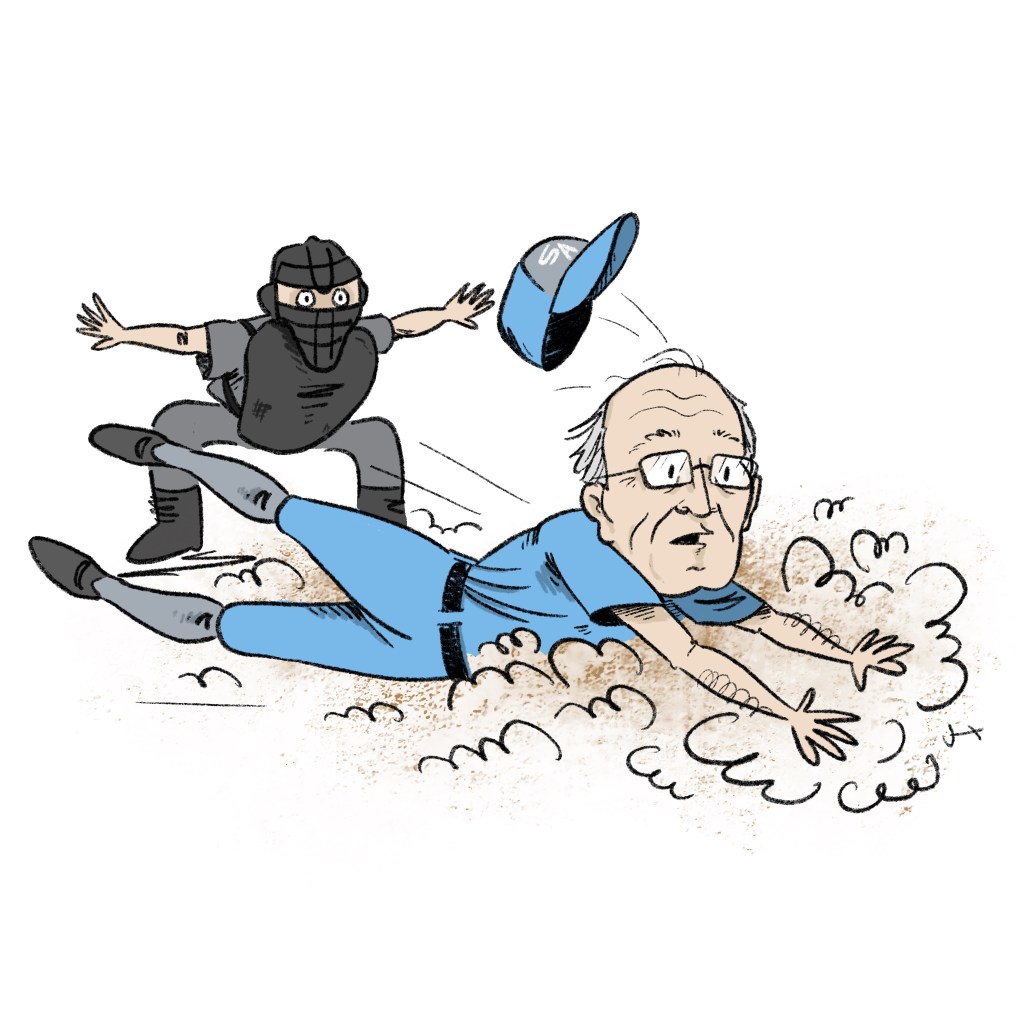
Hairy Harry Marries Merry Mary
by Ivan Brown
There was a quiet street in Toronto many years ago, not far from the bustle of downtown, that was lined with little shops that did a modest business. One of those shops was operated by a butcher named Harry. Over the shop was a fading sign with its simple name: Butcher Shop. Harry had wanted for a long time to adopt a more imaginative name, but up to this point just the right one had not popped into his mind.
One fine spring day, the space next door to the Butcher Shop was newly occupied by a cheerful florist named Mary, who filled her shop with flowers and plants that spilled out all over the sidewalk outside. Mary was always happy and smiling, and the sun seemed to shine a little brighter along the street now that she was there. A few days later, some workers came by to install a sign over her new shop: Merry Mary’s Flowers.
Now Harry was not without a wry sense of humour – for a butcher, that is – and he began to think that what his shop really needed was a name to complement Merry Mary’s Flowers next door. After some thought, an idea formed in his mind. He was a gentleman whose head was almost completely devoid of any hair whatsoever, so he thought it would be amusing to name his shop Hairy Harry’s Butcher. And so the same workers were commissioned to erect his new sign.
Despite the moderate excitement the new shop names generated on the street, business at Hairy Harry’s Butcher and Merry Mary’s Flowers did not flourish. They tried everything. They even tried wearing costumes, Merry Mary in brightly-coloured sundresses patterned in common garden flowers and Hairy Harry in a variety of very hairy gorilla suits. The costumes were robustly commented upon, so Harry and Mary continued to wear them, but sadly this did not help boost sales very much.
One day, Mary came by Hairy Harry’s Butcher with an idea that was just too ridiculous for Harry to resist. “We should put our products together to create a new sensation,” she said.
That is exactly what they did. They put meat and flowers together. They advertised their new products, and soon a buzz emerged. The mayor of Toronto dropped by, ate a braised sausage and yellow daylily sandwich, and said “Wow!” on television for the evening news. Soon their fame spread and Harry and Mary were kept as busy as honeybees in a field of flax thinking up new ideas for their eager customers. The Canadian Ambassador to Denmark heard about them and flew in to try the chicken breasts sauteed in buttered marigold petals. The Vice-President of the United States purposely sought them out to buy the lamb chops barbequed with nasturrium flowers and seasoned with roasted bee balm leaves. The Secretary-General of the United Nations went out of his way to fly into Toronto to try the rump steak marinated in pansy oil and topped with pickled honeysuckle blossoms.
Business was blooming.
But they were not content. Success had made them greedy for more. “There is one thing to make business even better,” Harry suggested to Mary one evening. “We should get married.” The very next day, they put a large sign outside their shops that read:
COME AND CELEBRATE
August 31
HAIRY HARRY TO MARRY MERRY MARY
Following the wedding, 10% off all merchandise
On the blessed day, Harry stood in his shop amid his finest t-bone steaks and pork livers. He was dressed in his very best hairy gorilla suit, which was adorned only with a simple bow tie. By Harry’s side stood a local minister of the cloth, his fingers quivering on his holy book betraying his excitement to begin the nuptials. A lone piper, accompanied only by a lone drummer who was accompanied only by a lone fiddler, had been engaged to sound out the wedding march as Mary emerged from Merry Mary’s Flowers in her bright yellow bridal gown and carrying a stunning bouquet that advertised her most beautifully coloured and perfectly rounded blooms.
A huge crowd had gathered outside to partake of the excitment. The mayor of Toronto was in attendance. The Canadian Ambassador to Denmark stood proudly nearby. The Vice-President of the United States tried to blend seemlessly into the milling crowd. The Secretary-General of the United Nations was caught on a television camera wiping a gentle tear from his cheek.
The wedding was an enormous success. As soon as the final “I do” was sealed with a modest kiss, the shopping spree was on, and within the hour there was not a single piece of withered stewing beef nor a single stalk of wilting daisy to be seen in either shop. All were sold.
And in this way the financial stability of both shops was secured.
If you should wander down that same street in Toronto today, you would still see the proprietors of Hairy Harry’s Butcher and Merry Mary’s Flowers serving the loyal customers from their neighbourhood. The signs have faded considerably, and of course Harry and Mary have long since retired. The shops are now operated by their children: Hairy Larry, Merry Kerry, Hairy Barry and Merry Sherry.
They try their best, but it’s not the same now. Oh, the current mayor does drop in from time to time, but no Ambassador, Vice-President or Secretary-General has been seen for many years. No, nothing on that quiet Toronto street has been quite as grand as the day Hairy Harry dressed in his very hairy gorilla suit to marry Merry Mary wearing a bright yellow gown and carrying a bouquet of beautiful blooms.

If Oscar Wilde Had Only Known My Great-Great-Grandfather
by Ivan Brown
Earlier today, I watched a 2002 movie version of Oscar Wilde’s popular play The Importance of Being Ernest. I had seen this play on stage and screen several times over the years, but it is always fun to see two young men pretending to be named Ernest, in their most unearnest manner, and creating much clever comedy and romantic chaos along the way.
I could not help thinking, though, what contributions to the literary world Oscar Wilde might have made had he only known my great-great-grandfather, Charles McDonald. Charles, like Oscar, was in his prime during the 1890s, but as he was a poor farmer living in a remote corner of Grey County, Ontario, the two men’s paths never crossed.
Pity.
You see, just as the two young women in Oscar’s play had a particular fondness for the name Ernest, Charles had a particular fondness for the name Catherine. There was some logic to this, as his own mother was Catherine McDonald, so his neighbours and relatives were not inordinately surprised when he wooed and married a young maiden named Catherine, making two Catherine McDonalds. In the fullness of time – actually, in too short a time in the opinion of the local gossips – Charles and Catherine had a beautiful baby girl, who, after consideration, was christened Catherine. So there was mother Catherine, wife Catherine, and daughter Catherine.
Sadly, Charles’ wife Catherine died, but happily – after a suitable few months of mourning of course – Charles ran across a widow named Catherine McDonald, whom he promply married. So, now there was mother Catherine McDonald, late wife Catherine McDonald, current wife Catherine McDonald McDonald, and daughter Catherine McDonald. You can look them up yourself and find them all tripping over each other on ancestry.ca
One winter morning, it occurred to Charles that he had no horse to pull his sleigh, known as a cutter in those days, to get to the village store to buy supplies. So he trudged through the snow to a local animal sale and when he saw the name of a mare for sale on the program sheet, he bought her sight unseen. Her name was Catherine.
Charles brought Catherine home and tied her in the stable beside their prize cow, Catherine, and fed Catherine and Catherine some hay. Then he proceeded to the henhouse where he gathered ten eggs from his twelve hens, each one named Catherine. Back in the house, he presented the ten eggs to Catherine, Catherine, and Catherine. “My,” said Catherine, “Dear,” said Catherine, “Well,” said Catherine, “it seems that two Catherines did not lay today.”
The next morning, after Charles had milked Catherine and gathered two eggs from the two deliquent Catherines, he hitched Catherine to the cutter in readiness for their trip to the village store. Catherine, Catherine, and Catherine squeezed in beside him and off Catherine trotted down the snow-covered lane. It was a scene highly reminiscent of a Currier and Ives Christmas card, as their dog, Catherine, chased along behind them, temporarily forgetting its constant state of gender identity confusion because he was a male and could not figure out why he had a girl’s name, Catherine.
To complete this idyllic scene, the housecat, Catherine, purred on the windowsill as she watched Charles, Catherine, Catherine, and Catherine, pulled by Catherine and chased by Catherine. But Catherine was purring not in contentment, but with the dismay of a mother cat who can’t tell which of her four kittens is which because they are all named Catherine.
Oh, the shame of it all that Oscar Wilde never even heard of my great-great-grandfather Charles McDonald and his bevy of Catherines. What fame and fortune he would surely have risen to if he had only had the opportunity to complete his next play, The Importance of Being Catherine.
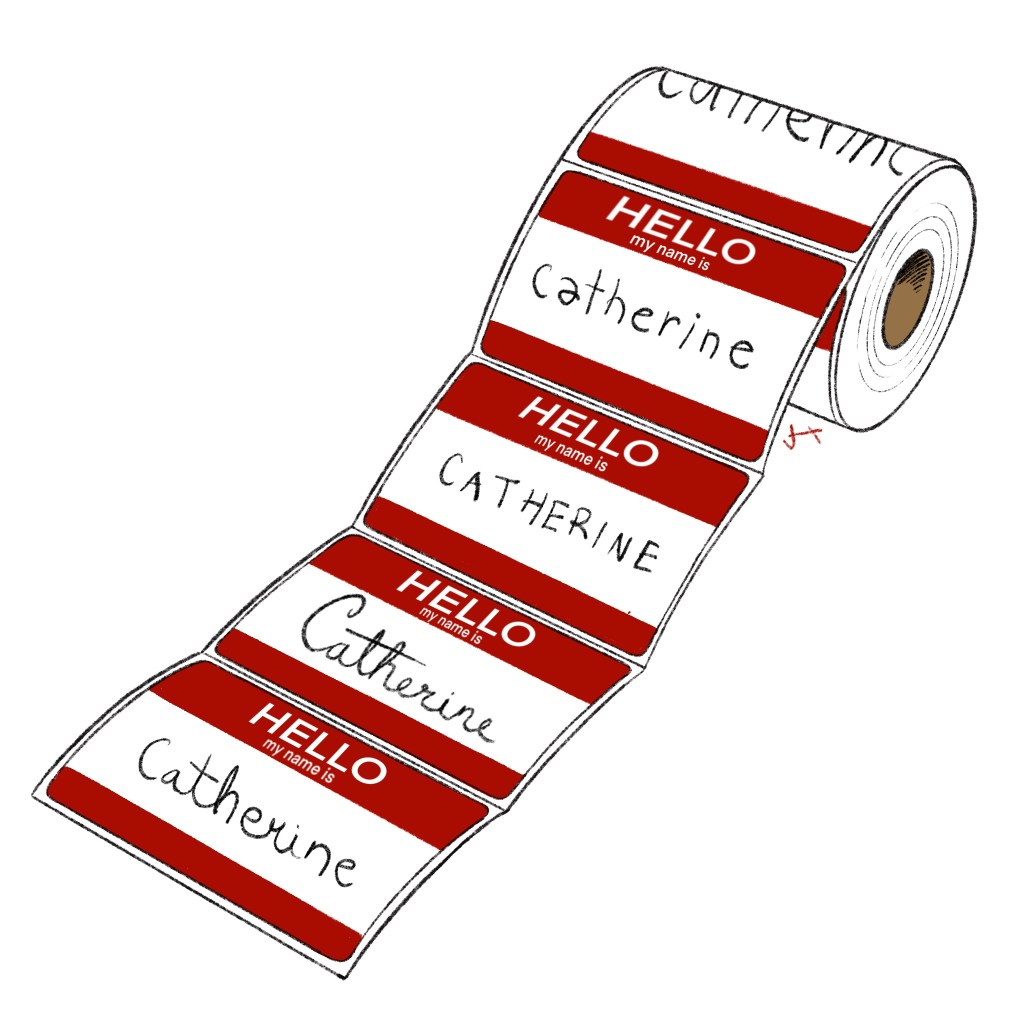
Why Young Career Women
Jog With Pony Tails
by Ivan Brown
One advantage of being lazy, as I am, is that you can sit on your front porch evening after evening watching your neighbours. Weeding their flower beds. Mowing their grass. Pushing their babies in strollers. Jogging.
It’s all very satisfying and I observe so much. As the legendary Yogi Berra famously noted, you can observe a lot by just watching.
I have observed, for example, that great numbers of young men, looking a bit hassled, can be seen any evening of the week pushing babies in strollers, while almost equal numbers of young women, looking like they have careers lucrative enough to afford the most fashionable sports outfits, can be seen lazily jogging by. As if this gender role disparity weren’t enough to arouse my curiosity, I also observed, just by watching, that the women joggers always sport pony tails. I began to ponder this mystery: why the perpetual pony tails?
The simple explanation, I foolishly thought at first, is that all young career women have long hair and they tie it in a pony tail at the backs of their heads so it doesn’t flop in their eyes as they jog. But, no, I soon realized, I should not buy that. Career women today are much too canny for such a simple explanation. Over several evenings, I began to understand the real reason.
On their way home from a busy career day, all young women today turn their attention to planning how to get away from their husbands for most of the evening. They start scheming as soon as they grab the first bus seat they see, leaving to stand where they might the tired construction workers who have stood and held their shovels in an upright position for almost the whole day and the exhausted teenage students who are still yawning from having to sit through an actual chemisty lesson. By the time they reach home, today’s young career women are ready with an evening to-do list for their husbands. Then they pour themselves a hearty glass of wine and sit down well out of sight on the patio, feet up.
After a time, their husbands arrive home and read the first two things on the to-do list: 1. Pick up the baby from daycare. 2. Go to the store and buy red peppers, broccholi, and chicken thighs for dinner.
So, innocently, back out their husbands rush to get the baby and the food. At first, there is just a trickle of them, but as I sit there on my porch evening after evening, I observe the sidewalks swelling and blossoming with dutiful husbands on their way to and from daycares and food stores, pushing their strollers up the street, then down the street, then sometimes sideways along the street. The street fills and is soon overflowing with young fathers pushing strollers in every direction imaginable.
Some even seem to have remembered to put babies in them.
Meanwhile, the women are getting anxious. It is nearing the time when their husbands will be getting home with the baby who is almost certain to interfere with the last few pleasurable sips of wine. It is time to move on to the next stage. If all works well, they will not have to see their husbands until 7:30 and they will not have to see their babies at all. They add two more things to the to do list: 3. Cook dinner. 4. Oh, and feed the baby. P.S. I have gone jogging.
There is just one problem. Their husbands are not home yet, still roaring up and down the neighbourhood sidewalks pushing their strollers here and there, and the women are fully aware that when they go jogging there is always a real danger that they will run into their own husbands pushing their own babies along in a stroller. Oh dear!
Now, as you recall, all young modern career women have long hair, and their husbands have never actually seen any of their full faces, since 90% of them have hair covering 91% of their faces 92% of the time. So, to disguise themselves, the women pull their hair back into pony tails and go jogging. They jog right past their unknowing husbands who do not even recognize their bare faces. As soon as they have left their husbands in the dust, I observe in the distance that the women find a park bench and sit down to enjoy the evening air, the fragrance of the blossoms in the bordering flower beds, and the happy twittering of birdsong eminating from the nearby cedars.
Ah. This is peace at the end of a busy day, I think I hear them murmering.
Later, still sitting on my porch, I observe them meandering back home at 7:29. Before entering their houses, they hurriedly ditch the pony tails then burst inside. I imagine their kitchens to now be redolent with the aroma of cooked red peppers, broccholi, and chicken tighs. The baby has been fed, diapered, and put to bed. Their husbands slowly remove their aprons and oven mitts, and wait to see if they might get a hello kiss.
Yes, I have watched a bit lazily, but with care. And I have observed that, for young career women today, the pony-tail-while-jogging disguise must be worth its weight in gold evening after evening.
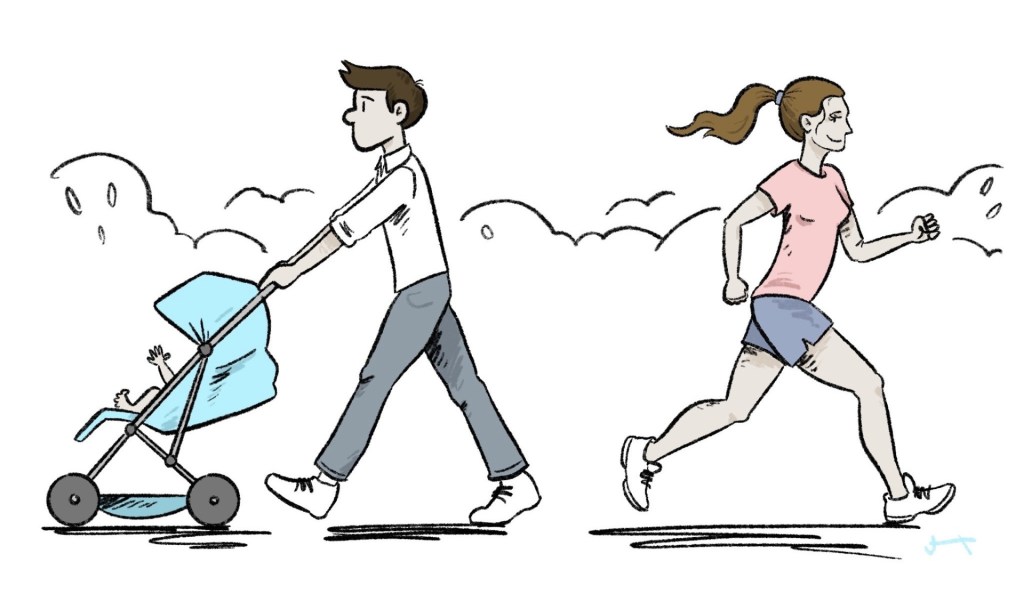
How I Became An Olympic Flagpole
by Ivan Brown
One day in early August, I was repairing the floor of my front porch when it occurred to me that I needed a break. I set aside my hammer, saw, and screwdrivers and sat down on the steps. As the summer Olympic games were in progress at the time, I decided to check some of the results, hoping this would prolong my break by thirty minutes or more. To my surprise – and with great floods of national pride swelling in my heart, I must say – I noted that Canadian athletes had won gold medals in both women’s and men’s Hammer Throw.
Wait a minute. Throwing a hammer is an Olympic sport?
Yes.
I was totally taken aback to learn this. After all, my dad had once reprimanded me very sternly and warned me in no uncertain terms that I was absolutely not to throw the hammer at my sister ever again, no matter how annoying she might be. So, forgive me, but I kind of thought throwing a hammer was a definite no-no.
But apparently the Olympic pooh-bahs, the IOC members, think otherwise.
If they think throwing hammers around is so sporting, I wondered, what other so-called games might they have in mind for the future? I had to find out. The next day, I flew to Switzerland, camouflaged myself with an amply-sized tree branch that I sawed down in an alpine forest, and hid in the park across the street from the head office of the IOC. It was fortunate that I had chosen a windy day, for when a large gust of wind began blowing dust and leaves around, I was able to slither across the street, totally unnoticed behind my branch disguise, and up to the main door. I did not know exactly where the IOC members would be meeting, so with a half-emply bottle of something I had found under a park bench, I bribed the security guard to lead the way up to the room, suggesting he needed to open a window as wide as he could. Off he went, deserting his post, and I took the opportunity to slither along behind him up the stairs, still fully camouflaged as leaves and twigs. He looked around a few times as we proceeded, perhaps wondering why a branch was following him and undoubtedly vowing to cut down a bit on the number of times he tipped the bottle during work hours, but we both continued onward.
Once we were in the room, I had to change my camouflage. It would just be silly to pretend I was a tree branch inside a meeting room. So, while the security guard made his way over to the window, making the IOC members look the other way, I tossed the tree branch under a side table and quickly wrapped myself in an Olympic flag that happened to be hanging on a stand by the door. The guard opened the window wide, as instructed, and left the room to resume his duties at the front door. Or look for his half-empty bottle. Wrapped in the flag from head to toe, I was ready to overhear the discussion in the room. As I had anticipated, they were debating the merits and demerits of new sports to introduce, but I was a bit too far away to hear clearly exactly what they were saying. I got my chance to move closer when a huge gust of wind blew in through the open window, which made it seem totally natural for me to flutter across the floor – in the manner of any fine flag fluttering in a strong breeze – until I was almost beside the table. “What the…?” wondered the sedate ladies and gentlemen assembled, but they soon returned to their debate.
I wished to take some careful notes so as not to miss a thing, but the light was rather dim under my disguise. So I had to hold my pen and paper outside the flag and jot down my comments as I stuck my head out through the opening.
“May I interupt for a moment?” asked one woman, her head tilted markedly to the left. “Why is the flag holding a pen and paper and taking notes?” The meeting Chair looked puzzled for a moment. “Hmmm,” he said, “there is nothing in our by-laws that prohibits a flag from taking notes, so we will have to allow it.” All immediately concurred.
“The Hammer Throw is good,” one man said, “but throwing a hammer as far as you can and wondering how many people it might hit before it lands who-knows-where has grown a bit, you know, dull. We need something bolder.” There ensued several suggestions of sports based on screwdrivers and screwnails, but these went nowhere. Then the talk really took off with the suggestion of providing athletes with dull saws, which they would have to sharpen as quickly as they could on old-fashioned grinding wheels, then race around a track, stopping every 30 metres to cut through a 30 cm board until they had sawed through boards made of the wood of every tree that grows in the nations of the competing athletes. There was great cheering when this was proposed.
But no. Appealing though it was, this was not the sport to be adopted that day. The final decision was much better. At the sound of the starting bell, the athletes would have to hammer 200 nails into a piece of oak to form the shape of the Olympic rings, run out and find a sheep, shear it, wash the wool, card the wool, spin it into yarn on a spinning wheel, dye the yarn in the Olympic colours, then weave the dyed yarn through the nails in the shape of the Olympic rings to form artistic patterns. “It will be our masterpiece,” declared the IOC meeting Chair triumphantly, “a sport that features speed, multiple talents, and the creation of beauty.” Loud shouts of “three cheers” rang from the open window of the room.
“This is sure to be so popular that we should have the gold medal winner displayed in front of an Olympic flag!” one woman suggested when the din had subsided. “And we have the very flag right here by our table. We can use this one. It is even fluttering on its own Olympic flagpole!”
And thus it occurred. I became the Olympic flagpole in the display. I am still standing there inside the flag, no longer needing to take notes, but wondering if I will ever get my porch floor repaired.

My “Triathalon for The Lazy” Becomes a Success
by Ivan Brown
My friend Aaron and his family all enjoy athletics. I sit in awe listening to their many exploits, because their idea of a fun day is to be out jumping around like bunch of jackrabbits on steroids, while mine is to sit and rest like an old frog sunning itself on a lilypad. With a glass of wine, usually, although I have never been really sure if frogs drink wine or not.
I am fascinated by what Aaron’s family find fun about all their physical activity. Take their love of triathalons, for example. They purposely choose to pay sizable portions of their hard-earned money to take part in organized triathalons, where they run 5 km, swim 400 m, then bike another 5 km. Or, Aaron has assured me, they can also elect to bike 10 km, swim 2 km, then canoe 5 km. Afterward, there is comradeship and merriment from the various participants, he beamed. And a bit of sweat too, I thought. Fun, fun, fun.
I just don’t get it.
But my ears perked up when Aaron informed me that a local triathalon company runs these events as a profitable business. They set out the courses, provide free water, and charge every person an above-modest entry fee. That gave me an idea. There was money to be made here, so why not extend the fun of triathalons to lazy people like me? The very next day, I set to work. Okay, I hired an assistant to set to work, but using my brilliant idea: a Triathalon for The Lazy.
We advertised our endeavour, and on the morning of the triathalon great numbers of people arrived by car or taxi – no one walked or biked of course – and eagerly paid their entry fee. By the sign-in desk was a large table, amply supplied with complimentary coffee and donuts. After some time, a balloon was released that floated lazily upward, giving the participants to understand that they could begin the first lap of their triathalon. An arrow indicated that they were to stroll – when they chose, naturally – along a country dirt road as they enjoyed the sight in the nearby meadow of wild grasses, blue chicory, and white daisies swaying and fluttering in the breezes. If the strain of walking became overly draining, they could board a small shuttle bus to carry them forward, and if the effort of boarding and deboarding the shuttle bus made for too much stress on their calves and ankles, the bus driver would kindly lift them down at the 100 metre mark, their first stop. Here, participants could linger and rest for a while on conveniently provided benches. Servers came by offering glasses of refreshing lemonade to soothe their parched throats.
The second lap of the triathalon, a full 200 metres, featured an amble alongside a babbling brook, where herons nodded as they waded in the shallows, frogs croaked their merry tunes on their lilypads, and fish lept from the waters in great athletic arcs as if they were saying hello. Once again, if those walking became distraught from the physical effort, they could board an old-fashioned horse-drawn buggy to carry them to their next stop. Here, they were delighted to find an ice cream stand where they were served double cones in their choice of fourteen flavours. Afternward, they could stretch out for a while and relax on one of the numerous cots placed under the shade of a neighbouring maple tree. A gentle cowbell sounded every 30 minutes to remind those who nodded off that there was still one more lap in the triathalon.
The third lap of the triathalon, at 300 metres, was by far the most burdensome. To camouflage the exertion required to accomplish this long stretch, my assistant had set out a trail that wound like a series of S’s through a pine grove. Dappled sunlight filtered through the gently-swaying branches above and sparkled on the pine cones strewn about on either side of the path. Robins, cardinals, and red-winged blackbirds chirped in harmony and in time with the footfall of the amblers, accentuated by the occasional call of a crow or blue jay intent on welcoming us to their neighbourhood. There were no rides to be had on this strenuous lap of the triathalon, but my assistant had wisely placed fallen logs along both sides of the trail for sitting and gathering up strength to carry on. Into the fallen logs, he had carved flat “trays” every 50 metres that were supplied with an assortment of locally-grown wines and little plates of exotic crackers topped with various goat cheeses and six kinds of raspberry conserve. By this means, most were able to overcome their weariness and make it to the end of the triathalon where, sitting comfortably around umbrella tables on padded chairs, sipping an afternoon cocktail and nibbling on delicate crabmeat sandwiches, they were awarded certificates of achievement.
A few days later, I met Aaron for a morning coffee. At least I had coffee. He had chamomile tea. “How did your triathalon go last weekend?” I asked.
“Great! It was so much fun and we had an excellent turnout – 52 people.”
I just smiled as I took another sip of my coffee and offered to treat him to a bran muffin. I could easily afford it, for I had realized a very healthy profit from the 252 people who attended my Triathalon for The Lazy.
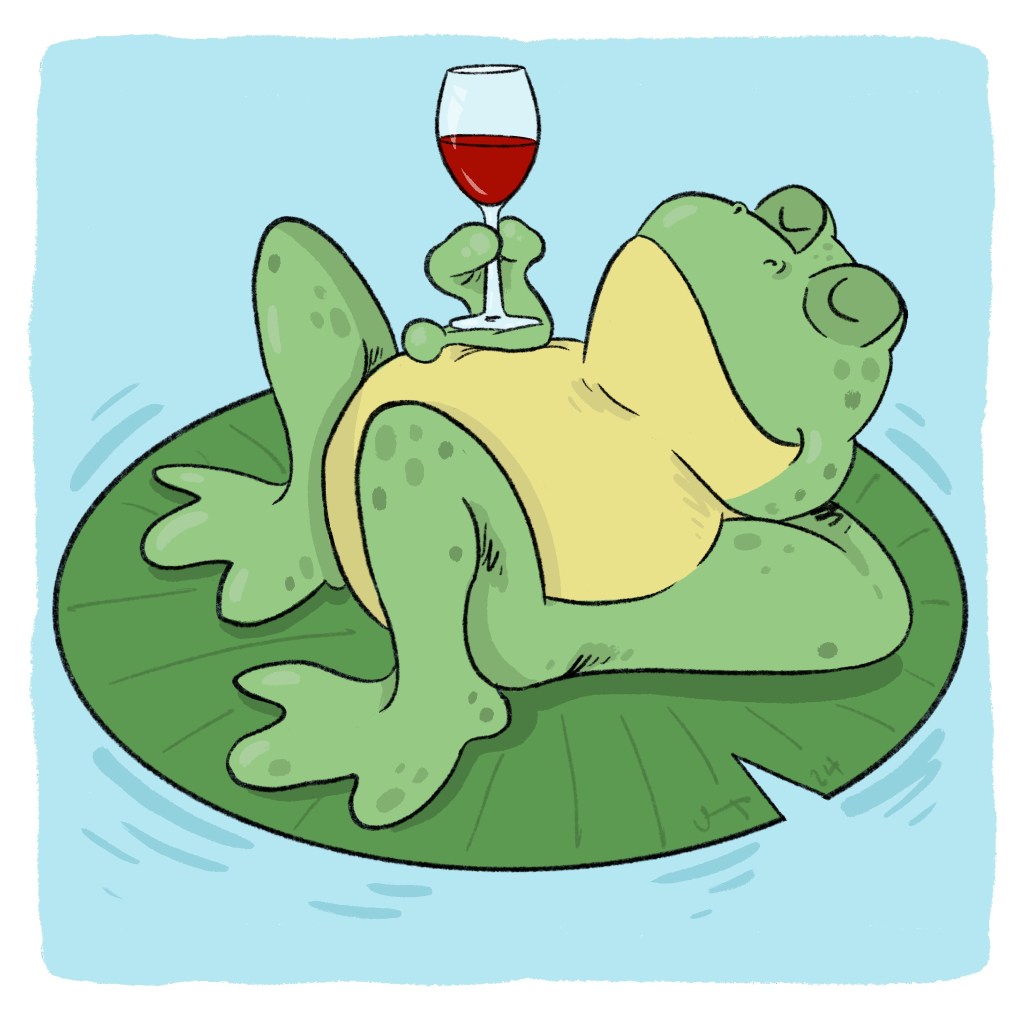
Shelley Brooks Is Awarded An Honourary Plaque
by Ivan Brown
Shelley Brooks had an unusual job. She was an animal control officer at an Adult Naturist Ranch. All her close friends and family members assumed this meant that she led horseback tours for adventurous vacationers looking out for wildlife that inhabited the local natural environment.
But no. That was nowhere near the truth of it. The Adult Naturist Ranch was a vacation destination for adults who enjoy throwing off their usual outer layers and living for two weeks in their natural wear-withall, or, more accurately put, their natural wear-without. In short, they were nudist.
So no, Shelley’s vocation did not involve acquainting vacationers with wildlife, as you might have expected and others were led to believe, but rather keeping wildlife away from the unclad holidayers. After all, a woman of some refinement does not wish to meet up with a curious coyote as she strolls about in her birthday suit admiring the stars in the night sky. Shelley is needed to distract the curious beast by offering it a slice of bacon or a recently-deceased mouse. And it is commonly understood that it is unwise to encounter a hungry chipmunk searching for nuts when the gentlemen are engaged in an outdoor volleyball match and their intimacies are bobbing about in the breezes. Shelley really has to shoo those creatures away by throwing acorns at them as they retreat. And certainly one does not want to shock a wandering skunk that might glance up to see one bending over to pick a wild strawberry to savour. Shelley is absolutely needed to steer the dismayed critter in another direction before it panics and perfumes the foreign globes that look so threatening.
I think you are now gaining an understanding of the importance of Shelley’s life work.
Now Shelley had her office in a trailer that sat in the middle of a meadow adjacent to the main lodge of the ranch. The trailer was equipped with windows on all sides so that she might keep a close watch on the wildlife and keep careful records of those that were stunned into immobility when they saw the ranch guests strutting here and there au naturel and those that scurried off in fright. It was the former that Shelley would have to use every bit of her ample creativity to distract.
But there was one problem with having an office in a trailer: it had no foundation. Burrowing wildlife were inclined to dig their homes underneath where they were safe from their predators and where they could enjoy the warmth seeping through from the floor above in the cold winter months. For these very reasons, the basement of the trailer became home to a family of skunks.
Shelley tried everything in her arsenel of tricks to get rid of the skunks. After all, she was the expert. Every evening, she played Irish jigs loudly and Celtic-danced her way up and down the floor, as well as across and around, in an effort to annoy the skunks into moving. Shelley was never entirely sure if it was her imagination or if it were a real thing, but she thought the skunks just banged on their ceiling
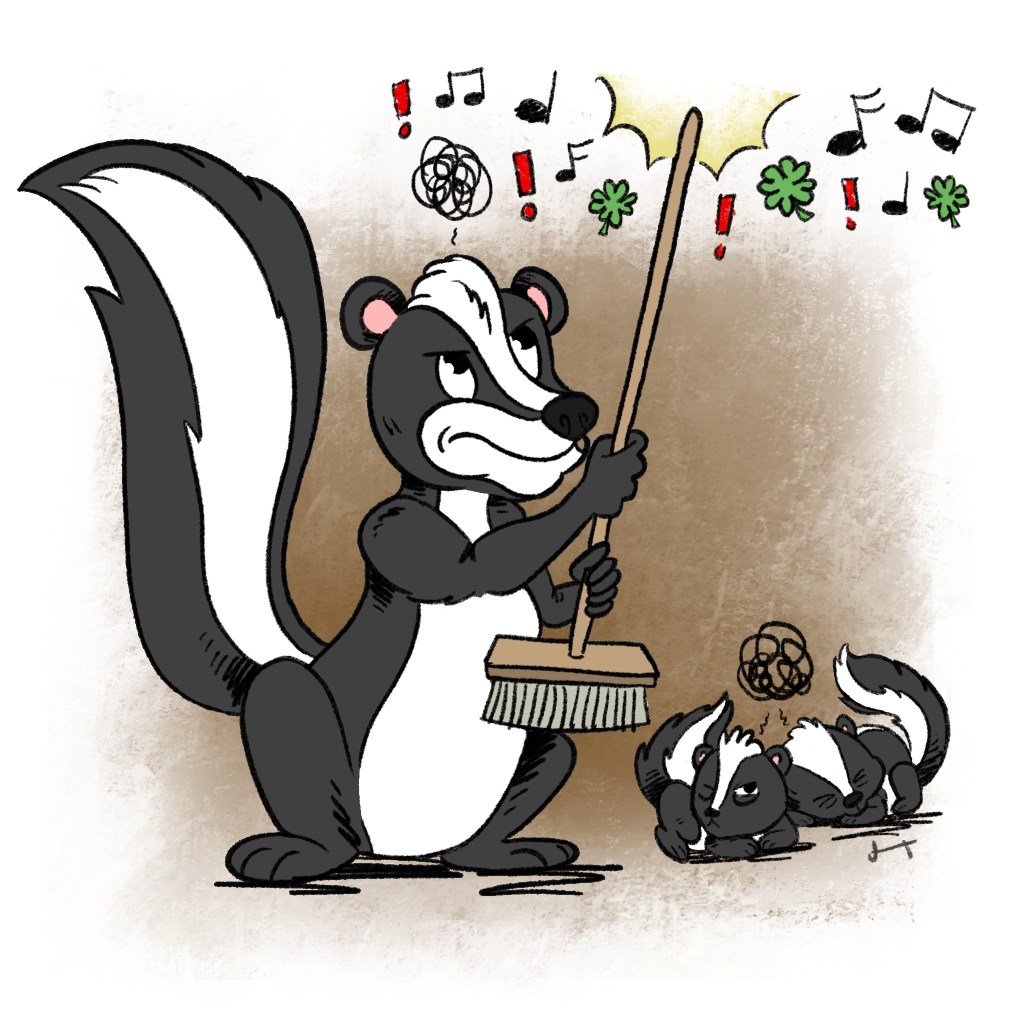
with little skunk-brooms. Next, she set up a pole vaulting station outside the skunks’ hole and invited the ranch’s bare-skinned guests to fly over it in an effort to scare the intruding pests off with flip-flopping shadows. But again, the skunks were unmoved and – again it is possible that she might have imagined this – they just put on their sunglasses and ambled lazily by. No matter what she tried, the skunks would not leave. After many concerted attempts, Shelley gave up and admitted defeat, and resigned herself to live with the skunk family as neighbours, she above and they below, for the next number of years.
In the fullness of time, Shelley reached the age when it was appropriate to retire. Her employer, the ranch owner, thought fit to do something in her honour. She bought a card at a discount store and baked a cake, topped with a thin layer of icing and the message: Thanks For The Frights, Shelley Brooks. She took up a collection from the guests who, over the years, had benefitted so much from Shelley’s work. With the $8.42 she collected she was able to afford a small plaque. The plan was to nail the plaque to a post somewhere on the ranch that would name something in Shelley’s honour, and that would be an ongoing and living legacy celebrating her long and dedicated career. But, where to nail up the plaque?
After considerable thought, it was decided. On the day of the awarding, the owner and all forty current guests, uncovered to the core as everyone was, gathered around in a circle outside the trailer. A heavy cloth was covering something attached to a short post, but Shelley could not see what the surprise would be. A brief speech was orated by the owner and graciously accepted by Shelley. Happy hands were clapped by all in appreciation. Tender tears were shed in joy by everyone present. The owner slowly unveiled the plaque beside a small hole in the ground outside the trailer, while the guests applauded and cheered. The plaque read: The Shelley Brooks Honourary Skunk Hole.
Should People Who Are Equinely-Inclined Have Their Own Country?
by Ivan Brown
There is a man who lives down the street from me who has a face that looks very much like a horse. Perhaps it is rude, I’m not sure, but every time I sit on my porch and see him strolling by on his morning walk, I involuntarily turn my ear somewhat toward him, wondering if I might hear a bit of neighing or if I might detect the clip-clop of his feet on the pavement. I try not to do it, but I can’t seem to help myself.
Yesterday, after he passed by I began to wonder how many people on the planet Earth have faces that look like horses. This man is the only one I see in my neighbourhood of about 500 people, so with the help of my calculator I figured out that, at this same rate, there would be 14 million people among the world population of 7 billion who have faces that are equinely-inclined. That’s a lot.
It is against my ethical principles, as well as my abundant inclination toward human kindness, to wish to segregate people, especially those who have distinctive looks, but this high number does make one wonder if the 14 million people who have faces that resemble a Clydesdale or an Appaloosa shouldn’t have their own country. A place they can call their own. A prairie habitat seems most suitable, and perhaps Canada could donate a large swath of Saskatchewan or Russia could donate a territory of equal size on its windswept Steppes. In my imagination, I am thinking any environment that easily fosters the growth of hay and oats would do, but again those thoughts may be somewhat rude.
I am not sure what their country would be called, but the one thing I am certain of is that it should contain the word horse. Horsefeathers, of course, would not be appropriate for their new land as that word suggests frivolity and there is absolutely nothing frivolous about this. But if they should decide to focus primarily on the more serious business of agricultural development, they might call their country Horseradish and specialize in growing great fields of horseradishes. If they should specialize in laundry, on the other hand, they might opt to adopt the name Clotheshorse. If they decide it would be more profitable to become a popular tourist recreation destination, they might settle on calling their beloved homeland Hobbyhorse, Horseplay, or perhaps even Horseshoes. All are highly appropriate, but let’s go with Horseradish.
One thing is for sure: last names would be easy to allocate to the equinely-incined citizens of Horseradish. And this would make communication so simple. A gentleman on his morning walk would just have to look at the horse face of the woman approaching him and say, “Good morning Ms. Belgian,” and she would have no trouble remembering his name because she would just glance at his sleek facial bearing and say, “Good morning Mr. Arabian.” It is such a good idea to wear your name identity on your face.
Of course, jobs would have to be tailored to particular horsefaces in Horseradish. Certainly an American Quarter Horse could not be expected to accept any job that was half time. A Pinto would look totally out of place in the boxing ring. And it would obviously be wrong to ask a person who resembled a Thoroughbred to plough a field, just as it would be injudicious to ask someone who looked in the mirror and saw a Percheron to twirl about on ballet toes. That all seems perfectly clear.
You might be wondering what kind of horses the citizens of Horseradish would ride, should they wish to take a recreational trot through the countryside on a weekend afternoon. I guess they would be mounted on horses that have faces that look very much like a person. Perhaps not movie idol glamorous looks, but certainly features that appear more like modern folks than Homo habilis or Homo neanderthalensis. Yes, people in Horseradish with the countenances of a Standardbred or a Shetland would surely be riding on horses that look remarkably like today’s Amandas and Brendans.
I am feeling confounded as to whether or not I should mention any of this to my horse-faced neighbour who lives down the street. I would not want to offend him. Nor would I want him to think badly of me. After all, as far as I know he has never thought of me as anything but that monkey-faced man who sits on his porch with one ear turned somewhat toward him as he strolls by on his morning walk.

Darwin Has His Own Version Of Evolution
by Ivan Brown
I know a man named Darwin who poo-poos evolution as we have come to know it. This seems strange, as he has the same name as the famous scientist Charles Darwin. In fact, his own mother had quoted liberally from On the Origin of Species, Charles Darwin’s 1858 argument for evolution, in her undergraduate biology thesis. She had been so intrigued by the whole idea that she named her firstborn – and only – son after Charles.
But her son, Darwin, just does not buy that evolution is one of nature’s wonders. Quite the opposite.
“It does not really make sense,” he said to me one morning over coffee and snacks. “If evolution is so perfect, why would it devise a system where the only way for carnivors to survive is to eat other perfectly-adapted animals, and the only way for herbivors to survive is to munch on perfectly-adapted plants. For that matter, the only way for plants to survive is to suck life out of the perfectly-adapted earth and sop up the perfectly-adapted rain. They are all just eating each other. What kind of a perfect system is that?”
I had no answer.
“So, what system would your have devised?” I ventured, biting cautiously into my egg and sausage biscuit.
“Obviously, one where all plants and animals – and even people – rely on nothing but solar energy to grow and thrive. But, to keep things simple, let me just tell you how it works for people.”
“Okay…” I said, doubtfully. But a look of pedantic assuredness had already come over Darwin’s face.
“As soon as your baby is born, you simply set it on a window sill in a sunny spot beside the geraniums and begonias, go about your life, and wait for it to grow. When your older kids seem a bit listless, give yourself a break and send them out to play in the sunshine for the whole day. Their energy and mood will soon perk up, and so will yours. If your wife needs a bit of a lifter-upper in her life, send her off to canoe on a sparkling lake for a week with the remnants of her high school gal-pals. By the time she paddles back home, she will be right as rain. Simple as that!”
“Sounds perfect,” I exclaimed in amazement, “but does it always work out without anything going wrong?”
“Of course, you can get too much sunlight at times, and then you have to take remedial action. Say you forget that you had set your new baby boy on the window sill, and a few weeks later you come by to water the geraniums and you see that the constant sunlight has made him grow so fast that it looks like he needs to start shaving already. Well! You just shove him under the begonia leaves for a few days and the shade will soon bring him back to normal size. Or maybe when you sent your kids outside to play to get rid of them for a while, you neglected to tell them you sold the house and were moving that day. When you drive by a month later, you hardly recognize your own children because they have grown so tall from all the sunshine that you are not sure you will be able to get them in your new front door. Easy. Just put them in a dark corner of the garage for a week or so and they will shrink down to their former height. And I hate to think how all that sunlight sparkling off the lake might affect your wife and her friends on their canoe trip. By the time they get home after seven days of non-stop solar rays, your wife will be as fat as a pregnant walrus eating its way through a cheesecake shop. So, just lock her in the hall closet – the one with the wide door – for a couple weeks and she will be ever so grateful to you for being on her side.”
“Wow,” I said, munching on another bite of my egg and sausage biscuit, “I never thought of it that way. But wouldn’t we miss the pleasure of eating?”
“That is the beauty of my system. We evolve so that sunlight tastes delicious. Face directly into the sun, open your mouth wide to let the sun shine in, wiggle your tongue, and it tastes like stuffed turkey with gravy. Turn your head a little and you taste deluxe pizza, and tilt your head the other way and you get butter chicken curry. You will soon get the hang of it.”
“But what about people who live in the far north where the sun doesn’t shine for months at a time?”
“That did present a challenge for people in my system. They had to design several series of giant mirrors that reflect sunflight from one to the other, up and down the whole lines from the equator right to the most northerly outposts. People who live in Greenland and Baffin Island simply line up and take their turn standing in front of the final mirror for fifteen or twenty minutes every day and, what do you know, they are energized enough to shuffle back home and tut-tut with their neighbours about the bad old days when they actually speared seals and snared arctic hares and were forced to eat them to survive.”
“How horrible!” I blurted out involuntarily. “Your system is so much better! It is bound to win out in the struggle for survival of the fittest system.”
“Ah, but in my system, there is no struggle,” Darwin beamed with confidence, “we just stretch out on our lawn chairs in the sun for half an hour and chuckle over how silly Charles Darwin’s idea of evolution really is.”
Shelley Brooks Gets A Job At The Bank
by Ivan Brown
When Shelley Brooks retired from her illustrious career of scaring wild animals away from nudists at a nudist resort, she moved to the small town of Buffalo Horns in Saskatchewan. At heart, Shelley was a small town girl so she bought a small house sight unseen in the heart of wheat country, packed up all her Toronto belongings, and moved.
You might wonder how Shelley Brooks selected Buffalo Horns as the place to live out her retirement years, when there were so many other alluring towns to choose from in Saskatchewan. The reason was that the town boasted two babbling brooks and that matched her name, if not her personality. That alone would be enough to convince anyone. But, more than that, when seen on a map or from an airplane flying overhead, the two brooks took on a shape that looked remarkably like two buffalo horns. For Shelley Brooks, that was irresistable.
The townsfolk are very friendly to newcomers in Buffalo Horns, friendly beyond the wildest imagination of anyone who has lived in Toronto even for a short period of time. There was just one small problem: everyone she met asked her what her name was. And when she replied, as one might expect, by saying “Shelley Brooks” they went as pale as ghosts and rushed off as fast as they could. You see, there had been another Shelley Brooks who had been very well known in Buffalo Horns, and who had only very recently vacated her earthly body to assume her well-deserved heavenly reward. The late Shelley Brooks had been the only teller at the only bank in town from the day she graduated from high school with the highest mark thought possible in bookkeeping until the day she retired from the bank on her 87th birthday. She was of course discrete beyond reproach, but she knew to the penny how much everyone in town had in their bank accounts, she knew exactly who owed how much on their mortgages, and she could pinpoint the men and women, their mothers and fathers, and their grandmothers and grandfathers, who had defaulted on their personal loans over that past 70 years. Of course, she would not reveal any of this information – unless asked. Then it was only polite to mention a few facts.
Yes, the late Shelley Brooks was well known around town.
When the new Shelley Brooks moved to Buffalo Horns, she heard there was a vacancy at the bank and she thought she might apply — at least on a part time basis – as she could use a bit of extra income to supplement her pension. Her many years experience developing clever tactics to scare wild animals away from nude vacationers would surely qualify her nicely, she thought, as she assumed the main task of a bank teller was to scare people away from thinking they were going to get money out of her. So she put on her best dress, which happened to be a frilly white piece, and went in to see the bank manager.
“Hello. What is your name?” he inquired politely.
“Shelley Brooks. I’d like to work here as your teller.”
The bank manager bolted from his chair. Shelley Brooks? Could it really be? After 70 years faithful service and an unfortunate demise, had Shelley’s ghost come back to work for him? She didn’t look the same, but then again when a person returns as a ghost they would not necessarily take on the same looks as they had before. Would they? Yes, this surely seemed very much like Shelley Brooks, ghost, coming back in another form to take up her usual position behind the counter.
The bank manager had no choice. He couldn’t take chances. He hired her on the spot. Shelley Brooks, bank teller, was back.
Shelley began work that very afternoon. There she stood behind the counter facing a long lineup of eager customers waiting to withdraw their pension cheque money. She smiled wryly at her own clever tactic, as she pinned on her name tag that boldly stated, “Hello. My name is SHELLEY BROOKS.” She didn’t have to do a thing, or even know anything about banking for that matter. Her name tag did all the work for her. When the first person in line approached the counter and looked at the tag , she fainted and Shelley had to throw a glass of water on her face to revive her. The second one went into such a state a shock that Shelley had to call an ambulance and the poor man was unceremoniously carted off on a stretcher. The third one could guess what was likely to happen to him, so right there in front of Shelley he grabbed his phone, wobbling badly on his shaking legs, and called the local undertaker to make arrangements for his own funeral. And so on and so forth, on down the line of visibly distraught customers.
The day might have seemed like a disaster to some, but the bank manager was pleased beyond imagining. Shelley Brooks had done her job beautifully, scaring off every last customer. Not one person had withdrawn a penny of their pension cheque money from his bank that day. And they would probably not be back for a long time. Think of the interest he would earn! Shelley had only worked in the bank for half a day, but the bank manager immediately named her Employee of the Month. It was a well-deserved honour, for Shelley Brooks was worth her weight in… But wait. Does a person’s ghost actually weigh anything?

My Adventures In Ticklish School
by Ivan Brown
I love ancestry.ca. I prowl around in there for an hour or two at least once a week looking for stuff that Dad, for all his ability to turn unseemly and scandalous family goings-on into great stories, either did not know about or chose not to reveal. The elopement that was always said to have taken place in the serene family church. The coverup of a white woman marrying a dark-skinned man in the 1870s. The distant cousin who lived for years in an asylum and did not actually die in a terrible horse and buggy accident after all.
All these things I discovered with great relish. Until I had my DNA tested and started discovering things about myself.
I got a message from ancestry.ca informing me that my DNA had been analyzed and they could now tell me the origins of my ancestors. I already knew that all my great-grandparents had emigrated to Canada years ago from Ireland, Scotland, or England, so I was surprised to read that I am 42% Scandanavian. A few weeks later, I was watching a documentary on the early history of Britain and learned that the Vikings invaded England and Scotland and carried on in a rather violent and scurrilous manner for about 200 years. It was then that I realized the sad truth: I am 42% a product of Viking rape and pillage.
Deflated, I did not look at ancestry.ca for months. But when my courage emerged from the ashes once more and I connected, I was delighted to be simply informed that, according to my latest DNA test, I enjoy the taste of cilantro. I never knew. Should I plant a big patch of it, come spring? But right on the heals of that interesting revelation, was the one that I had been so anxiously waiting to hear about. Ticklishness.
According to ancestry.ca, I am not ticklish and I never was. I just do not have the genes for it. Moreover, since this comes from both my mother and father, the possibility of me ever being able to enjoy a good tickle seems as remote as… well, come to think of it, as remote as me ever planting a big patch of cilantro next spring.
For weeks, I moped around feeling sorry for myself. But then I remembered what everyone knows, and what even some psychologists know, that just because you do not have natural ability it doesn’t mean you can’t learn something. So I enrolled in Ticklish School to learn how to become ticklish, and now I go to classes every Tuesday and Thursday evening.
“The first thing we are going to do,” said the Ticklish School teacher, who goes by a name I suspect she might have given herself, Ms Tickles McMickles, “is choose a partner and wiggle your fingers on each others’ sides, about waist high.” The 28 tickle students broke into 14 pairs and we wiggled our fingers madly on each others’ sides. None of us giggled. Not even a little smirk at the corner of our mouths. Next, as instructed, we crawled around on the floor like 10-month-old babies, while Ms Tickles McMickles circulated and tickled the backs of our knees. But there were no chuckles. Nothing.
“Hmm,” sighed Ms Tickles McMickles, “this will take some time. But my method is a sure-fire winner. Every single one of you will be ticklish by the end of the course. But you have to work on it. You will have to practise and practise.”
She gave us every exercise she had recorded in her book for the next three months of Tuesday and Thursday evenings. She even gave us homework. “Ride on the subway and ask random stangers to tickle the bottom of your feet, then fake-laugh as loudly as you can. Practise. Go to a church choir rehearsal and ask them to sing in silly giggles while the choir master tickles you under the chin. Giggle along in harmony. Practise, practise, practise.”
We all did our homework, and most improved weekly. But not me.
For our final exam at the end of the course, Ms Tickles McMickles took us to a local park that featured an old oak tree with a sturdy horizonal branch. She instructed us all to climb up the tree, and dangle ourselves from the sturdy branch by our two arms. When we were all lined up dangling from the branch, Ms Tickles McMickles went up and down the line of her 28 students, tickling each one in turn under our arms. One after another they began smiling, then laughing, then doubling up so much that they lost their grips and fell to the ground. All except me, that is. Try as hard as she might, Ms Tickles McMickles could get even a smile out of me. Nada. Zilch. I had to be helped down.
My failure was an enormous shame for Ms Tickles McMickles. Her sure-fire method to make every one of her students ticklish had not worked. Deflated to the core, she quietly slinked away, head down, and immediately offered her resignation to the Ticklish School principal. The 27 successful students had to pin on their own red ribbons and wander off home by themselves, without a word of encouragement from their ex-teacher.
So, I am a ticklish failure. But I still hold my head up high, and I still think of the other abilities I have in a positive way. In fact, I have a firm plan to enrol next in sauna-taking lessons. I feel confident that my 42% Scandanavian genes will incline me to achieve better there.
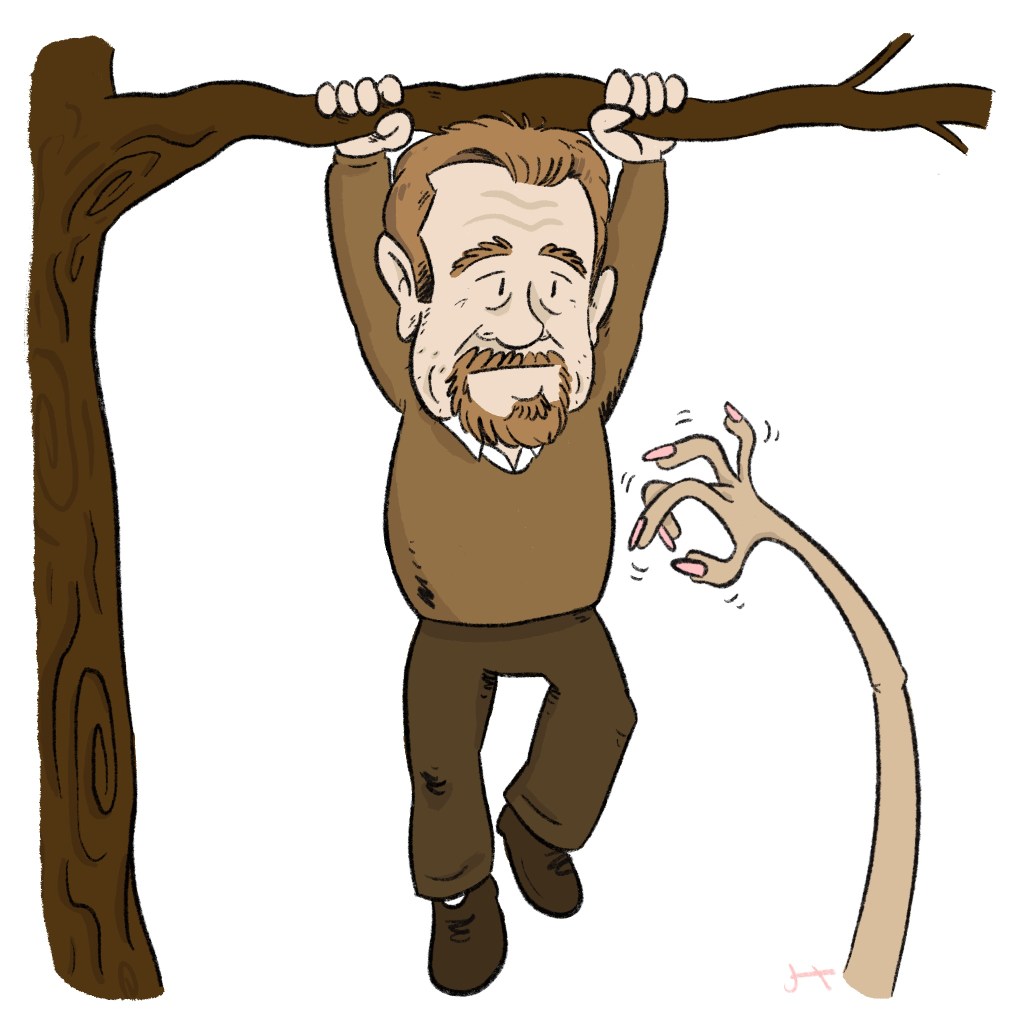
Santa and the Elves Teach Modern Children a Lesson
by Ivan Brown
Santa had a serious problem with his elves. You see, kids today are modern, and Santa’s elves … well … they are not so modern. For centuries, they have lived at the North Pole where, after a brief vacation following Christmas, they parade back into their workshop and work the rest of the year merrily hammering and sawing and sewing to make little toys for deserving children to find in their stockings on Christmas morning.
That much we all know in our hearts to be true.
But kids today are different than they used to be. They want electronic gadgets and little dolls and teddy bears and toy trucks that have minds and actions of their own that rely on electronic programming. Santa can scratch his beard as much as he wants, wondering what to do, but the trouble is very few of his elves are graduates of the Computer Science Program at the University of Waterloo, and, quite frankly, they don’t know the first thing about making the electronic toys that kids today so desperately need.
Much of the problem is bad timing on the kids’ part. When Christmas is over, they go out skating and making snow people, then school starts again, and they forget all about Santa and the elves. There are a lot of toys to be made so the elves have to start back to work in January, stock-piling a big stash of toys, but kids never even think about what they want for Christmas until late November. One day they are in the mall, dragging along behind their mothers who are shopping for just the right skin moisturizer, when suddenly they see Santa in a chair beside his sleigh ho-ho-ho-ing to a lineup of younsters anxious to ask for their favourite toys and gadgets. It is only then that most kids remember Christmas, and in a flash of other-worldly inspiration, they also remember the true meaning of Christmas: getting exactly what you want when you open your stocking on December 25th. So they line up for ever so long, which gives their mothers time to apply a bit of their skin moisturizer, and when it is their turn they jump up on Santa’s knee and make sure that he knows about all the electronically-based toys and gadgets that have been invented recently and advertised widely on all the children’s television programs. Santa nods and continues ho-ho-ho-ing, as if he understands what they are telling him.
This, then, was Santa’s big problem. His elves had already made huge stacks of old-fashioned toys but the kids were all asking for things the elves didn’t have any idea how to make. Back at the North Pole, Santa called a staff meeting. Every elf was required to attend. The problem was presented, discussion ensued, and a suggested solution was put forward: this year, every kid in the world would get a pair of hand-knit mitts. This would not only teach them the ethical value of human equality, but also make them highly appreciative of any old wooden or stuffed toy available next year.
There was much cheering and clapping when this suggestion was put to a vote and passed unanimously. It really was an excellent idea, they all agreed, high-fiving one another as high as elves can high-five. A complicating factor, though, was that, as talented as elves are at hammering and sawing and sewing, not a single one had any proficiency at knitting mitts. Santa himself was rather old-fashioned in that department, and was all thumbs when you put two knitting needles in his fingers. Rudolph and all of the other reindeer were really no help at all, since it is not easy to knit a pair of mitts when you have hooves at the ends of your arms. So, it was all up to Mrs. Santa who was immediately put to work knitting 3.6924 billion pairs of children’s mitts in less than a month.
Of course Mrs. Santa was up to the task and in what seemed like no time at all, mounds of mitts were finished and stock-piled away in preparation for Santa’s big journey on Christmas Eve. The elves were kept so busy attaching each child’s name to each pair of mitts and organizing them all in Santa’s outdoor storerooms that they hardly had sufficient time to properly apply their moisturizer to their weather-worn faces.
And so, that year all the kids in the world got a pair of mitts in their stockings. Even the ones who lived in hot countries or in the Southern Hemisphere where summer was in full swing. Santa, Mrs. Santa, the elves, Rudolph, and even all of the other reindeer had neglected to remember that not everyone in the world lives at the North Pole and can use a good sturdy pair of mitts for Christmas. As for the kids, their tragic flaw was that they had been so preoccupied with stressing exactly what they did want in their stockings that they had neglected to mention to Santa that they didn’t want mitts.
But the mitts did the trick anyway. When the next Christmas rolled around, there wasn’t one kid in the world who whined about getting a little wooden car hand-painted by the elves, a simple little rag doll with straw hair and a frilly apron, or a little stuffed animal with two blue buttons sewed on for eyes. All were welcomed and all were loved by kids from far and wide. They may be old-fashioned gifts and not at all what the kids asked for, but at least they weren’t mitts.
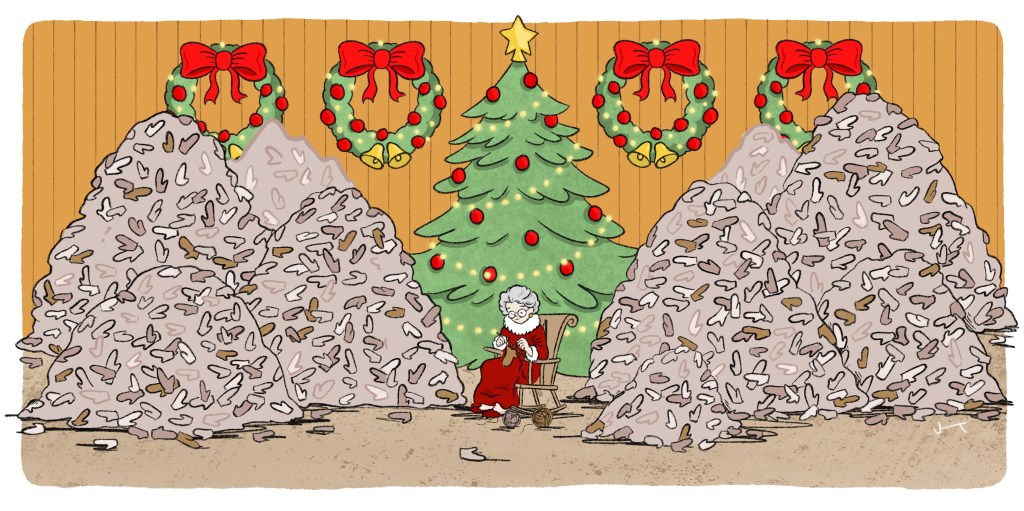
Why I Gave Up On Scientific Discoveries
by Ivan Brown
I suppose we all have our favourite scientists. Mine is Louis Pasteur, the inventor of pasteurizing milk, because I grew up on a farm and I remember how many flies were in the barn. But other scientists have certainly become favourites, or famous, or at least infamous, for other reasons. And not all their discoveries seem to fit nicely with my reality.
Marie Curie may be famous for being the mother of radium, but to be honest I have no idea what radium is. When I was a young boy, I got it mixed up with radio and I thought somebody named Marie had invented the radio. Later, when I was studying math, I got it mixed up with the radius of a circle, and for two years in high school I believed Marie Curie to be the inventor of geometry. I am not sure I have it straightened out yet. And as for Einstein, well, I am quite willing to admit that E might very well equal MC2 for anything I know to the contrary, but my moral prinicples regarding neatness would hamper me from spending time discussing the matter with someone who has hair as unruly as Albert. Or did he prefer to go by Al?
My reverance for scientists is obvious.
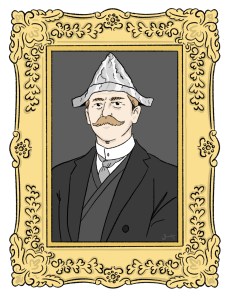
So I was very surprised when my nephew Eric, a scientist to the core himself – even to the point of wearing a white lab coat around the house – told me about an astronomer who built on the speculation of other scientists of his day and “discovered” something quite remarkable, only to fall flat on his face. Percival Lowell looked through his telescope in 1894 and saw canals used for irrigation on Mars. He was a featured speaker, wrote scientific papers, and even published three books on his findings. But several decades later, after his death, other scientists figured out that he was only seeing the reflection of the blood vessels in his own eyes through the telescope. No canals. No irrigation. Just veins and arteries. Oops. Poor Percy. Or did he prefer to go by Perce?
But I feel sorry for our dear Perce too, because when a scientist discovers something, only he or she knows. If Perce said he saw irrigation canals on Mars, who could argue? Nobody, that’s who. Everybody just has to acceptd that if a scientist says so, it must be true.
And thus Perce’s discovery of canals on Mars became an accepted truth and – if I have understood my thorough research correctly – both Perce and his irrigation canals soon became a world-wide phenomenon.
Slowly, and ever so quietly, the belief in Mars irrigation canals spread around the world and a curious trend began to grow. In The Netherlands, experts in water management stayed up late into the night in their candle-lit rooms drawing up design plans for dykes to contain the inevitalbe flooding over the Mars canal banks. Engineering students at MIT in the United States began failing their required courses because they were spending every waking moment concocting plans for foot bridges, vehicle bridges, and even goat path bridges to span the gulf between two dusty Mars expanses. Strong young men in Venice put sturdy tape over the holes in their gondolas and entertained secret hopes in their hearts that they would one day be in a position to row along the Mars canals, singing lustily and fleecing gullible tourists.
Yes, Perce’s scientific discovery flowed through every corner of the earth and was as popular as a scuba diver’s bare legs in a shark-infested canal.
Common people around the globe, upon hearing the news, felt a stab of excitement in their bellies and a bubbling of joy in their souls. Community projects sprang up to simulate and commenorate the wonderful new canals discovered on Mars, projects happily supported by generous government grants. In India, great canals were built to snake through the villages, their banks decorated with shining Dewali lights, and devotees took ritual air-baths in the heat of the empty ditches. In Australia, Mars-like canals were constructed to stetch as far as the eye could see across the Outback, and kangaroos delighted in hopping from bank to bank in joyous celebration. Similar creative projects abounded in locales too numerous to mention, and prizes were unstintingly lavished upon those deemed to best represent the spirit of the Mars canals.
But alas, the trend was not to continue, and one day it would all come tumbling down. Little did those enthusiasts know that they were sailing down the wrong canal altogether. They were planning, and building, and rowing, and air-bathing, and hopping over nothing more than the veins in poor Perce’s eyeballs.
Ah, can we really believe any scientific discovery? I don’t know. It is all so very discouraging.
I think I will give up on following scientific discoveries altogether. I may just sit in my easy chair, sip on some hot chocolate made from pasteurized milk, and listen to some soothing music on my radio. And feel ever so thankful that Marie Curie invented the radio so many years ago.
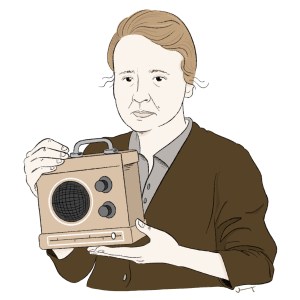
Doreen Goes To A Wine-Tasting Class
by Ivan Brown
Doreen was not much of a wine drinker. She led a calm and simple life, one where comfortable routines and the contentment of experiencing the familiar over and over again provided her with most the meaning of life that she needed. A simple cup of tea and a good book that ended in happily ever after, read by her fireplace in the evenings, was all she had ever ventured to enjoy. She had never really known the thrill of a spontaneous caper, and her inclination for impetuous escapades was about as apparent as a drunkard’s love of an AA meeting.
It was a surprise to all then, even to Doreen herself, when the unprecedented idea flashed across her mind that she should learn more about wine. She reallly didn’t know much about it, and she was always a bit nervous that she was serving the wrong thing when she occasionally had friends over. Yes, she would become a wine expert. A sommelier. She was pretty sure that was the word for a person who knows what wine to serve and just how to serve it at just the right time and to just the right crowd. She had run across the word in a crossword puzzle once, and had to look it up in the dictionary.
And so, in a very uncharacteristic move, Doreen began her adventure by enrolling in a wine-tasting class.
“The first thing you need to know,” the instructor started out as she handed each eager student a glass of red or white wine that she refused to identify, “is the five steps that even the amateur wine-taster must know.” Doreen eagerly jotted down the steps in her notebook as each was explained:
1. See – Look at the wine. What colour is it? Is it clear or cloudy?
2. Swirl – Swish the wine around in your glass, adding oxygen to open its aroma and let any sulphuric odours dissipate.
3. Sniff – Smell the aroma. What does it remind you of?
4. Sip – Take a taste. Swirl it around on your tongue, mixing it with air. How does it first strike you?
5. Savour – Focus on the many tastes in parts of your mouth, from first taste to what lingers.
Now it was time for the demonstration. The instructor held her glass up to the light. “A beautiful dark red, almost red cosmos…” Her voice trailed off into a daydream. Doreen jotted in her notebook: Red cosmos? Look that up. The instructor regained herself and the demonstration went on. She swirled, sniffed, sipped, and savoured and in the end gave her full verdict of the wine:
“This luminous wine, deep ruby at its core with a garnet rim, decorates the glass with light patterns of worn leather and sun-dried black cherries. Its aroma radiates like late August raspberries, ripe and pithy, fallen to the ground and resting in the damp soil at sunset under their bushes. It explodes on the tongue with notes of overripe pomegranates dipped in a mixture of salt and watermelon juice with hints of malt vinegar and fresh geranium petals. It sings in the mouth with plum mocha overtones and leaves the palate humming with a lingering zing of syrup-baked almonds and sharp garlic curd.”
Doreen’s classmates erupted in spontaneous applause.
“Now try it yourself,” the instructor said. “Jot down everything you are reminded of as you go through the five steps.”
Doreen and her classmates picked up their glasses. They saw, swirled, sniffed, sipped, and savoured. All her classmates began jotting down their impressions with gusto, but Doreen could think of nothing. She went through the five steps again. Still nothing. She tried a third time, and a fourth. Then a fifth, and so on… In time, her head began to buzz and become more than a bit fuzzy, but a miracle of sorts had occurred – at last she was beginning to see what the instructor was getting at, and she was able to start writing down things she was reminded of as she tasted.
“In the glass, it reminded me of the paint I spilled on the floor when I was putting a new coat of paint on the bathroom cabinet. It felt sharp in my mouth when I sipped, like a hundred of those needles they use for taking blood samples at the medical clinic. The prickling on my tongue died down, eventually, after I had shuddered visibly like the dead leaves in November on the oak tree in my back yard. Oh, I forgot the sniff part. When I breathed in, it reminded me of the wet skunk I smelled wandering in my front yard – after it had rolled around in my rhubarb patch. And I think there were definite hints of the dead chrysanthemums that I tossed on the compost pile. I also think I caught the aroma of the cat litter I forgot to clean out last night. I tried to taste the notes of syrup-baked almonds, but all I was reminded of was a custodian scrubbing floors on her knees who can’t get the taste of floor polish out of her mouth.”
All the students read out their descriptions. When it was Doreen’s turn, she stood up, somewhat shakily, and read hers in a timid and slightly slurry voice. To her surprise, though, she was rewarded with the loudest applause of all and with enthusiastic cheers from her classmates. They loved it, even if the the instructor couild be seen frowning.
Doreen sat back down, feeling more confident now. Maybe she was a wine-taster after all. Maybe she would even be a sommelier some day. Yes, she thought, I believe I am truly on my way to becoming a sommelier now.
But she really didn’t care anyway. All she could think was that she was as drunk as a wet skunk that had just eaten an over-abundance of October apples, the ones that had fermented on the ground under the tree in her back yard. Maybe it had even rolled in her rhubard patch.
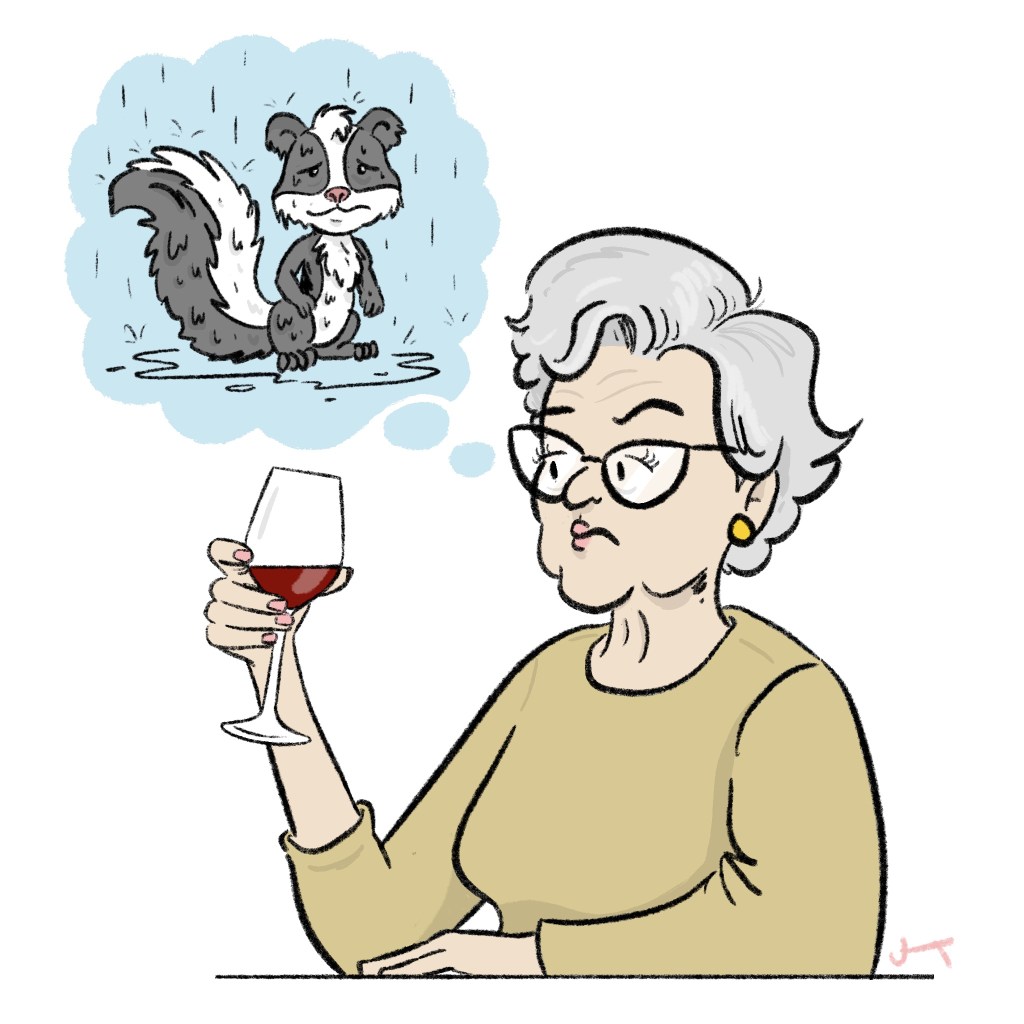
Herb Coaxes Wiarton Willy Out Of His Hole On February 2
By Ivan Brown
I expect most of you have experienced the occasional morning when you are lying in bed and you just don’t want to get up. Your whole body is so relaxed, your bed is so soft, and under the covers it is so warm and cozy. The demands of the day may be whispering in the back of your head but you ignore them. You are just not ready to budge.
Such was the way, quite some years ago now, with the groundhog Wiarton Willy on a particular February 2 – Groundhog Day.
Eveyone knows that if there is one day in the year when Wiarton Willy is not supposed to linger in bed it is February 2. By tradition, he is obliged to rouse himself from his comfortable nest underground, crawl up his tunnel, and emerge to pass judgement on whether there will be an early spring or six more weeks of winter. As long as he doesn’t see his shadow, all is well and he stays out to enjoy an early spring. But if he does see his shadow, it frightens him so much he rushes back down to the comfort of his bed below until winter finally leaves in six weeks’ time.
Oh yes, even Wiarton Willy knows the routine and what is expected of him. But this particular morning, he simply refused to budge. He was just too comfortable. I have never actually been down a groundhog hole myself, as far as I can recall, but I imagine Wiarton Willy had made himself a soft bed of dried grasses that was both fragrant and heat-retaining to keep him snug during his long weeks of hibernation. Actually, it sounds nice. I don’t blame Wiarton Willy for not wanting to be disturbed.
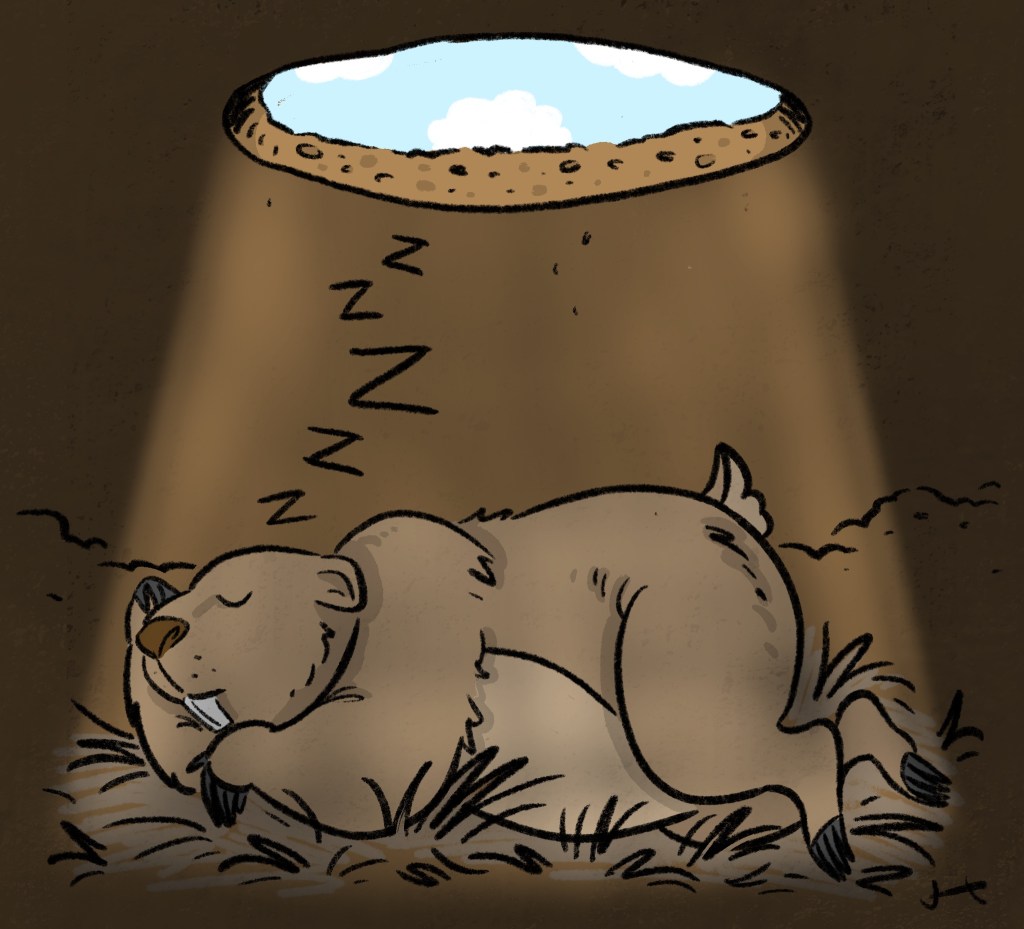
The problem was, though, that a large crowd had gathered around outside the opening to his groundhog hole waiting patiently – well, some were waiting impatiently as they stomped their feet in the cold Wiarton snow and clapped their hands together to keep warm in the bitter Wiarton wind. Yes, a large crowd was there, consisting of a great many ordinary townsfolk, official representatives of the town council, local bank, grocery store, and gas station, a healthy sample of radio, television and newspaper reporters, and a smattering of foreign dignitaries such as the ambassadors from Thailand, Tanzania, Tahiti, and Tobermory.
All waited in rapt expectation. But Wiarton Willy did not appear. He just snored on below.
At length, when the ladies serving hot chocolate became overtly agitated because their urns were running low, the major made an announcement. “Ladies and gentlemen, it seems Wiarton Willy needs some coaxing to come out this year. Does anyone here speak Groundhog?”
The arm of a man named Herb from the Bruce Penninsula shot up. “I do,” he said, “I speak Groundhog.”
Herb, all the locals nodded in agreement, must surely know Groundhog, for he was known throughout several counties for his talent to lure groundhogs out of their holes. So he was called on to try to save the day. Herb sauntered up to the front of the crowd, got down on all fours, and stuck his head down Wiarton Willy’s hole. This positioin, although absolutely necessary for tackling the task at hand, made his rear stick up rather conspicuously, all those in attendance murmured in agreement. A number of the older women could be seen blushing even in the frosty Wiarton air, but all the reporters rushed forward as they recongized they now had their story for the day – Herb’s east end prominently pointing west, upward and outward, with his head fully immersed in Wiarton Willy’s hole. Oh the headlines this would inspire! Flash, flash went the cameras. Whir, whir went the video cameras. Scribble, scribble went the pens of the newspaper reporters.
Herb was successful, of course. All the locals knew he would be. Whatever he said in Groundhog with his head down Wiarton Willy’s hole and however he said it, it worked. Herb’s head popped back out to see the light of day once again, with Wiarton Willy emerging shortly after. But Herb’s unaccustomed position had caused him to take a severe spasm in his back and he could not straighten up. So there he was, unable to budge from being on all fours with his face resting on the white Wiarton snow and his rear… well… still rearing. Cameras flashed in front of Willy, creating his dark shadow behind him, which scared him so much that he rushed back down into the safety of his hole.
Six more weeks of winter. Wiarton Willy was happy, knowing he had lots of time ahead for dozing on his cozy bed of fragrant dried grasses. Herb had saved the day, even if the unfortunate fellow had to be carted off on a stretcher in that same unflattering position. Still, it was Herb, not Wiarton Willy, who was the hero that day. It was Herb, not Wiarton Willy, who was the lead story in every television and radio broadcast and who was featured boldly on the front page of every newspaper. Well, at least one end of him was featured.
This was, and would always be, Herb’s claim to fame. The highlight of his life.
To the end of his days, Herb would tell and retell this story to his friends, neighbours, and grandchildren. He always related it with much pride and feeling. And he always ended his tale the same way by saying, “That all happened years and years ago. As it was at the time, this story is all behind me now.”
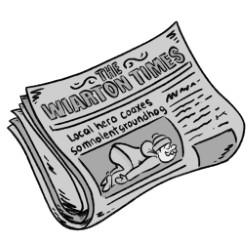
What Does One Do With Old Professors?
By Ivan Brown
I have known many professors throughout my career, and a few of them even grow old and retire. But most do not. They grow old, yes. But retire? No. They keep on going and going, doing the things they always did, no matter how many times you stop paying them and no matter how much you try to divert their attention onto more leisurely activities. They rarely budge. Of course, one doesn’t want to dismiss their accumulated wisdom or their specialized skills, but how to wind down their clocks as the eleveth hour ticks steadily forward can be quite a formidable challenge.
What is one to do with old professors, anyway?
I suppose you could take three or four of them with you into one of your lecture halls and stand them in a corner with their arms outstretched so students would have something to hang their coats on. But the old professors would probably collaborate on completing a statistical analysis on the types of coats placed on their arms, with size, colour, style, and sex of wearer as independent variables.
You could lead them up to the top floor of the library and line them up out of sight on a high shelf somewhere. But they would most likely write a multi-authored paper sythesizing the principal themes in all the other books on the shelf.
You could organize a symposium on human aging and stand them up at the front as you poke and prod them and refer to them as Figures 1.1, 1.2, and 1.3. But they would then probably write a government-funded report on elder abuse, which would immediately be widely ignored, citing themselves in the report as Figures 1.1, 1.2, and 1.3.
You could trick them into going on an outing to a Museum of Natural History and seat them on chairs behind an exhibit glass, so visiting school tours could marvel at their dress and demeanour as they take detailed notes for their class projects. But the old professors would probably thoroughly confuse the children by bursting into a spontaneous, but heated, debate about whether it was the compiled philosophical teachings of Socrates or the five books of Euclid on geometry that have comributed more substantially to human progress, with a sub-argument threaded throughout as to the appropriateness of suggesting that humans are actually capable of progress at all.
Or I suppose you could take them home with you and have them sort out all the papers in your recycling bin, but when your back is turned they would probably be grading all the papers A, B, or in the case of flyers from the local department store, only a C.
You could take them to your local grocery store, then abandon them as you rush ahead to hide several aisles over. But if you peeked back at them, you would probably find they had organized the staff of the fresh meat department into a seminar to discuss the psychological ramifications of displaying bits of fat alongside the lean.
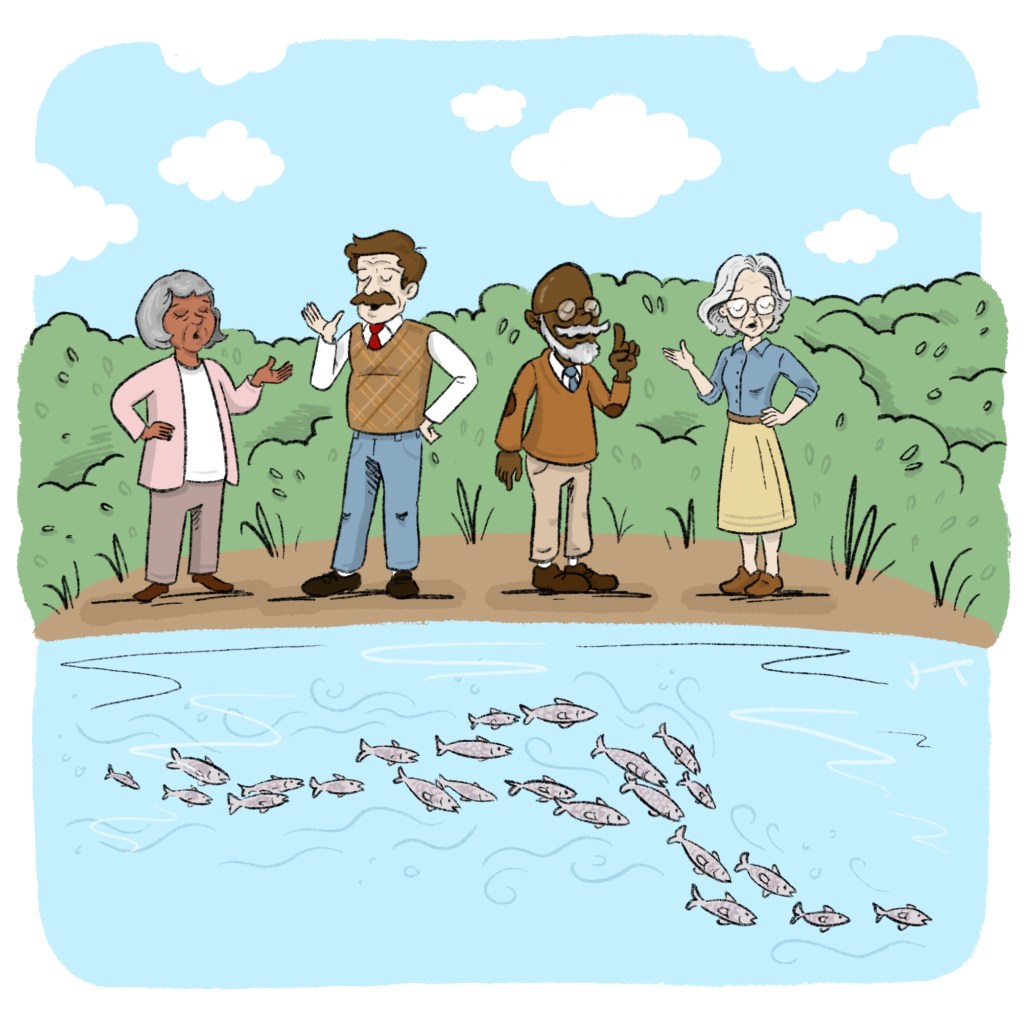
Alternately, you could round them up and take them for a leisurely stroll down by the river and accidentally leave them behind a bush. But the neighbours would probably complain about a strange little group of people standing and looking out over the river, apparently lecturing in loud voices to the frightened schools of fish.
You could organize an old folks book club for them, then rush out the door as they delve into the pile of current novels you have left for them to read. But they would probably toss the novels aside and make everyone in the group read the books they themselves had published, but no one has actually ever read: Gastro-intestinal Problems of the Electric Eel, and when that has been thoroughly discussed, Philsophical Theories of Fibbing and Penance in Peru in the Fourth Century BCE.
As a last resort, I suppose you could set them down in front of a laptop and let them amuse themselves by typing out some silly stories about odd things that pop into the remnants of their minds. But they would probably try to create a website, package their stories together in a semi-coherent way, and send them out every two weeks to all their family, friends and acquaintances.
Ah, yes. What DOES one do with old professors anyway?

Darwood’s Teeth Wear Sunglasses To Their Dental Appointment
By Ivan Brown
Darwood always took extra good care of his teeth. He brushed morning, noon, and night, and as a result he was proud to think that his teeth glowed like a moonlit night in August. Before he would go to a dentist appointment, he always brushed twice – sometimes three times – just to be sure that every bit of residue from his last meal had been thoroughly whisked away.
But as the years rolled by, Darwood found it harder and harder to get the white gleam that had been so easily attained in his earlier years. No matter how hard he brushed, there was still a yellowish tinge to his teeth. The problem was that he had a dentist appointment the next day to have a filling replaced, and he certainly did not want to be leaning back in the chair, opening wide, and revealing yellowish teeth. Not Darwood.
There was only one rational thing to do, Darwood figured: paint the fronts of his teeth with a shiny white high-gloss. Off he went to the store for paint and an extra small brush, and when he returned home he carefully painted all his front teeth. They glowed brightly.
Just before leaving home for his appointment, Darwood took a look in the mirror to admire is radiant teeth. “Hmm,” he thought, “They are shining so brightly that they are almost blinding me. I am seeing spots! I think they may be really a bit too bright.” Then Darwood remembered that he had found a miniature pair of blue sunglasses at the bottom of a box of popcorn once – a toy meant to amuse kids – and by some stroke of good fortune he had saved them. Darwood figured this would be just the thing for his teeth. So he found the sunglasses at the back of a drawer and fit them into his mouth. He was ever so pleased that they were just the right size to reach from one side of his mouth to the other and fit nicely between his upper and lower lips. A perfect fit.
Yes, Darwood’s teeth were sporting a nice pair of blue sunglasses.
He glanced in the mirror again and was so delighted with his new look that he let out a little squeal of joy. He marched proudly down the street featuring his teeth sunglasses between his open lips. He noticed that people stopped in their tracks to stare intently, which he interpreted as sheer admiration.
It was such a wise decision to have his teeth wear sunglasses. As he got on the bus to go to his appointment, the bus driver nodded, in appreciation Darwood asserted, and as he took his seat his fellow riders smiled, in agreement Darwood assumed that the sunglasses were a good choice to protect them from the bright reflection of his painted teeth. The woman beside him seemed to mouth the words “too much” and Darwood’s heart swelled up with pride at the compliment, for he totally agreed that his new fashion look was too much indeed.
Darwood arrived at the dental office and began to lie back on the chair. “Hello Darwood,” the dentist began, “I notice your teeth are wearing blue sunglasses today. I’m afraid I will have to ask you to remove them before I begin my filling.” Then she turned on that bright light that shines into a patient’s mouth, and Darwood removed the sunglasses from his mouth.
Well, I hardly need to tell clever readers like you what happened next. The bright dentist’s light sparkled so glaringly off Darwood’s high-gloss teeth, right into the dentist’s eyes, that it temporarily blinded her. But she had already filled her needle to give the freezing, waving it in her hand now, and that’s when it occurred to Darwood that he had perhaps not thought this whole thing through very well.
The dentist was ashamed to admit that her own light had been the main cause of her temporary blindness, so she proceeded with the freezing as if nothing were wrong. She missed Darwood’s mouth entirely and sunk the needle instead into his ear, freezing it solid.
“Can you feel the freezing now?” the dentist asked after a few moments.
“Whaaat?” shouted Darwood.
The dentist sat back to consider the situation, and slowly her temporary blindness began to subside and she was able to see through a thick fog again. She could see the shape of Darwood’s open mouth now, and she saw the outline of the teeth between his open lips, although they still looked a dull gray colour to her.
“Darwood,” she said, “It seems that your teeth have grayed over the years. You don’t need those blue sunglasses for your teeth now. In fact, we really ought to think about having those front teeth brightened.”
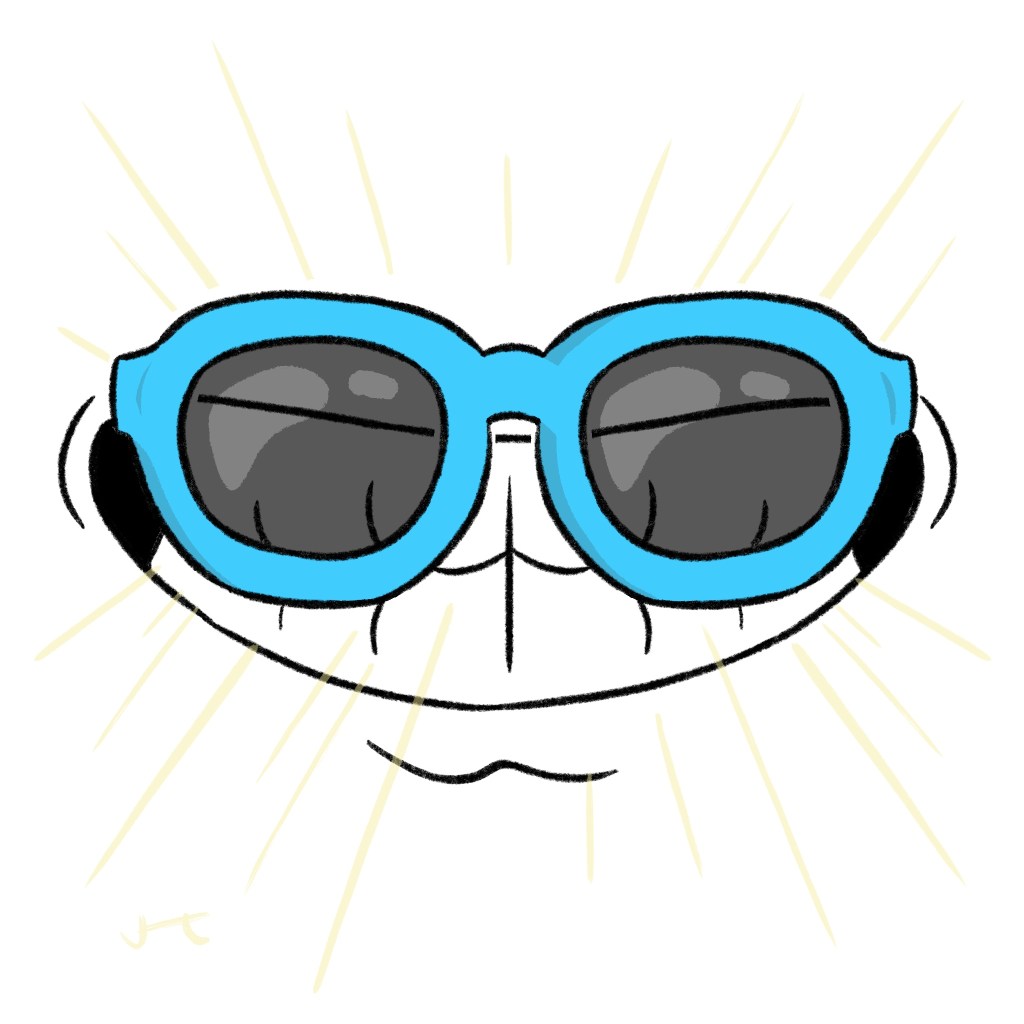
Grace’s Grace Lacks Grace
By Ivan Brown
Grace, most of those who know her agree, is the exact opposite of what her name suggests. She is clumsy of body, feisty of mind, and oppositional of personality. Her friend Martha says Grace has about as much grace as a skunk in a perfume shop.
One day, Martha’s overbearing nature got the better of her and she spoke up boldly to her friend. “Grace,” she said, “you really have to start demonstrating some grace!”
The problem was, though, that Grace was more than a little hard of hearing so she confounded the meaning of having grace with saying grace at the beginning of a meal. “This,” Grace grumbled to herself, “is another one of Martha’s stupid ideas. I have never been a particularly religious person, and the only thing I have ever liked about the curious custom of bowing your head in lengthy prayer at the beginning of the meal is it gives me a chance to breath in the delicious aroma of the roast beef and mashed potatoes on my plate. But Martha! What a bossy so-and-so.”
Still, to keep her friendship going, she searched through the Internet for a suitable grace that she might say at the table, something that would not strain her patience unduly. Grace did have her limits. She found a number of commonly-used graces, such as “For what we are about to receive, may we be truly thankful, Amen,” and “For the bounty before us, may we be ever grateful, Amen.” Grace grimaced. These were not at all her style. She would have to keep searching for an alternative. Perhaps something a bit more… well, light-hearted.
A few week’s later, Martha invited Grace over for an evening dinner party where they would enjoy the company of a group of Martha’s well-heeled friends. It was a typical affair that began, as usual, with a glass of fine wine and some tasty hors d’oeuvres served on neat little napkins. It was all very successful, given that Grace only knocked over one glass of wine onto the rug, and only stepped on two of the hors d’oeuvres that slipped off her napkin.
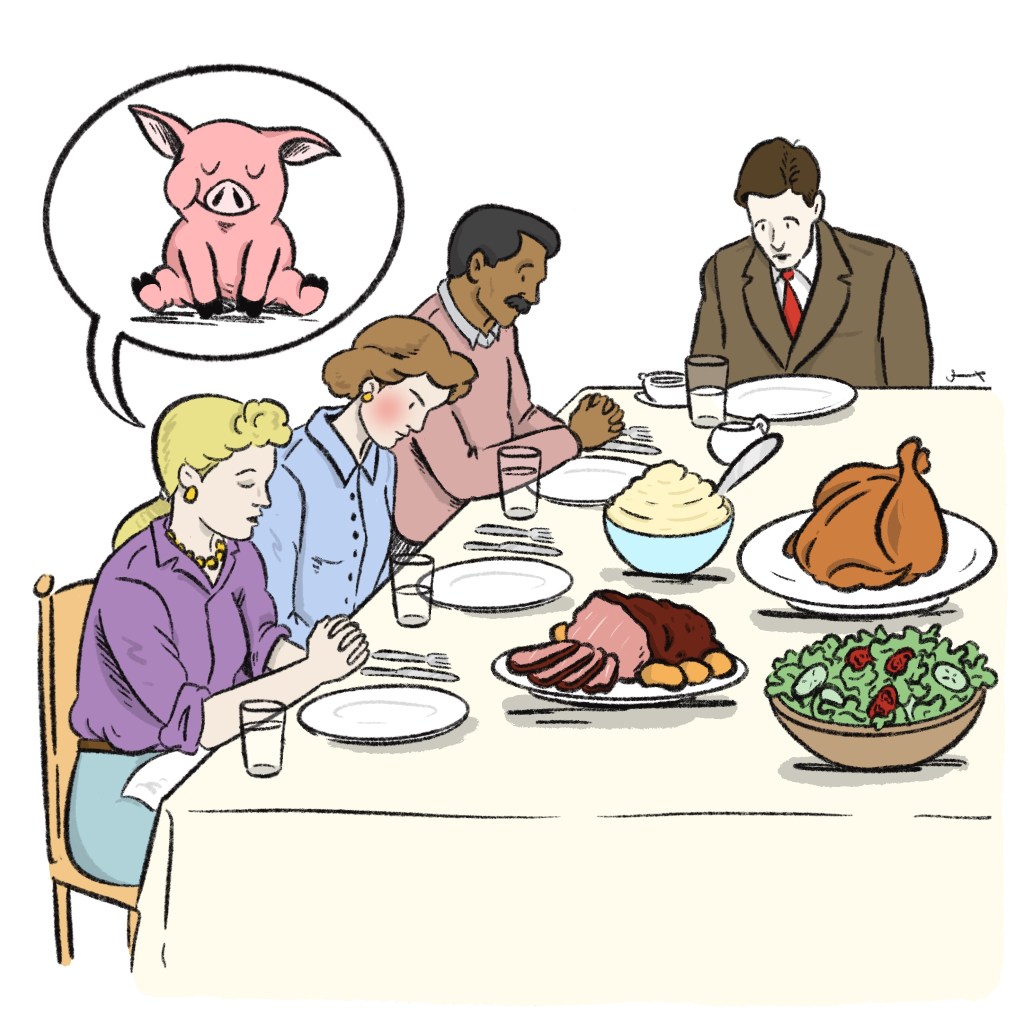
When it came time for the meal, the guests gathered around the dining table and were directed to their appointed chairs. When seated, Martha announced, as arranged beforehand, that Grace would begin by saying grace. Around the table, everyone – hostess and guests – bowed their heads in reverance and waited. In a moment, Grace slowly began to intone, “Father, Son, and Holy Ghost, The biggest pig will eat the most.”
Well. The entire room went sombre. It seemed, by the expressions on the faces of Martha’s guests, that Grace’s grace had been somewhat lacking in grace.
Martha was appalled. The very next day, she came to visit her friend. “Grace,” she said, “that grace was really not appropriate. I’m afraid you have offended most of my other guests. Really, Grace. The next time I have a dinner party, I want you to say a proper grace. A grace with some grace, Grace, if you know what I mean.”
Grace gave it some thought over the next few weeks, and when an invitation arrived in the mail to attend another of Martha’s nice dinner parties, Grace was well prepared. She arrived at the house on time, dressed fairly well except that she had purposely put her shoes on the wrong feet. She nodded yes to the offer of a glass of wine, but took two glasses so that she held a glass of wine in each hand. This aroused some minor comment from the other guests, but they carried on. After a time, Martha announced that they might proceed to the dining room for dinner, and they all giggled in surprise as if they were not expecting it. At the table, Martha again said in a solemn voice that Grace would begin by offering grace. At this, the guests all reverently bowed their heads, ready for prayer. Grace cleared her throat, and slowly began:
Dear One Who Devines All —
I’m thankful that my bottom ‘tis, Not half as fat as Martha’s is. Amen
The Sock And The Glove
By Ivan Brown
Everybody in the entire world has lost a sock in the laundry. Not just once, no, for if you live long enough you will have lost quite a few lone socks in the laundry over the years. One of the greatest mysteries of the universe is where those lone lost socks go. Somewhere between dropping your clothes into the washer and sorting them to go back into your dresser drawer, one sock just goes AWOL and no one can ever figure out why.
Over and over, you are left with one surviving sock.
And who of you has not been walking along a winter sidewalk and found one lone glove that someone has dropped in the snow? You pick it up and set it on a nearby fence where you presume it will be visible to whomever dropped it and has come back searching. A week later, though, the glove is always still there on the fence. No one ever claims it.
Look in anybody’s glove drawer and you will find an assortment of lone gloves whose mates have been dropped in snowbanks of various shapes and sizes and have been featured for a week or two unclaimed on fences of various shapes and sizes. Left in the drawer are those lone gloves whose mates have gone forever.
One day I got to thinking. Why not put one of my lone surviving socks and one of my lone surviving gloves together to form a useful pair? So I put a red sock on my left hand and a blue glove on my right hand, then looked in the mirror. “Ah-hah!” I burst forth in a spontaneous shout of delight and self-appreciation that could only be matched by the triumphant cry of Hercule Poirot suddenly solving yet another Agatha Christie murder mystery. “I have done it!”
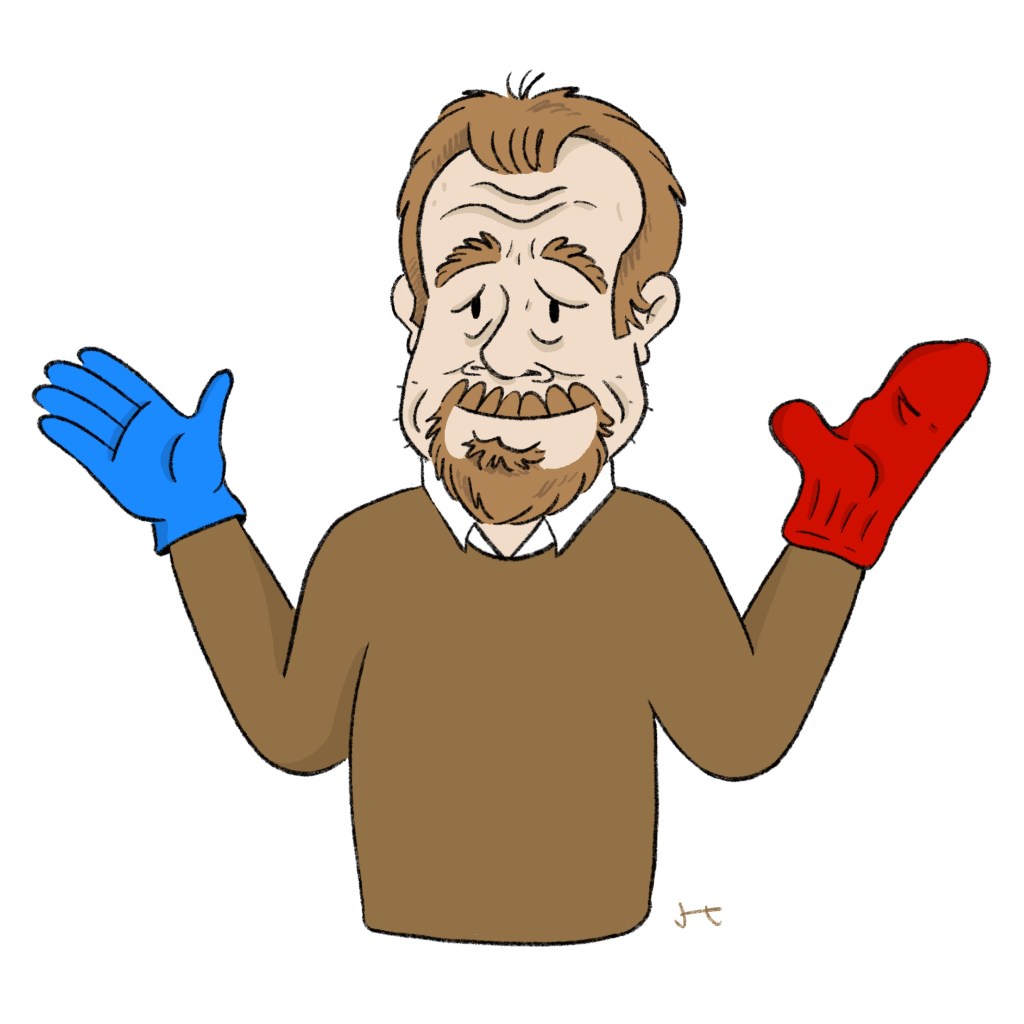
I was ready to set forth into the world to proudly exhibit my clever invention.
That very morning, I had an appointment with my physiotherapist to work on some arthritis in my left hand. “Ah,” he said, “I see you are wearing a red sock on your hand. That is so wise. The wool in the sock will…” He had some long technical explanation, but I didn’t listen because I was too busy congratulating myself on my very wise choice to wear a wool sock on my hand.
The same day I had an appointment with my chiropodist who was excavating something or other to do with a toenail on my right foot. I put the sock on my left foot, and the glove on the right, with my right foot toes fitting snuggly into the single slots of the glove. But toes are much shorter than fingers, so I had to fold the ends over a few times and secure each one with a clothes pin. “So sensible,” my chiropodist nodded, “Blah blah…” I heard nothing. I was too busy beaming with pride.
I continued on throughout the whole of that winter going to family gatherings, high school reunions, religious ceremonies, opera opening nights, and many other events where the sock and the glove on my hands or feet proved their inimitable usefulness time and again.
But over time, the sock and the glove became soiled with use and it became obvious that they needed cleaning. So off I went to the laundromat carrying the rest of my laundry with the red sock on my left hand and the blue glove on my right. When I was dropping my clothes into the washer, I included the sock but I was alarmed to discover that I did not have my glove. I must have dropped it in the snow along the way while checking to make sure I had sufficient coins for the machines. I did my laundry anyway, but – as you have probably already guessed – when I moved my clothes from the washer to the dryer, I noticed my sock had mysteriously, but quite definitely, disappeared. Sock and glove both gone. Again.
I sauntered home, disheartened. But part way home, I spied on a fencepost one lone bright green and yellow glove. “No one will claim it,” I thought, “so I might as well take it.” And when I got home and was putting away my clothes, I found there was an extra sock that must have been hiding in the dryer and stowed itself away in the rest of my laundry. By some miracle, it was also bright green and yellow.
So now, I am back to wearing a sock and glove on my hands or feet wherever I go. No one mentions anything any more, I presume because they match so well and look so stylish. I am a little surprised, though, that people neglect to congratulate me on solving, at long last, the dilemma of how to match reuse/reduce/recycle/ with fashion.
Shelley Brooks Wonders If Deer Are Stupid
by Ivan Brown
When Shelley Brooks retired and moved to Buffalo Horns, Saskatchewan, there was one delight she had not anticipated. Every morning three deer came by to enjoy a breakfast of the grass in her back yard, and they often hung around in the afternoons and even sometimes overnight. What Shelley did not quite understand was that this was the deer’s territory, and whoever had built her house years ago had done so under the erroneous impression that it is fine to purchase land that had already been clearly claimed and well marked by animal urine and feces.
The deer, apparently, were having none of foreign intruders buying and building. They were not about to abandon their lands.
So, every day the deer came to eat, rest, and frolic in Shelley Brooks’ back yard, and when they tired of that they did the same in her front yard.
Now winter nights can get a bit chilly in Buffalo Horns, Saskatchewan. It is not out of the ordinary for the temperature to dip to -25 degrees or sometimes even to -35. One winter morning, when Shelley peered out her window at the thermometer mounted on a post outside, she noticed it covered in icicles and registering a bone-shivering -34 degrees. As she did every morning, she then looked to see if her three deer were around, and she was delighted to see they had slept overnight. But she remarked on one thing: “Why had the three deer each chosen a separate spot to settle down for the night? Are deer stupid? Wouldn’t it be smarter,” Shelley wondered, “if they all cuddled up together for warmth? Or at least companionship?” She shook her head, thinking that, for sure, deer must not be very bright.
All through her morning toast and coffee, Shelley Brookes kept wondering, “Are deer stupid?”
Later that morning, Shelley shivered her way down to the post office to ask Jean, who had run the Buffalo Horns Post Office for the past 36 years. Jean knew pretty much everybody and everything worthy of being known around Buffalo Horns. Without even asking how are you, how is your sick cousin in Medicine Hat, what’s new in town, or who died yesterday – Shelley was, after all, from Toronto and thus not up on the social niceties of proper conversation – she piped right up, “Jean, are deer stupid?” Jean merely pointed to the bulletin board where she posted the funeral notices for all those who had died recently. “Do you see any deer listed there?” she asked. “Somehow, they are smart enough to survive the winter. Not all people can do that.”
Only partially satisfied, Shelley tramped through the snow and cold to the grocery store where she asked Bert, the grocer, “Bert, are deer stupid?” With no hesitation whatsoever, Bert knew the answer. “I haven’t seen one in here today … maybe they heard about my habit for putting venison on sale the last week of every month.”
Still not fully convinced, Shelley recalled that she had an acquaintance in Toronto who was a noted animal psychologist. So she phoned and asked him, “Are deer stupid?”
“I have just the thing you need,” he said. “My internationally-recognized and highly respected intelligence test for deer.” It came by express post the next day.
INTELLIGENCE TEST FOR DEER
© Henry Hoffleby, D.V.M. (University of Guelph), noted Toronto animal psychologist
Part 1. Genetic memory intelligence (what is natural to deer)
- Does the deer run away when a wolf chases it? (Correct answer: yes)
- If you put out a carrot and a rotten fish, which one does the deer eat? (Correct answer: carrot)
- When there is Saskatchewan-style hail pelting down from the sky, does the deer: 1) seek immediate shelter, 2) gather up some hail, add milk, and make a grass smoothy? or 3) put up an umbrella and say, “Oh my. It’s hailing!” (Correct answer: seek immediate shelter)
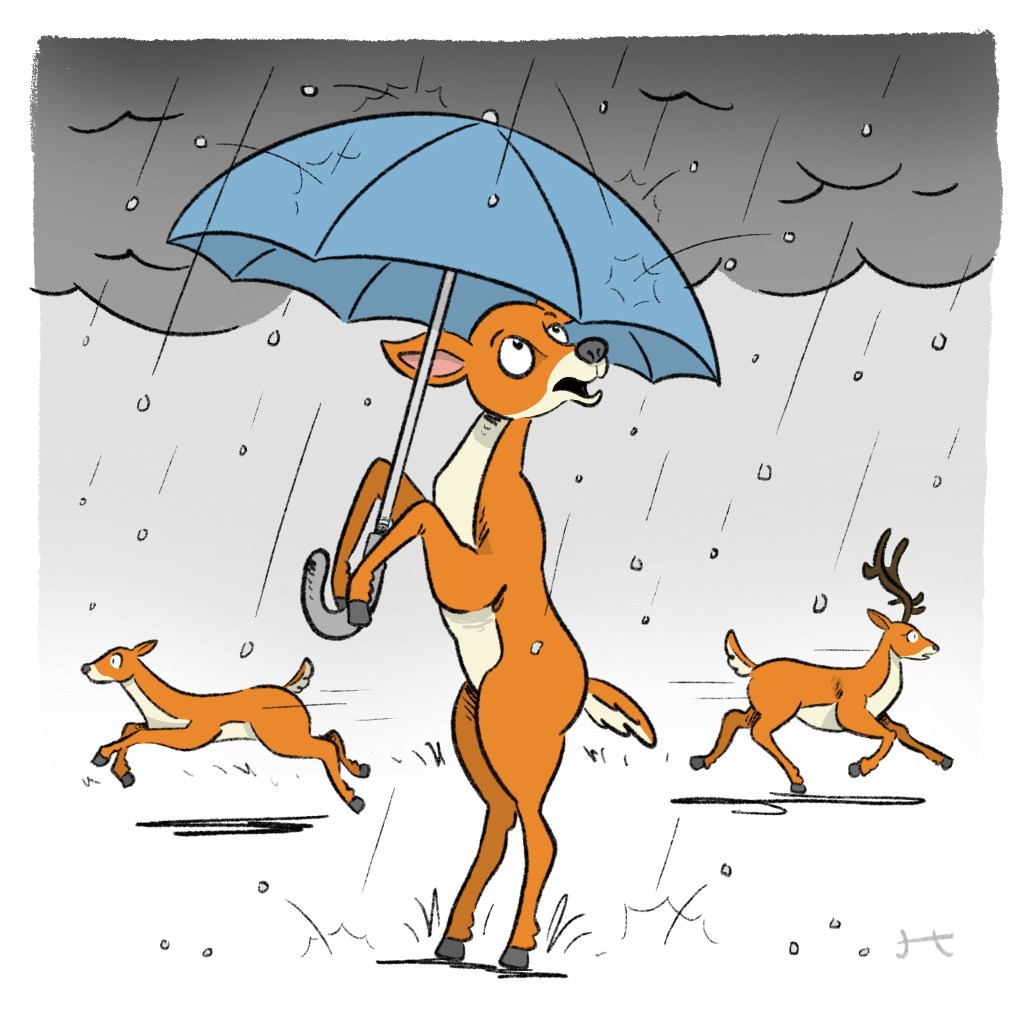
Part 2. Adaptive learning intelligence (how deer adapt to their immediate environment)
- If your neighbour is deathly ill from a really bad flu, do the deer go to the post office to check out Jean’s bulletin board for funeral notices? (Correct answer: yes)
- When Bert advertises venison on sale this week until Saturday, do the deer slip quietly out of town and go into hiding until Sunday morning? (Correct answer: yes)
Shelley Brooks rushed out the next morning and administered the test. Her deer scored two out of three on Part 1 and three out of two on Part 2, suggesting high intelligence.
“But if they have such high intelligence,” Shelley still wondered, “why did they stupidly all sleep in separate spots? Surely, they would have been warmer sleeping together!” Shelley sauntered into the kitchen, once again to enjoy her morning toast and coffee, abandoning all hope of ever knowing the answer. But out the window, well out of Shelley’s sight, each of the deer got up, took a morning stretch, and began to nibble on the personal little patch of grass in the spot where each had slept. Their body heat had melted the snow revealing the grass below, providing a sufficient separate breakfast for each deer on a cold Saskatchewan morning. Very intelligent.
Shelley Brooks was busy munching on her toast and stirring another spoonful of sugar into her coffee, and thus noticed none of it. As for Dr. Henry Hoffleby, D.V.M. (University of Guelph), noted Toronto animal psychologist, he never knew that it would have been an intelligent move indeed to add an item about why deer sleep in separate spots to his internationally-recognized and highly respected intelligence test for deer.
Joanne Has An Itchy Shoulder
by Ivan Brown
This morning Joanne was awakened at 6:38 a.m. from an itch near her left shoulder. Joanne is not the type of person to leave a situation unresolved, and in her 46 years of life she had learned a thing or two about itches. All she had to do was reach around, rub through her nightie – the nice new one with polka dots that she was wearing for the first time – over the offending spot, and all would be in settled and ready for her to doze off again.
The problem was, though, the itch was in an awkward spot, down her back a bit from the top and toward her spine. In her sleepy state, she stretched around with her right arm, then with her left, but she simply could not reach the itch. It was in that no-man’s-land where an itch defies being got at.
Joanne propped herself up on a pillow so she could think what to do. At first, she thought she might use a hairbrush to reach the spot, so off she stumbled to the bathroom. Brush in hand, she attempted any number of acrobatic arm maneuvers, but all culminated in absolutely no success whatsoever. Next, she thought perhaps to try the broom. She stood it again a wall, upside down, backed into it and wiggled vigorously from side to side for several minutes. Still no satisfaction. She would have to try something more radical.
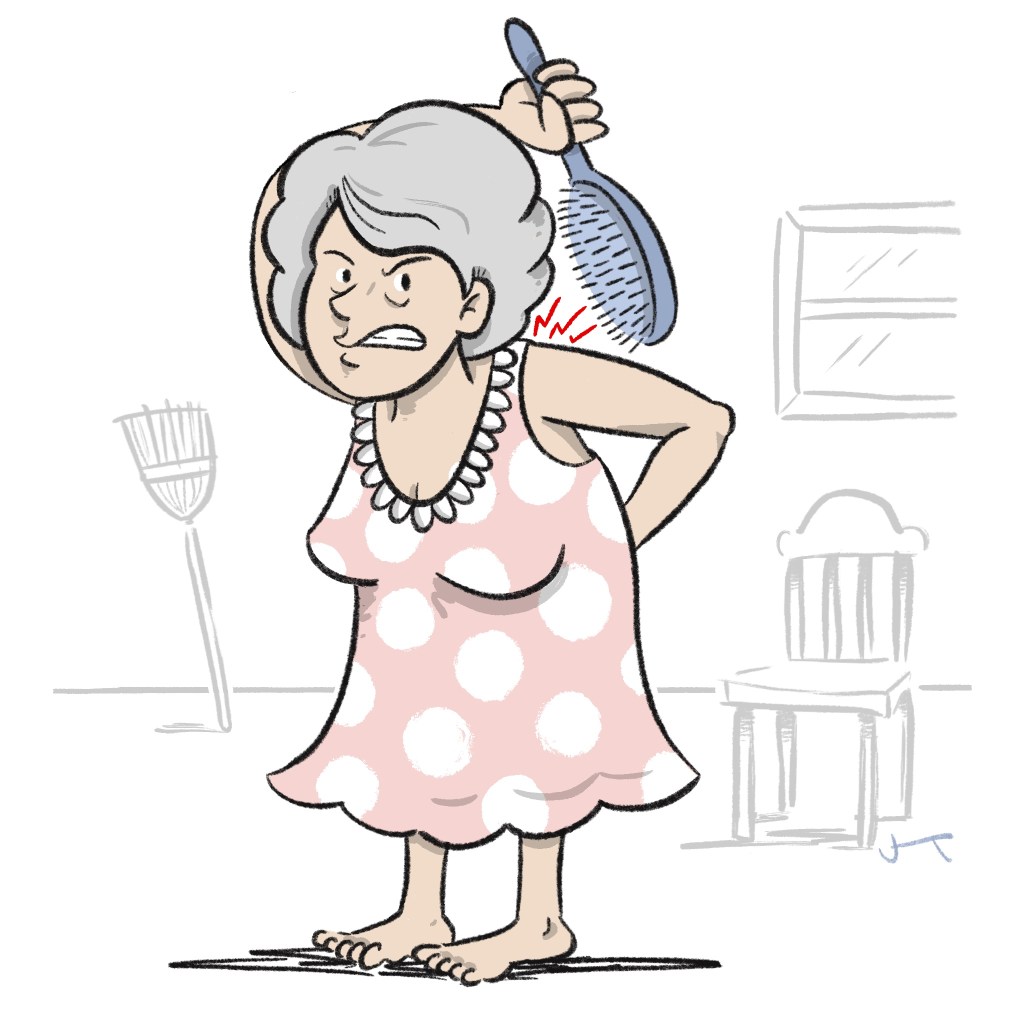
An idea hit her. Perhaps if she were to lie down on the floor, face down, and put a few pieces of cheese on both her shoulders, a mouse would come by to eat the cheese and its little paws would scratch her itch. Down she went to the floor, face down, balancing the pieces of cheese on her shoulders. But she neglected to figure into the plan that she had a cat named MouseBreath, so when the mouse did come by – as we surely all knew it would – MouseBreath gobbled up the mouse and both the cheese and the itch were left untouched.
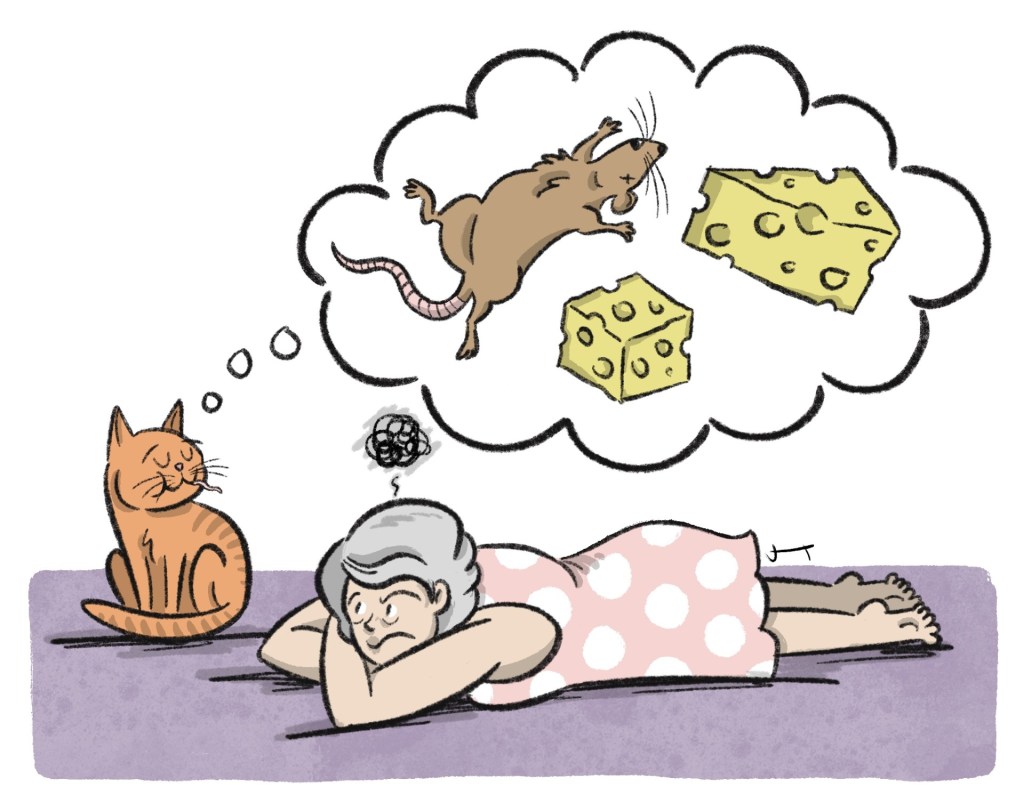
Joanne got to her feet, losing hope, and went outside to think. There, she spied a gardener walking along the sidewalk, whistling to himself and carrying a rake over his shoulder, evidently on his way to the park to begin his 8:00 a.m. work shift. This gave Joanne an idea. “For a small amount of cash,” she offered, “would you stop for a few minutes and rake my shoulder? Right near the top of my backbone. No. Higher. More to the left…” In spite of a full five minutes of energetic raking, though, the gardener was unable to satisfy the itch.
Nothing was working. Joanne sat down on a stump in her garden to ponder, hoping a solution would occur to her.
Her neighbourhood was beginning to stir with its morning bustle and this opened up some new possibilities for Joanne. She saw four schoolgirls playing skipping rope on the sidewalk before they had to get to class. She rushed over to them and lay down flat so that every time the girls turned the rope it would hit her shoulder right by the itch. That did not actually work, nor did it work when one of the girls began jumping up and down on her shoulder, skipping merrily and singing a little rhyme, but not noticing that Joanne was lying under her feet. Still itching.
Along came a street cleaner, with its big swirling thick brushes to get all the leaves and other debris out of the gutter. Again, Joanne rushed over and prostrated herself in its line of action so that the rough brushes of the street cleaner ran right over her shoulders. Even that did not satisfy her itch.
In desperation, she boarded a local train where she opened a window and stuck her itching shoulder out through it as far as she could. The train came to a lengthy wild spot where the branches from the bushes brushed against the sides of the train and beat furiously against Joanne’s shoulder. This seemed to almost work, but soon the train came into a clearing and there were no more bushes to beat at her itch.
Head hanging low, Joanne sauntered back home. She had been so concerned about the itch on her shoulder that she neglected to remember that, throughout all her efforts, she was still wearing her new polka dot nightie. She went slowly into her bedroom and began to change. When she removed her nightie, she suddenly noticed the itch disappeared. It had been caused by a tag inside at the back of her new nightie.
Joanne felt more than a little foolish that she had been outsmarted so badly. Now that her itch was gone for good, though, she just sighed, grabbed the broom and turned it right side up again, swept up the bits of cheese still scattered around the floor, and began to think of what else she had to do this morning. She listed several household chores in her mind’s eye, but, she noted to herself, at least this morning she would not have to feed her cat. MouseBreath had already eaten his breakfast and was full.
Ambrose Plans To Put His Ashes in Vinyl
by Ivan Brown
When Ambrose turned 50, his wife began nagging him to make a will. “You are over the crest of the hill now,” she whined at him over and over, none too gently, “I don’t want you standing in line to try your luck at getting into the Pearly Gates and regret that you never made your will.”
“That would not be my only regret,” Ambrose mumbled to himself. “Getting married…” His voice trailed off.
It had been like this all his life – everyone nagging and making fun of Ambrose. “One day,” he often thought to himself, “I will get even.” But he never did. And thus, off he went, dutifully, to see his lawyer to set up his will.
“And what would you like done with your ashes?” the lawyer asked. “There are several options. Here is a brochure.” Ambrose looked over the list: 1. Bury your urn in a traditional cemetery plot beside the spot reserved for your wife. 2. Lovingly set the urn on your wife’s mantle. 3. Scatter your ashes under a thorny bush in her garden. 4. Store the ashes in her bedroom closet so you can always rest near one another. 5. Mix your ashes with vinyl and have an old-fashioned record made, so your beloved wife can relive your wonderful times together as she listens to the recording.
“A vinyl record made with my ashes? Is that really a thing?”
“Certainly,” said the lawyer. “Right here in the brochure is the company name – Vinyl Stairway to Heaven.” Ambrose gave it a bit of thought, and decided that having a vinyl record made from his ashes did seem like a really good idea.
Ambrose showed the brochure to his long-time friend, Howard, over a snack in the coffee shop. “The Vinyl Stairway to Heaven?” Howard just looked at Ambrose and burst out laughing. “How many steps are there in that Stairway? The way you shuffle along, I sure hope there is an elevator!” Howard was still laughing as he exited the coffee shop and left Ambrose sitting there alone staring at the brochure.
Ambrose wasn’t sure if he should proceed, but, if he did decide to, he wondered what he should record on the vinyl. “Why not record people’s fondest memories of me?” he thought. He began with his son Trevor, who immediately piped up his happiest recollection of his dad – when Ambrose tripped over the mat and fell on the dog, and they both had to be taken to emergency with broken legs. Ambrose abandoned the idea of finding fond memories.
“Perhaps,” he thought, “a few songs would be more suitable. But what songs?” He asked his next door neighbour, Jessica, for suggestions. “I know just the songs for you. I saw this on the internet once: Hit the Road, Jack; Ding-Dong the Witch Is Dead; and Another One Bites the Dust. Just don’t do Amazing Grace and change the words to Amazing Ambrose!” Jessica was still laughing as she made her way back across the lawn to her own house.
His wife had a song suggestion too: Somewhere My Love from the movie Doctor Zhivago. She joked about it to her friends and they all laughed heartily about where Ambrose’s “somewhere” might actually be. The Pearly Gates was never among the options mentioned.
Ambrose was disheartened. He realized that nobody had any fond memories of him and nobody had any good song suggestions for him. But off he went to the recording studio anyway. In a somber voice, he recorded his wedding vows, ending in “…till death do us part.” This was followed by him singing along, in his slightly off-key voice, to the song Breaking Free from the movie High School Musical.
Ambrose completed his will. His friend Howard, his son Trevor, and his neighbour Jessica were not mentioned. He left his entire modest accumulation of money to the Hospital for Injured Dogs, and his wife was bequeathed one vinyl record.
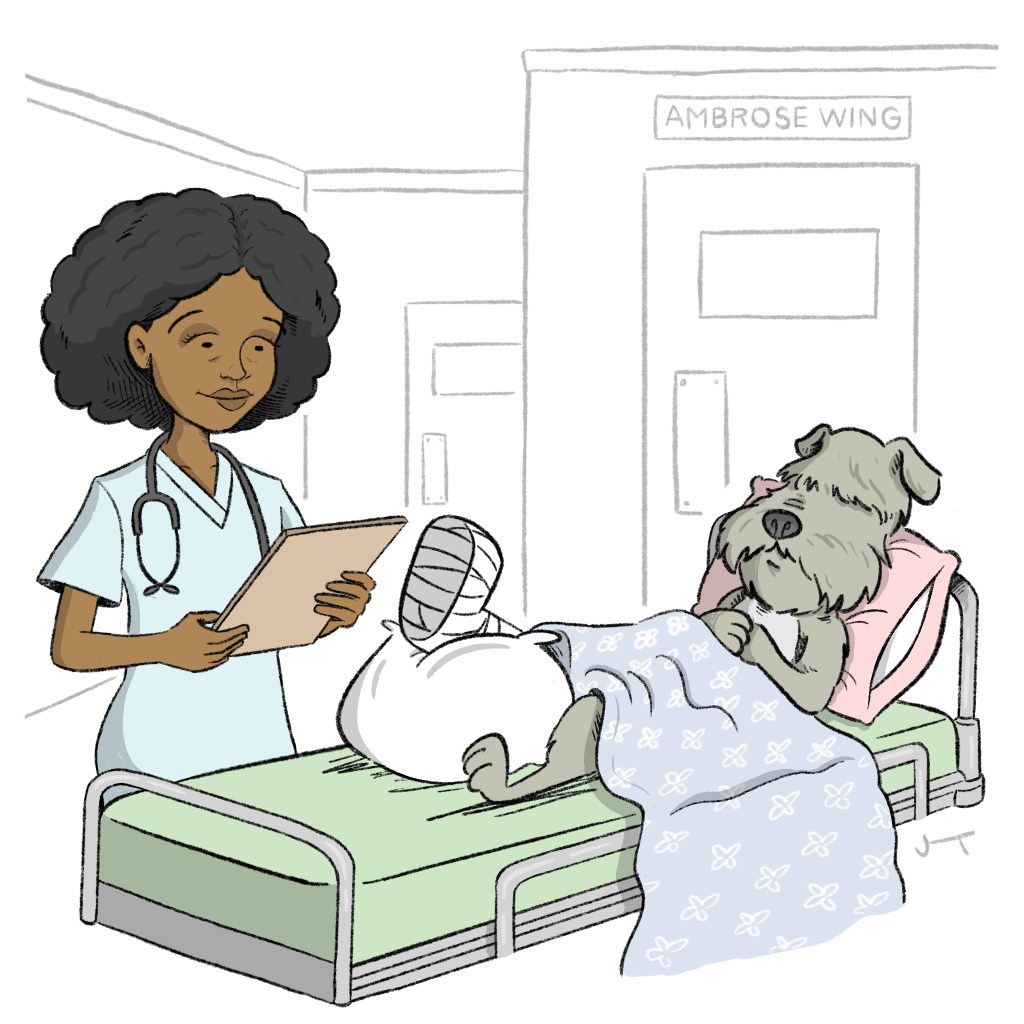
Dorothy Has A Fly In Her Fridge
by Ivan Brown
One fine morning, Dorothy thought to open her kitchen window to let in some fresh breeze. Unnoticed by her, though, there was a little hole at the bottom of the screen and it was not long before a fly found its way inside. All morning long, the fly buzzed around her kitchen and living room, while Dorothy wondered howshe was going to get rid of the thing.
As she went about her tasks in the kitchen, Dorothy opened the fridge to get out some milk and an egg for the cake she was baking. The fridge door was only partially open, but it was ample space for the fly to sail inside. Dorothy stood helplessly by as the intruder disappeared into the whiteness of the fridge’s interior and, try as she might, Dorothy could not spot it. How was she going to get rid of the annoying encroacher in her fridge?
Dorothy had an idea. She got out her fly swatter, and opened the fridge door. Eventually, she spotted the offending culprit, and she began swatting madly here and there and all around — carefully avoiding the milk, the broccoli, and the left-over casserole – until the alarm beeped for her to shut the door. The fly was still buzzing around unharmed inside. She would have to think of something more efficient.
She remembered a plant that eats insects – the Venus flytrap. She rushed out to an exotic plant shop and purchased their full stock of 13 flytraps, then positioned them around the inside of her fridge. But the fly was having none of it. After a full day, it was still roaming free.
“What else eats flies?” Dorothy wondered. Then she remembered spiders. She got down on all fours and, with a magnifying glass in one hand, she searched in the cracks all along the walls of her kitchen for spiders. As expected, she easily found a jar-full of 17 spiders which she then set at liberty in the interior of her fridge. By the next morning, 17 beautiful cobwebs had been spun among the milk, the broccoli, and the left-over casserole. But no fly was entangled in any of them.
Dorothy figured she had better go with something bigger. Frogs love a fly smorgasbord, she k
new. So, donning her rubber boots, she tramped through her local park to a pond where she procured 23 lily pads and, with a long-handled net, she captured 23 hungry frogs. Back home, she positioned the lily pads all around her fridge among the Venus flytraps, the cobwebs and the food, and set one frog carefully on each lily pad. She thought for sure this would work, but she was badly mistaken.
Perhaps birds would do the trick. A little research soon informed her that robins, swallows, and cardinals all enjoy a feast of insects, so she scampered outside with her bird calls and bird traps and managed to return back home with a nice menagerie of 31 robins, swallows, and cardinals to let loose in her fridge. The birds flapped around inside for ever so long, but they simply could not capture the fly.
The next morning, Dorothy slid open her fridge door just a little to grab some milk for her morning coffee and, when she did, out flew the fly. It buzzed around the kitchen for a couple of minutes, then headed for the window where it escaped to the outside world through the little hole at the bottom of the screen. After all her efforts, the problem was solved – just like that!
Fully relieved, Dorothy sat down in her easy chair to enjoy her morning coffee. She was so pleased to finally get that fly out of her fridge. Of course, she still had 13 Venus flytraps, 17 spiders and their 17 beautiful cobwebs, 23 frogs sitting on 23 lily pads, and a flapping miscellany of 31 robins, swallows, and cardinals to contend with.
She wondered if the left-over casserole would still be okay to heat up for supper.
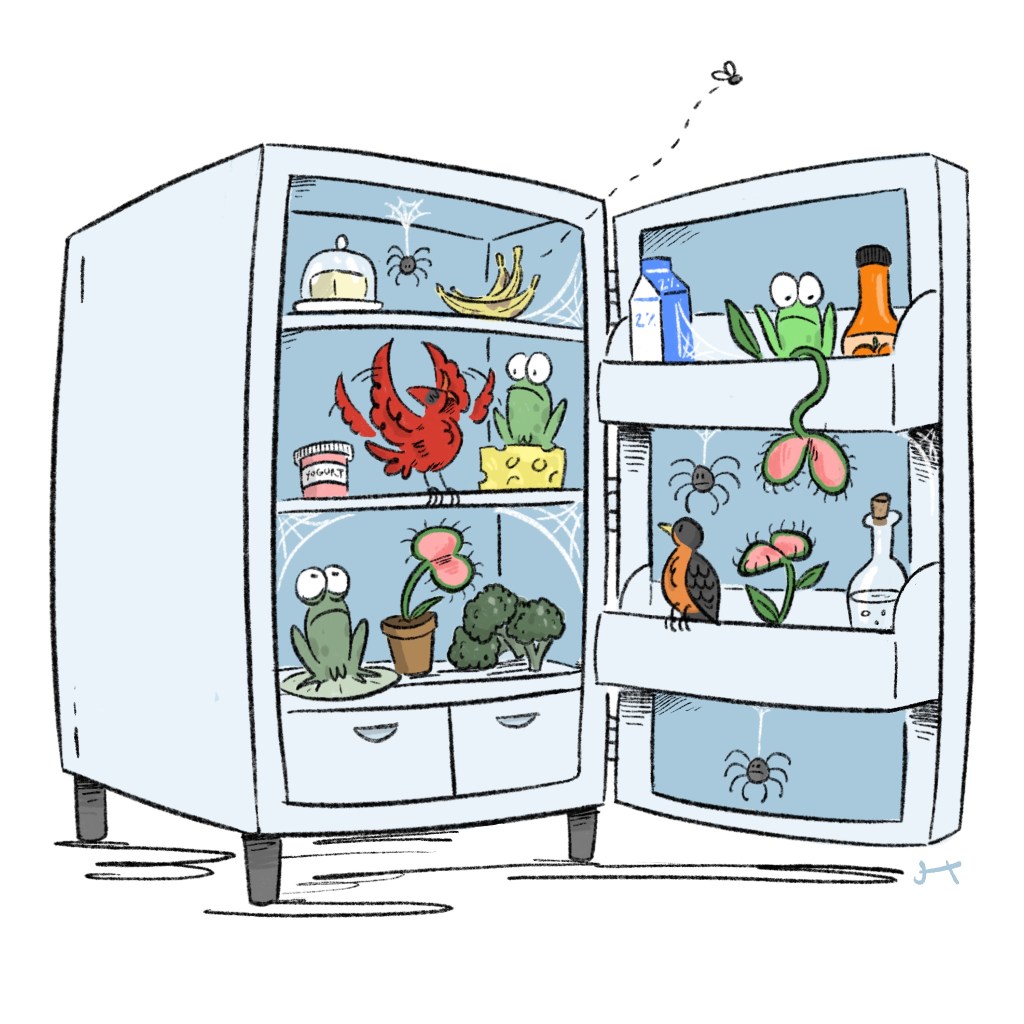
Clifford Has An Adventure At Age 40
by Ivan Brown
On the morning of his 40th birthday, Clifford set down the newspaper he had been reading. He had just finished an article about teenagers dressing and acting like cats, and demanding that litter boxes be installed in their school washrooms. Normally, Clifford would think this was a bunch of nonsense, and he would react like most 40-year-olds by scoffing, sneering, or even frothing at the mouth.
But not today. This day would be different for Clifford.
As he sat there contemplating what he had read, an unusual thought occurred to him: “Why can’t I be bold like those kids? I am 40 years old today, and what have I ever done that is wild and crazy? Nothing. If I am ever going to let loose, I better do it now before I am too old.”
Clifford thought more and more about how bold and adventurous the teenagers were to be cats. Slowly, an idea began to form in his mind: why not start a club for people who want to act like cows?
He placed an ad on every social media site his 40-year-old brain knew about, inviting people to join Clifford’s Cow People Club, and soon he had signed up a nice cohort of 27 people anxious to act like cows.
Their first meeting was in a meadow redolent with clover on the edge of town. The group of 27 cow people assembled in the middle of the field. The first thing Clifford did was a roll call to which each new member was required to respond with a suitable moo. It went well, except that the moos were all in different tones, each according to the voice of the mooer. “Hmmm…” thought Clifford, “that is going to sound rather odd when they all start mooing at the same time.” Once again, though, a brilliant idea struck him: why not have the 27 cow people moo in harmony?
He got the lower-toned mooers to moo a “do” while the higher-toned mooers followed with “mi” and “so”. The highest voices mooed in with a dominant seventh that completed the four-note harmony that trilled so very lyrically throughout the clovers and across the whole meadow. They tried other chords, then put them into a sequence, all with abundant success. Local farmers, accompanied by assorted family members – some of the elderly ones splashing milk from their milk pails and other old-timers with bits of butter and cheese stuck in their hair – heard the melodious moos and came rushing over to enjoy the occasion.
Clifford was momentarily stunned by the excellence of the sonorous sounds produced by his group of 27 cow people. At the same time, he was struck by the realization that a wonderful opportunity had come his way. Raising his arms and wielding a stick he had found on the ground for a baton, he directed their new-found talent in a moo-ing rendtition of Old McDonald Had A Farm, and when that was mastered successfully on the first try, they mooed Git Along Little Dogies, followed by the 90s country hit Down On The Farm.
“We must moove out of the meadow and share our talent with the world,” Clifford told the group of 27 cow people. “We will form a singing group, dress up a bit, and from now on our group will be known as The Moos-ics.” Together, they mooed, melodically, in happy agreement.
By the following week, all 27 members of The Moos-ics were outfitted from head to toe in black and white Holstein costumes, and all had donned headbands that featured two large cow horns. They assembled and recorded their three assorted songs, and they titled their new video album Pasture Prime. As expected, it went viral within hours.
Before they could catch their bovine breath, or even complete their first cud-chewing lesson, The Moos-ics were featured on various late night shows, and they were immediately signed to moo backup for Lady Gaga, then Justin Bieber and Taylor Swift. The following week, they received an honourary doctorate – the first ever awarded to a group of 27 – from the music department at the University of Regina. King Charles himself sent a congratulatory note praising the group’s magnificent achievements, mentioning only briefly that it might have been more environmentally friendly to dress as trees next time.
Clifford was ecstatic with the success of his group. But he had forgotten something he had heard so often as a boy, a saying his grandmother repeated from the Old Country: “Something or somebody can be euphonious for a short time only.” He had no idea what euphonious meant, or what the whole saying meant for that matter, but he was about to find out now. It would mean you can’t munch on the clover till the cows come home because… well, you just can’t. Sure enough, within weeks copycat groups sprang up here and there throughout the world. There was a group called the Symphonic Swimming Swans, another that named itself the Harmonious Howling Hyenas, and yet another known far and wide as the Glockenspiel Gonging Gnus. All were highly successful, and The Moos-ics became yesterday’s news.
Clifford’s day in the clover was over. His group of 27 Moos-ics dispersed. But Clifford had had a marvellous adventure, wild and crazy for once, and that made him happy to be 40 after all.
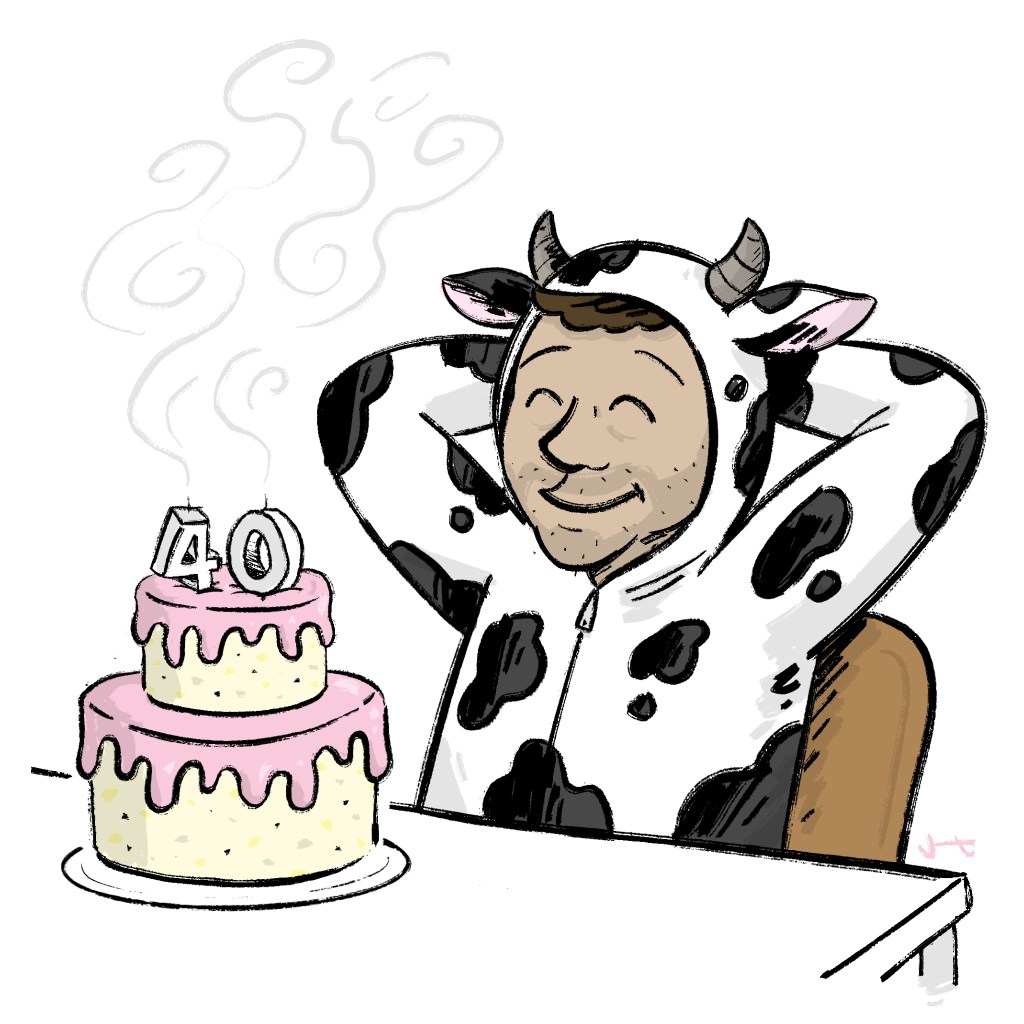
Are Squirrels Smarter Than I Am?
by Ivan Brown
When I opened my eyes this morning and peered out the bedroom window, I noticed a squirrel scampering from one tree to the next along a wire between two poles. “How do they do that?” I wondered. “I can’t even walk along a sidewalk without occasionally wandering onto the grass or off the curb.” Of course, I need to look at my phone to text my various friends as I walk along, and a squirrel doesn’t.
At least I don’t think squirrels have phones, do they?
For the rest of the morning, I camped out in my garden, disguised as a sunflower, to observe and jot down the comings and goings of my squirrel. I was amazed at all the things it could do. Slowly, a disturbing thought occurred to me: are squirrels actually smarter than I am?
Then I remembered I had a close friend, Dr. Henry Hoffleby, D.V.M. (University of Guelph), noted Toronto animal psychologist. Although best known for his internationally-acclaimed Intelligence Test for Deer, I thought surely he must know something about a squirrel’s intelligence. Dare I hope that he might even have worked on an intelligence test for squirrels?
“It is still in the development stage,” Dr. Hoffleby admitted in response to my inquiry, “but I feel confident that my newest test, the Intelligence Test for Squirrels, is going to be right on the money for me… er, I mean, right on the mark for you. I would be happy to let you try it out.”
“Yes,” I said as calmly as I could, disguising my voice to hide the excitement I so obviously felt.
INTELLIGENCE TEST FOR SQUIRRELS
© Henry Hoffleby, D.V.M. (University of Guelph), noted Toronto animal psychologist
Part 1. Genetic memory intelligence (what is natural to squirrels)
- Does the squirrel run up a tree when you chase after it with a broom? (Correct answer: yes)
- If you put out a peanut and a rotten fish, which one does the squirrel eat? (Correct answer: peanut – you may recall that deer do not like to eat rotten fish either)
- If the squirrel eyes another squirrel in the next tree, and it gets a romantic twinkle in its eye, can it scamper across a wire to the neighbouring tree to begin a love frolic? (Correct answer: yes)
Part 2. Adaptive learning intelligence (how squirrels adapt to their immediate environment)
- If there is a real sunflower and a person disguised as a sunflower sitting side by side in the garden, which one should a squirrel scamper up to get a snack? (Correct answer: the disguised person, who will give almost anything to get that furry tail out of its face)
- If there is a geranium and a person disguised as a geranium apparently growing in the garden, from which one would a squirrel pluck a flower to woo its squirrel-love? (Correct answer: the disguised person, as the flowers are not firmly attached)
First, I completed the test myself, as I was comparing my own intelligence to that of the squirrel. On Part 1, I can’t very easily scamper up a tree or along a wire – and I can’t recall ever having a twinkle in my eye for a squirrel, no matter how lovely – but I can eat a peanut, so… 1 out of 3. On Part 2, I guessed the real plants as they would be authentic, but no. 0 out of 2. Total score: 1 out of 5.
Next, I sat quietly in my garden, disguised as a geranium, to administer the test by observing the squirrel. To my surprise, it scored a laudable 3 out of 3 on Part 1, and a meritorious 3 out of 2 on Part 2. Total score: 6 out of 5. The squirrel had clearly outshone me on intelligence!
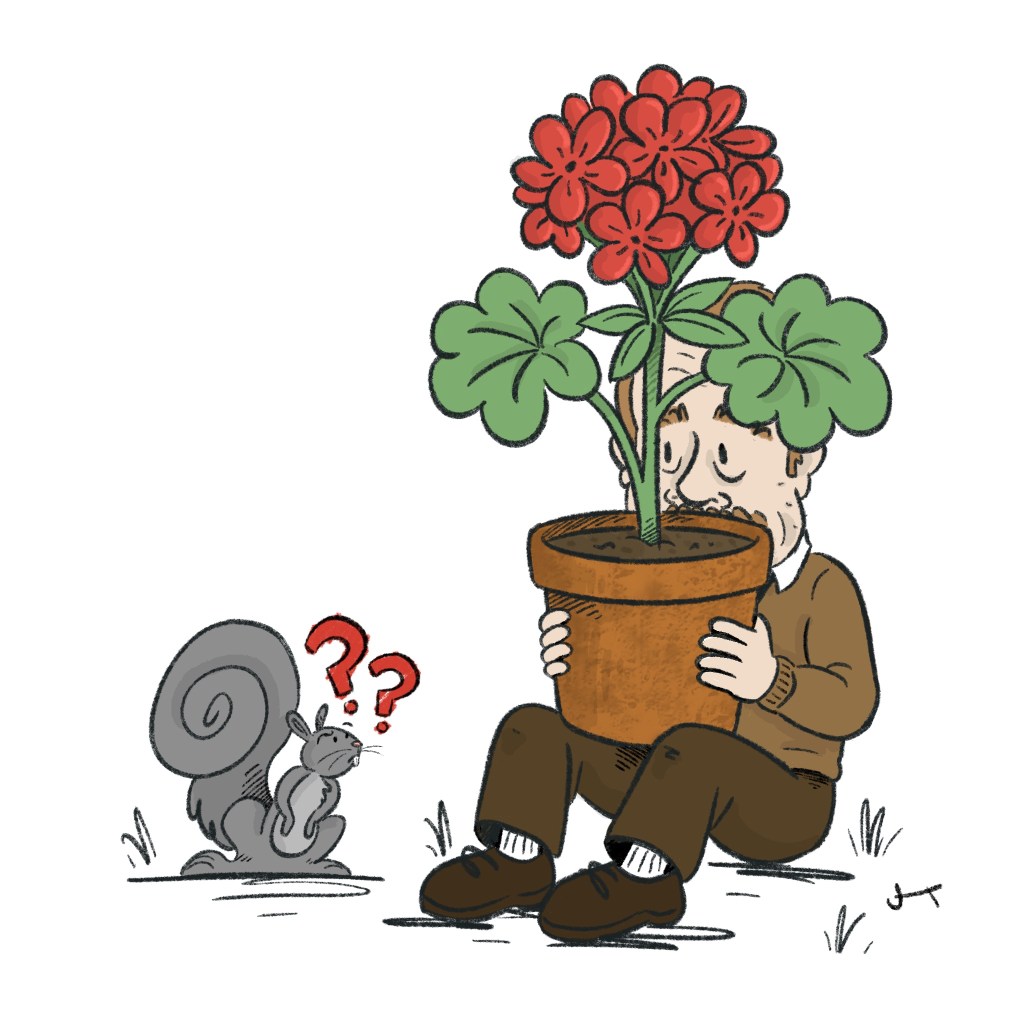
I couldn’t doubt the scientific integrity of the test, of course, but when I once again consulted Dr. Henry Hoffleby, D.V. M. (University of Guelph), noted Toronto animal psychologist, he advised that I engage in positive practice steps to improve my scores on a subsequent retaking of the test.
According to his plan, I tossed my phone in the bushes and was surprised to find I could then walk a straight line along the sidewalk. I set a decoy squirrel up on the grass on the other side of my lawn and walked toward it, pretending that I liked it enough to take it home with me and make it my pet. I practised these maneuvers all afternoon until I felt sure I was making real progress. I went to sleep that night feeling a wave of deep satisfaction that resulted in blissful dreams of me streaming to the finish line of a 5k run, beating my main opponent, a squirrel, by just a whisker.
When I opened my eyes the next morning and peered out the bedroom window, I was stunned by an astonishing sight. The squirrel had found my phone that I had tossed into the bushes and was balancing its way across the wire between the two poles, apparently texting all its various squirrel friends. It wasn’t looking where it was going. Off it fell, into the very bushes where it had found my phone.
Technology had come to my rescue. I was so pleased. Yes, technology was lowering the squirrel’s intelligence toward my own level, meaning I was catching up after all.
The Alien Who Found Photos In The Clouds
by Ivan Brown
Doris thought of herself as very modern. She was a woman of “a certain age” but when she went to a birthday or anniversary party of one of her friends, she snapped multiple photos. When she took her very modern and very adverturous annual vacations to Greece, the Galapagos Islands, or the Himalaya mountains, she took considerably more. She merrily shared a robust sampling of her best photos on various social media sites, as was her modern way, then stored all her photos in the cloud. In fact, she was so modern that she had not just one cloud, but three clouds, where she stored her many, many photos.
Like most people her age – or like most people of any age – Doris had no idea how clouds could store photos. But that didn’t matter because, modern as she was, she just assumed that it must work, and so she, along with thousands and thousands of others, blissfully sent their photos off to the clouds, fully trusting in their safety and well-being.
Now about this time, there was an alien, named Xzygxpfr, from a rather distant planet who decided to take a short summer vacation to planet Earth. It was the first time Xzygxpfr had been to Earth, although many beings from his planet had visited there over the centuries. What had intrigued Xzygxpfr were the many stories of how previous visitors made odd flashing lights in the sky then sped off faster than a shooting star, just to scare the daylights out of airline pilots. There were amusing stories about how they abducted stray joggers, luring them into the spaceship, then erasing their memories and setting them down in a pasture outside another town altogether. And hilarious stories about how they built great pyramids in the middle of vast deserts and long runways on high mountaintops that left humans scratching their simple heads in wonderment for centuries on end. Their stories all sounded like so much fun that Xzygxpfr just could not resist joining in the merriment.
So, off Xzygxpfr sped toward planet Earth in his small spacecraft, full of hope and anticipating a great adventure.
As he approached the region of Earth known to some as Canada, he noticed that it was such a cloudy day that he could barely peep through to see a bit of land or sea below. But these did not look like ordinary clouds, as they seemed to be covered with something. Curiosity overcame Xzygxpfr and he slowed his spacecraft to hover just above the clouds to have a closer look. Donning his helmet, he stepped out onto the wing of his spacecraft, and was surprised to see that all the clouds were covered with a thick layer of photos. What he didn’t realize at the time was that it was pollen season in Canada, and all the pollen in the air suddenly made Xzygxpfr sneeze, causing all the photos on the cloud directly below him to flutter into a chaotic whirlwind then slowly sift down toward the ground.
At that moment, Doris’ sister, Lorraine, who lived in Whitehorse, Yukon, was working in her garden harvesting her snow peas. She felt something flutter onto her sunhat, and was very surprised to reach up and discover that photos of Doris at the Parthenon in Greece had settled on top of her hat. Bewildered, Lorraine rushed into the house and poured herself a stiff gin on the rocks.
Xzygxpfr flew off to another cloud. What he did not realize at the time was that it was forest fire season in Canada, and the minute he stepped out of his spacecraft the smoke made him cough loudly. Down to Earth floated another scattering of photos.
At that very moment, Doris’ second cousin, Filmore, was raking dead leaves off his lawn near the Horseshoe Falls in Niagara, Ontario, when he suddenly stopped in his tracks, stunned, as he found himself raking a sizable pile of photos that featured Doris posing with various huge Galapagos turtles. “Huh?” was all he could mutter, as he stumbled into the house where he poured himself a stiff scotch on the rocks.
Xzygxpfr was confused. What on earth were all these things falling out of the clouds? Curiosity led him to investigate one more cloud. What he did not realize at the time was that it was Stampede season in western Canada, and when he heard all the cheering and clapping from the chuckwagon races he immediately joined in. Oops. This made another cloudfull of photos billow and eddy toward the ground.
Well. You guessed it. At that very moment, Doris’ great-aunt once removed, Olga, was outside in Kicking Horse Pass, Alberta, milking her goat when suddenly the goat gave an enormous kick that spilled the milk, the milk bucket, and poor Olga herself all over the barnyard. The kick resulted from the rippling arrival of numerous photos on the goat’s back and head, photos of Doris grinning into the camera beside an array of winter-clad Sherpas half way up and down and all around Mount Everest. The goat shook vigorously, and the photos spiralled here and there around the barnyard and ended up floating in puddles of goat milk, or lodging themselves behind Olga’s ears. Olga mumbled and staggered into the house where she poured herself a stiff goat’s whey on the rocks.
With some of the clouds dispersed now, Xzygxpfr could see what had happened. He quickly zoomed his spacecraft down to the three spots, gathered up all the photos of Doris and deposited them on another cloud somewhere in the sky. Off he went back home with a great side-splitting story to tell his fellow aliens.
And modern as she was, Doris never did understand why she couldn’t find her photos in the clouds where she had stored them, or why they were in another cloud altogether. Certainly, Lorraine, Filmore, or Olga were not going to say.
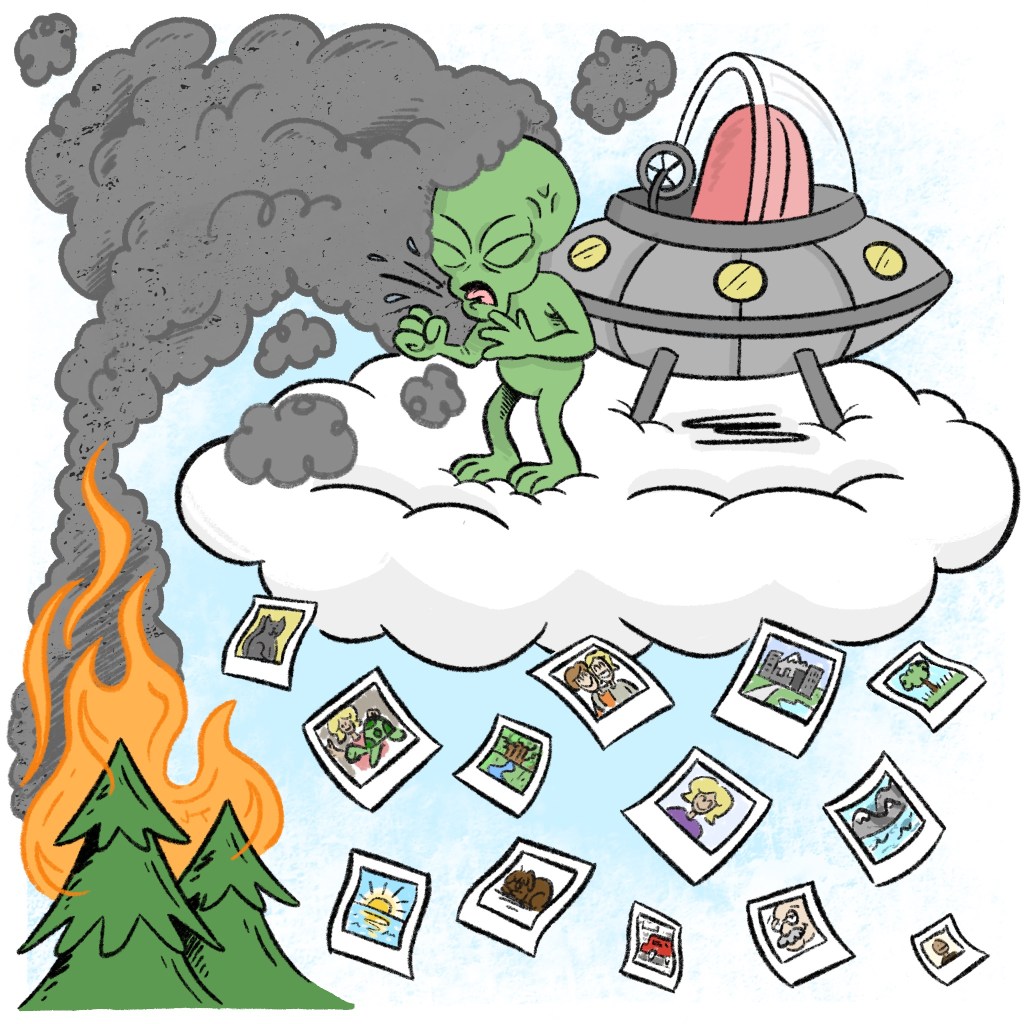
My Second Toe Is Longer Than My Big Toe
by Ivan Brown
Last year, as you may recall, ancestry.ca sent me an email saying that my DNA analysis revealed that I am not ticklish. That initiated my enrollment at the fashionable Toronto Ticklish School, where I failed so miserably that it sent the teacher, who went by the unlikely name of Ms Tickles McMickles, running shame-facedly for the hills and retiring in ignominy.
I should have learned my lesson and left well enough alone. But no, my curiosity was aroused again when ancestry.ca sent me an email message recently telling me that, according to further analysis of my DNA, I am in an elite group of only 5% of people who have a second toe longer than their big toe. I was astounded. I really had no idea my toes were so special.
How could I have lived all these years and not been walking around as proud as a peacock because of the relative length of my toes? I will never know. In any case, I determined that it was probably wise to verify their claim, so I sat down in a chair with a little ruler in hand to think about how I might best go about measuring my toes.
It occurred to me that measuring toes can be a tricky business. As every gentleman knows, the measurement of a digit can vary depending on whether you measure from the bottom, the top, or the side, so I was not at all sure exactly how to do it. I wanted it to be scientifically sound, of course, so I searched through several academic journals on anatomy and discovered to my delight that the standard method for big-toe-second-toe comparison is to stand the ruler between the two toes, then just look at both sides. Naturally, being a scientific method, it further recommended to repeat the measurement three times with three independent assessors to determine reliability and to avoid researcher bias. I concurred. I recruited three passers-by who were walking their dogs along my street, and all seemed delighted to take part in the endeavour.
The three independent measurements were carried out successfully with high inter-rater agreement among measurers, with only a ±1 mm difference. I was initially thrilled with this result, but then I jumped back, staggering, when I saw the actual figures. Left foot: big toe 5.5 cm; second toe 5.75 cm. Right foot: big toe 5.75 cm; second toe 6.0 cm. We were all surprised and, yes, a little aghast, not only because both my second toes were longer than my big toes, but moreso because the toes on my two feet are different lengths.
Do I have freak toes?
I had to find out. I could have completed another scientific search in my university’s library but, being lazy, I decided just to ask. First, I called the telehealth line that is so widely advertised on television as “helpful” and asked, “Do I have freak toes?” Their response was not as medical, nor as civil for that matter, as I thought appropriate. Next, I called the office of my member of parliament and asked the same question, but their response seemed far from polite, even for parliamentary language, in my considered opinion. Then I thought to call the office of my local church, even though I had not sat in any of their pews for some years, as it occurred to me that I would not wish to be judged negatively at the pearly gates, and thus not fit to enter, just because I have freak toes. The words used in their response were not nearly as pious as one might expect.
In desperation, I just asked my phone. Phones are so reliable, and they always give such accurate information. “No,” it answered right away, “you probably do not have freak toes. In fact, it is quite common for the toes on your left foot to be longer or shorter than the toes on your right foot. It is perfectly normal and not at all freakish. With one exception – if your second toe happens to be longer than your big toe!”
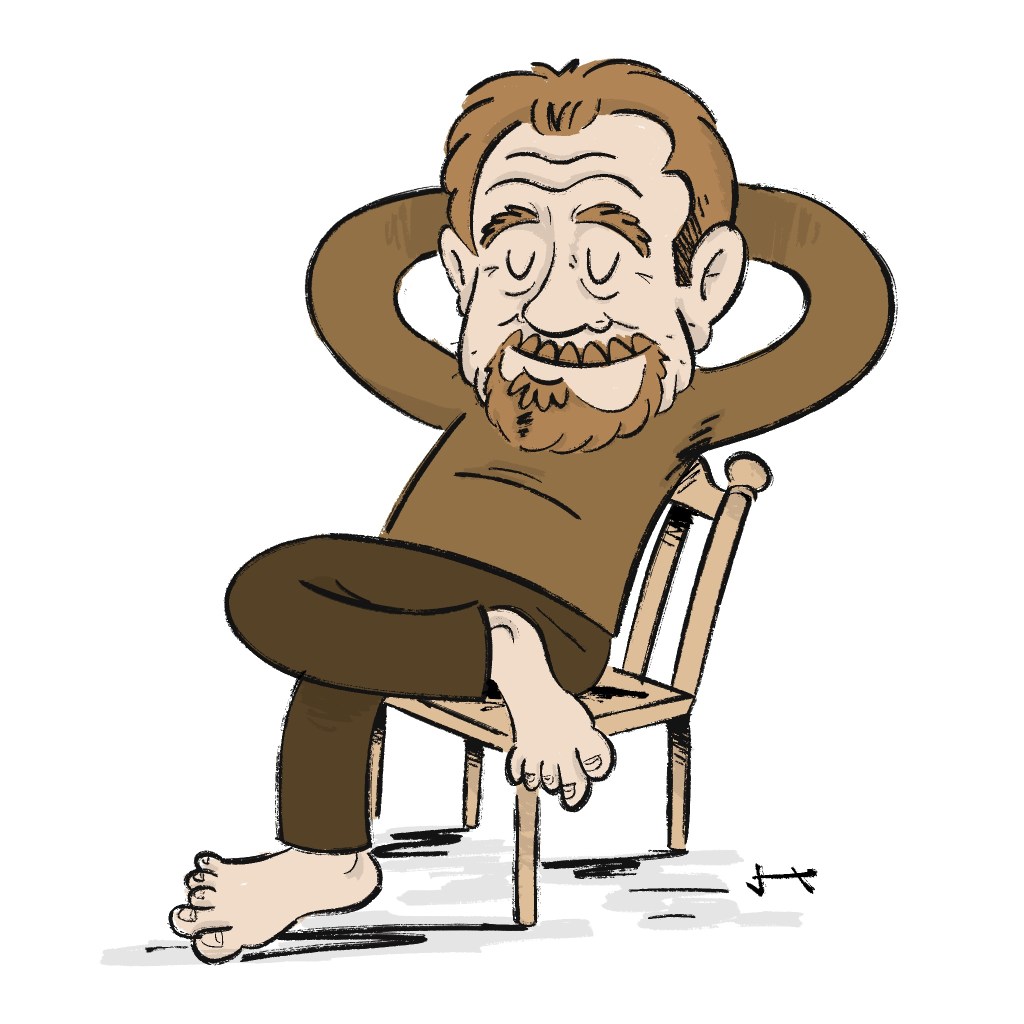
Candi And Bambi Lead Unidentical Lives
by Ivan Brown
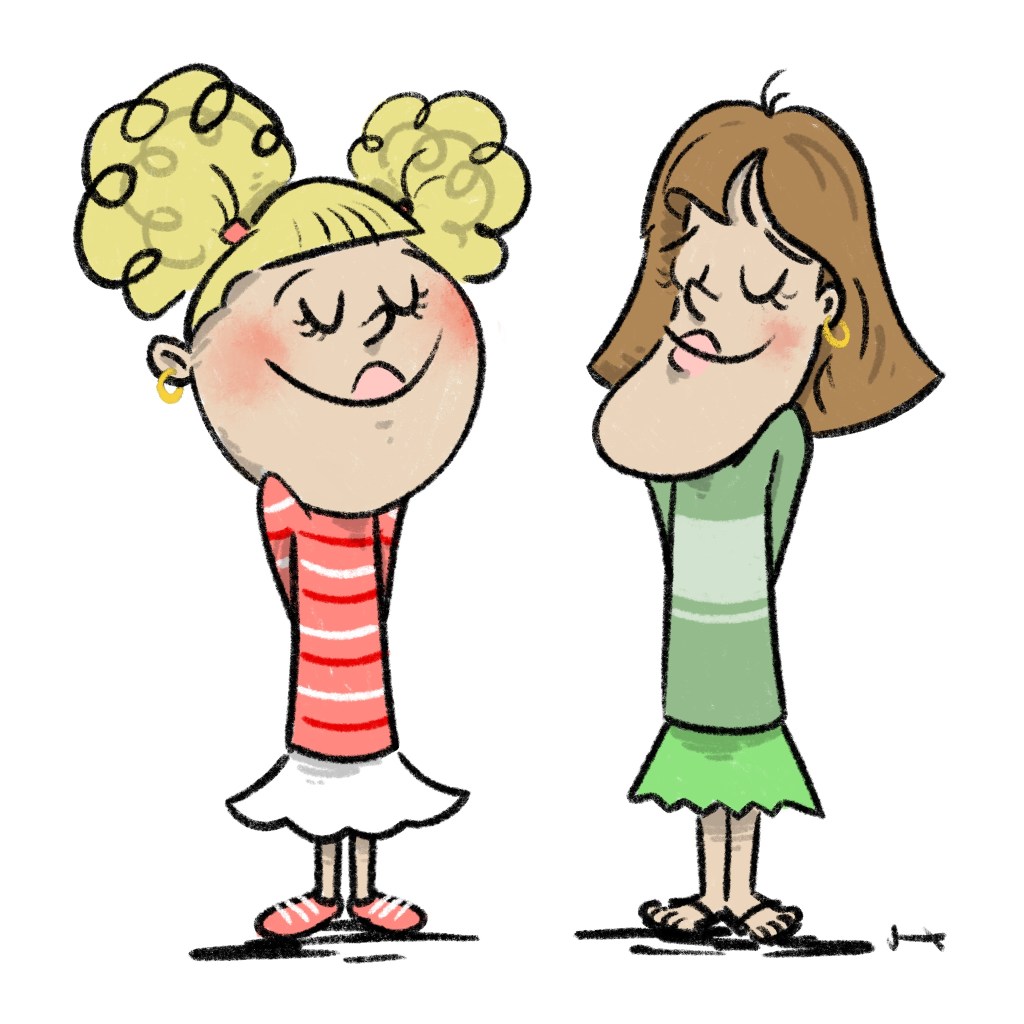
A couple I know named their twin daughters Candi and Bambi. I am not sure what possessed them to do so, but that’s how their birth certificates were registered. Candi and Bambi do not rhyme exactly, but, especially since they were identical twins, their names sound close enough that considerable confusion arose about which one was actually which.
To remedy this, their parents began to refer to Candi as “the sweet one” and Bambi became known as “the deer one” – a pun that they particularly enjoyed sharing with sour-looking friends and relatives. And this solved the problem of them being identical because, as you know, people do tend to act in a way to match their names and this makes them look like their names over time. True to form, Candi ate sweets a lot, while Bambi nibbled only on vegetation. As the girls grew older and their faces matured, Candi’s face gradually rounded out and her cheeks began to take on various colours until she more and more resembled a great big lollipop. But a sweet lollipop, her parents insisted. Bambi, by contrast, became a strict vegetarian of the most stringent type, and as she grew to the maturity of a young woman, her face began to look very much like a malnourished deer. But a dearly-loved malnourished deer, her parents insisted, still chortling over their pun.
As you also know, people tend to take on professions that are in keeping with their names. Candi and Bambi were no exception to this rule. Candi opened a sweets shop in Niagara-on-the-Lake, which to this day enjoys remarkably sweet success. Her face is all the advertising she ever needs. She just stands behind the counter, grinning her big lollipop face, and people immediately buy. Sometimes wayward children even try to lick her cheeks. Bambi bought a little farm just outside nearby Thorold, and set it up as a refuge for nervous deer who flocked to the safety of her enclosures during deer-hunting season, then just stayed on to feed on the red clover and alfalfa that grew abundantly in her meadows. They were so grateful for the hospitality that they sometimes licked her toes, or perhaps they just mistook her toes for a block of salt.
Now as it turned out, both Candi and Bambi fell in love – the very same week as almost always happens with identical twins or twins who were once identical. The two Romeos could not have been less alike. Candi’s hopeful, Juan Labra, was a suave señor originally from Peru and Bambi’s surely-intended, Johnny Hunter, was a rough-hewn lumberjack who hailed from Atikokan in Northern Ontario. Being old-fashioned women, Candi and Bambi married before starting their families and took on their husbands’ surnames.
This was unfortunate, for Candi’s married name was now Candi Labra, and Bambi’s was Bambi Hunter. Well, actually, it was not so unfortunate at all, because the names turned out to be a blessing in disguise, opening up new unimagined possibilities.
Soon after their marriage, Juan Labra and his new wife Candi Labra realized the financial possibilities of Candi’s name. They opened a lighting store next door to Candi’s sweets shop in Niagara-on-the-Lake and named it Candi Labra’s Candelabras. Who could resist flocking to a store with that name when you needed a new light fixture for your living room, or even your front porch? As for Johnny Hunter and his new wife Bambi Hunter, they also realized the gold mine that was in her new name. Just prior to deer-hunting season, they put up a large sign outside their farm near Thorold: Bambi Hunter’s Welcome. Hunters from far and wide misunderstood the sign, flocked to their door, and paid the $500 entry fee. They soon realized their error, though, when Bambi immediately undertook to convert them to vegetarianism and deer-loving. And was she successful! All she had to do was walk them out to the deer pasture, observe the delicate animals chewing happily on the abundant red clover and alfalfa, and not one hunter could retain his composure. No, it was not at all uncommon to see a manly teardrop slowly forming in the corner of a hunter’s eye as he observed the deer and felt his heart melting. All rifles dropped to the ground, never to arise again. To this day, rugged men in red caps and plaid vests can be seen frolicking through the pastures with does, fawns, and bucks of all sizes and shapes while cooing soothingly into their ears.
And thus Candi and Bambi led their unidentical lives. The sweet one became a shining example of quality lollipops and candelabras everywhere. The deer one gained wide recognition as a dearly-loved friend to reformed hunters who still delight in eschewing meat dishes of all kinds, instead spreading humus on gluten-free bread and munching on abundant red clover and alfalfa salads.
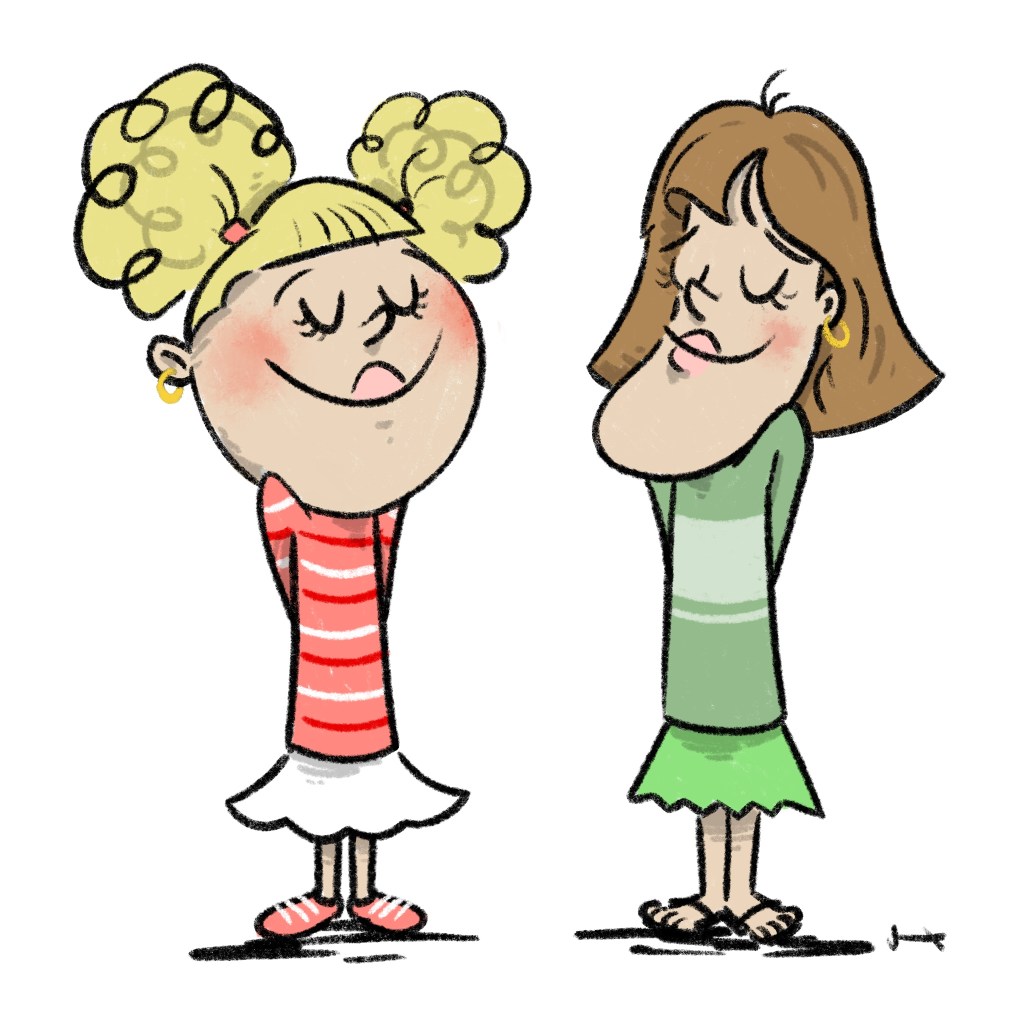
Also published in Medium, The Humor Pub https://medium.com/the-humor-pub/candi-and-bambi-lead-unidentical-lives-eb4279756197
Herb Gets A Job Watching A Door
by Ivan Brown

When Herb retired after many years of working, he found he had quite a lot of time on his hands. He was not a man to take up hobbies like woodworking or pottery. He had little interest in travel, and he could not bear the thought of joining clubs or going to the gym. Herb was a man of modest intellectual capacity, so reading a book or enrolling in an astronomy class were simply things that never crossed his mind.
Maybe he should get a part-time job, he wondered one day. His wife readily agreed that he should get out of the house. And the sooner, the better.
Herb looked in the usual spots for the many ads searching for old men with little talent to do meaningless work part-time. There were, naturally, dozens to choose from so he took his time and considered each one carefully. At last, he spotted a job that appealed to him very much. A film company was looking for a lazy person with no real ambition and a very meagre set of skills to sit on a stool and watch their stuff so nobody would steal it. That seemed like a perfect fit for Herb. He enjoyed sitting.
He was hired immediately.
Herb was not sure what to wear to his new job, but as this was a film company he thought something “artsy” would be best. He found a french beret at a local thrift shop, and set it jauntily on his head as he sauntered off to work that first Monday morning. He was not sure what he would be watching, but he had thought to take along a notebook and pencil in case he needed to jot down something. When he arrived at the film set, the supervisor hurriedly gave Herb a stool and told him to “watch this door today” then rushed off to issue orders to everybody else.
Herb sat down on his stool and looked at the door. It was closed. It was blue. It had a handle. Other than that, it appeared to have no features that were particularly remarkable. Herb sat there all morning watching the door. No one went in. No one came out. Nothing happened. He had no idea why he was watching the door, but he carried on anyway.
After several hours of watching, boredom itself planted an idea in Herb’s mind. He took out his pencil and opened his notebook and started sketching the door. He knew his wife would ask him later what he did on his first day at work, and he wanted to show her the door he had been paid to watch all day.
A film shoot usually attracts curious passers-by, and today was no exception. Several people stopped to observe the action, or to wonder why there was no apparent action, and when they saw Herb sitting on a stool, a beret set jauntily on his head and sketching a door in a pad, they understandably mistook him for a famous artist. They gathered around and peered at his pad while he drew, and marvelled at the simplicity of his style, at the child-like lines that oozed with a graphic vocabulary that, presumably, he alone understood.
Herb had no idea why the people were paying so much attention to his drawing, but he carried on anyway.
The next day, Herb decided to bring along a child’s painting kit that belonged to his granddaughter. When he arrived at his stool, where he assumed he was to watch the door again – although no one actually told him to – he was surprised to see quite a large crowd already gathered around waiting for him. A television reporter had been among the crowd the day before, and she had prepared a spot on the evening news about a new-found talent in the art world. Herb quickly got out his granddaughter’s painting kit and coloured the door blue, staying sort of between the lines, then sold it to a woman in the crowd who eagerly dug into her purse. The crowd called for another. Then another. So it was that Herb spent the whole day sketching one door after the other and painting them blue. Someone in the crowd set up an Internet site and began selling them. They sold like wildfire, and Herb was kept busy creating art until well after dark. The blue doors were popular beyond anyone’s wildest expectations and the demand grew steadily throughout the week. Although Herb really did not understand his success at all, he got so caught up in the momentum of the thing that he just carried on anyway.
By Friday afternoon, just as the demand for Herb’s art had reached a frenzy, the crowd around him was so large and teeming with so much enthusiasm that Herb was no longer able to see the blue door. But that did not matter because he was closing in on his 1000th piece and could easily draw the simple lines from memory now. While all this was happening, a curious teenager came by, opened the door and went in, leaving the door wide open. Out came the director shouting and waving her arms, “Who is supposed to be watching this door? Now you have let all the light in and spoiled the whole scene!”
Herb realized now why he had been hired to watch the door. He also realized his guilt, so he slid off his stool, slouched down amid the crowd and slowly began to slink away. The crowd, ardent fans to the core, encircled him and flowed off after him, keeping him hidden as he crept away out of sight. Away from the film set, away from his job, away from his art career.
And the bewildered director just stood there looking around, before storming back in through the open door. She slammed it shut and carried on anyway.
Should Women With Big Hair In Theatres Be Fined?
by Ivan Brown
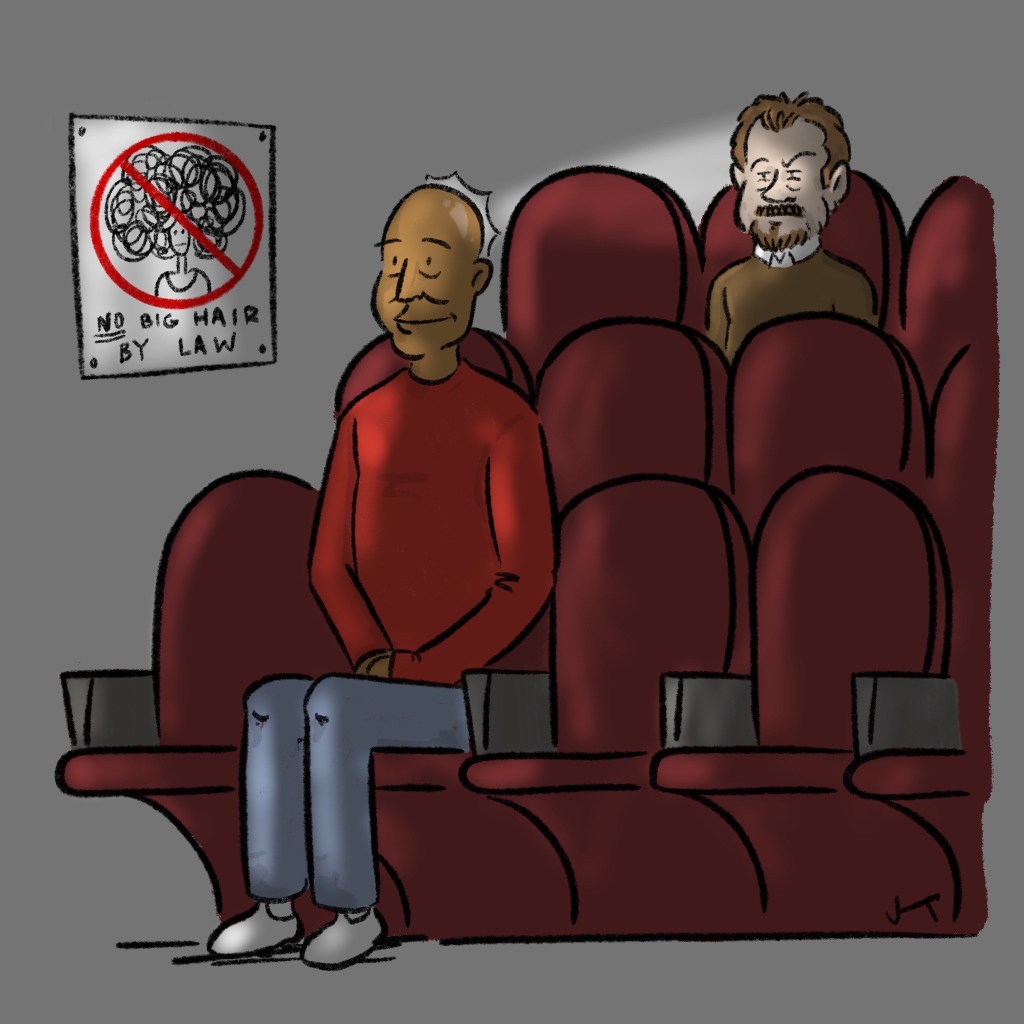
I don’t have anything against women who choose to have big hair – well, not much anyway. But, honestly, do they really have to sit in front of me in the theatre?
It seems like every time I go to the theatre, one of those women who sport enormous hair sits right in front of me. A great mound of coiffed gray has plunked itself right in my line of vision, looking very much like the hornet’s nest I thought I had whacked to death and tossed into the compost heap the other day. But no, there it always is, right in front of my eyes in the theatre, obscuring approximately 93% of my view.
I have little option but to sigh and give in, as I settle into my seat behind that large woolly globule on top of a head that hasn’t said hello to a pair of scissors in fifteen years.
Oh, I do try my best to look around that great mass of eagle’s-nest material, to get a glimpse of the play that I paid rather large sums to see. But never have I had success. I stretch my neck to the right, to the left, and up and down, but I can never see much of the stage. I mostly just see what very much resembles the twists and tangles of carefully permed sheep’s wool.
One day, in desperation, a solution occurred to me: women with overly-big hair in theatres should be severely fined. Moreover, they should be banned for life from theatres everywhere on the globe. Even Fiji. I immediately wrote to my member of parliament concerning the matter, and not only did she readily agree with me but she soon had a federal bill passed in parliament that was considered for less than five minutes by the Senate so that it could be rushed into law. Everyone was in agreement and pleased with the result.
I sighed in great relief. This would surely be the end of theatre-goers having to endure those great mounds of gray fur that, I feel certain, mice would be only too happy to frolick in.
Now as you probably suspected, those big-haired women cheated like crazy just to avoid paying their fines and still attend the theatre somewhere in the world. They flew on the sly to Tahiti where they sat on a log, blending their big hair in with the nearby bushes as they watched performers in traditional costumes dance around a fire. They sneaked off to an Azerbaijani opera house and took their seats in the back row so that audiences would not mistake their big hair for a costume and implore them to sing in a local dialect. They crawled on their bellies, as unobtrusively as women with very large hair are able, under the tent flaps of a travelling theatre in southern Chili, hoping the puppets in the traditional puppet show they were watching would not mistake their large headwear for firewood during their marshmallow-roasting scene.
In spite of this blatant cheating, I was pleased. The women with big hair no longer attended the theatre in my city.
Just to be sure, though, I decided to add a second solution – for insurance: whenever I bought a theatre ticket, I would purchase an extra “ticket” for the seat in front of me, then leave it empty. If a woman with big hair ever did try to sneak unnoticed into the theatre after the lights went down, the seat in front of me would not be available. She would have to take her big hair elsewhere.
As soon as I found the next play worthy of my attention, I bought the two tickets and marched into the theatre, anxious to actually see the stage for once. But there, two rows ahead and directly in front of me, sat a man whose height would make the tallest basketball player look quite ordinary in comparison. The houselights ricocheted off his bald head with a shining glow that, at first, I mistook for a harvest moon.
As I settled into my seat, I squinted and I stretched my neck to the right, to the left, and up and down in a hopeless effort to see a bit of the stage. But it was not to be. All I could do was sigh and think how desperately we need a law stipulating that tall men with bald heads in theatres should be severely fined.
Benny Designs T-Shirts For Coffins
by Ivan Brown
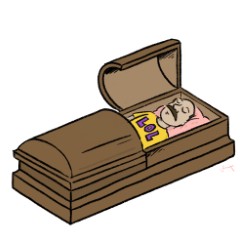
I have an acquaintance, Benny, who has an unusual profession: he designs t-shirts to wear in your coffin. I first discovered this when I was at a social event, a winter barbeque at his house, when we were both hovering as close as we dared to the barbeque flames in a losing attempt to keep warm. “So, what do you do for a living?” I inquired, shivering in so close to the heat that I was nervous about violating his personal space.
“Ah,” he piped right up, “I design slogans for t-shirts to wear in your coffin, and you have just given me a great idea for my next t-shirt slogan – I guess I got a little too close to the BBQ flames, didn’t I?”
I was flabbergasted. “Really? Slogans for t-shirts to wear in your coffin? Is there much call for that sort of thing? It sounds a bit … inappropriate.”
“Oh yes, it is getting to be very popular. There is a definite trend these days to make funerals light-hearted and joyful events, and people will spend a lot of money to make sure their funeral is that way.” I could almost see dollar signs popping out of his eyes. He continued, “When people today prepay their final social gathering – it is old-fashioned now to even call them funerals – they can select the size, colour, and slogan for the t-shirt they want to wear to give their guests a chuckle. That slogan you just inspired is a perfect choice for someone who loves to barbeque. I am going to make a lot of money out of that one.”
I had some doubts, but Benny seemed pleased. “So… how many different slogans do you have for people to pick from?” I asked, cautiously.
“I have 30 or 40. Do you want to hear my most popular ones that sell really well?” I was not sure I did, but morbid curiosity impelled me to say yes, so he lit right in:
Wish you were here
So long, farewell, auf wiedersehen, goodbye (with music notes)
Now I understand the saying ‘Get a life’
Excuse me for spoiling your golf game today
I’m still coming to your birthday party next month
Never turn your back on the Grim Reaper – I found out the hard way!
Seems I was the nut that fell off the tree of life
I’m not with Stupid any more (finger pointing to a spot to insert a photo of your spouse)
I was still not a bit certain that any one of them was very respectful of the death condition. Benny paid no attention, but continued on, boasting about how much money he was making from selling his coffin t-shirts on the internet. My jaw dropped. Business, it seemed, was not just lively, it was booming, “How much,” I wondered, “will he make from my barbeque-inspired slogan?”
A few weeks later, I noticed that there was a Barbeque Convention in my city. I wondered if Benny might be there selling t-shirts, so I bought a ticket and went. Sure enough, I soon spotted Benny in an exhibit booth that had a large banner across the front that read: Buy the T-Shirt To Wear In Your Coffin. Benny was busily selling t-shirts, every one with the slogan I had inspired: I guess I got a little too close to the BBQ flames, didn’t I?
When I came back a few hours later, I saw that Benny had enjoyed great success. Every one of the 350 t-shirts had been sold, and Benny was looking very pleased.
Later, at home, I mulled over the day’s events. I was finally beginning to understand what Benny had meant when he talked about today’s trends in funerals. Gone are the days when people dressed in black, hugged one another for emotional support, and sobbed into their handkerchiefs because they would not be seeing the Dear Departed in the future. Nowadays, it is up to the Dear Departed to provide the entertainment and make that final social gathering one for all to enjoy.
And that gave me an idea. I would get with today’s trends. I would design my own t-shirt to wear at my own final social event when the time came. The slogan on the shirt would read: Benny, I didn’t buy this one from you.
Also published in Medium,The Humor Pub https://medium.com/p/a02fd58cee9d
Willy Shakespeare Tries To Write Plays About Elves
by Ivan Brown
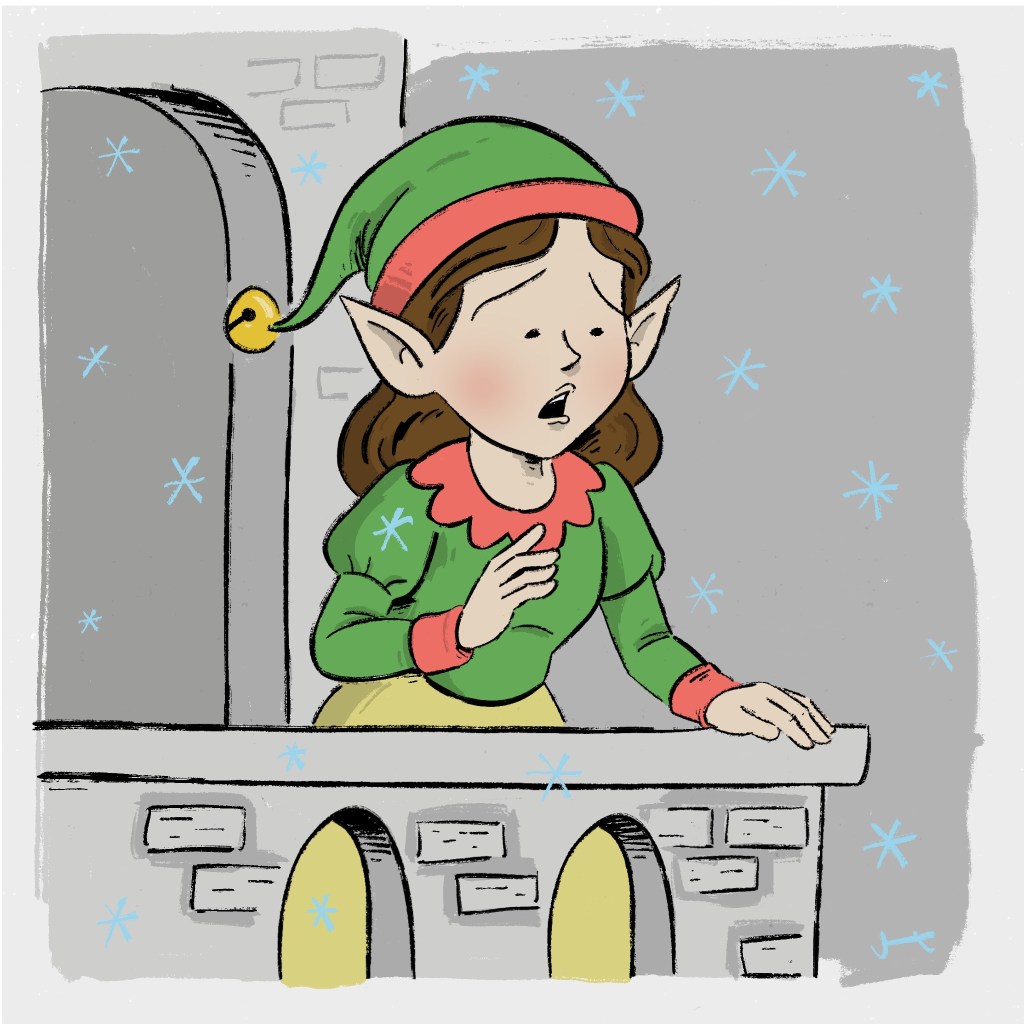
As you know, Santa’s elves have been around for several centuries now. What you may not know is that they did not always live at the North Pole. No, they were born in little villages around the world where they grew up alongside ordinary children, sharing the things that children everywhere love. When it came time for them to go their own way in life and earn a living, some of the lucky ones got jobs in Santa’s workshop at the North Pole making toys to fill children’s stockings on Christmas Eve.
Now one such elf, Milly, was born in England on December 24, 1563, in the dusty little town of Stratford-upon-Avon. Yes, of course you know that town. It is the very town where William Shakespeare was born and where he grew up. In fact, Little Willy – the moniker his father immediately chose upon spying the naked newborn squirming around and letting out his first holler – was born a few months later, right across the street from where Milly lived. They were neighbours.
Who knew these unlikely neighbours would grow up to be a famous playwright and a – well, maybe not quite so famous – elf in Santa’s workshop?
Milly and Willy became childhood friends and played together constantly. Willy made up ridiculous little skits about a funny old man who kept reindeer at the North Pole, and Milly created all the props. The two friends went to school together, too, where their different talents began to blossom. Milly excelled in craft-making and Willy showed some promise in soliloquy-making. When the time came, they even graduated together, wearing jester-shaped mortarboards as they marched across the stage, humming a little tune they had made up together that they called Pomp and Circumstance – you know, the very one Edward Elgar stole and copied note for note about three centuries later.
After graduation, the two friends went their separate ways as often occurs with young people. Willy made his way to London where he tried to break into the theatre scene. Milly, not knowing exactly how to fashion a career out of her penchant for making crafts, answered an ad she saw in the Stratford-upon-Avon Times seeking a talented elf to make children’s toys, like little tin drums, dolls, and choo-choo trains. The application was to be sent to S. Claus, North Pole, Planet Earth.
When Santa saw the charming samples that Milly included with her application, he hired her immediately. And thus, Milly moved to the North Pole and began her career as one of Santa’s celebrated elves.
Willy, for his part, never forgot his childhood friend. When the idea occurred to him one day to write a play, he sat down to scratch his head and wonder what to write about. Then he remembered that people always said to write what you know, so he thought, “Why not write about elves?”
His actor friend suggested he write a little something about an annoying uppity Scottish couple who lived next door to him, the Macbeths. Willy sat right down, goose quill in hand. The play started out with three elves in their kitchen stirring a pot of haggis soup, saying, “When shall we three elves meet again? At Stratford-upon-Avon in the rain?” The story unfolded with a bunch of naughty elves playing considerable havoc with poor Lady Macbeth. In a great climactic scene to conclude the third act of the play, an exasperated Lady Macbeth was to rush across the stage ferociously waving a broom at the scampering of bad elves, yelling, “Out, damned elves! Out, I say!” Sadly, Willy’s editor red-pencilled line after line, replacing the opening three elves with witches and the bunch of naughty elves with – merely – one damned spot. The editor maintained that her new line about the damned spot would be widely quoted, if it were ever to catch on, but Willy wondered who would want to watch witches and a spot when they could have elves. Still, he had to just sigh and give in. He wasn’t the one writing the paycheques.
A similar thing occurred the next few times Willy tried to write a play. He wrote about a beautiful young elf, Milliette, coming out onto her balcony and crying out into the night for her elf lover, “Willeo, Willeo, wherefore art thou Willeo?” The editor – weirdly – changed the characters from elves to teenagers and – selfishly – altered their names to those she had given her own two children, Juliette and Romeo. Well! In another play, Willy wrote about a handsome royal elf, Prince Ramlet, pitter-pattering his little feet to the front of the stage and wondering aloud, “To be or not to be an elf… Which one do you think would be a bit nobler?” Again, the editor balked. The prince was changed from elf to young man, the wording was changed, and Willy could only grimace on his way to pick up his paycheque.
This went on in play after play. A Midsummer Elf’s Dream, Richard the Elf, Two Elves of Verona, The Merry Elves of Windsor, and The Taming of the Elf all ended up in the trash bin, although the bones of the stories were later secretly dug out, altered substantially, and published to lucrative effect by Willy’s greedy editor.
So, not one of Willy’s wonderfully inventive plays based on his dear childhood friend Milly, a respected elf in Santa’s workshop, ever saw the light of day. Willy wrote to Milly, revealing the whole sordid story. A few days later, Santa came across Milly reading the parchment Willy had written on and drying tears from her eyes with the corner of her work apron. He asked her what was wrong. Her sad story made Santa empathize fully and shed a sympathetic tear of his own. Right then and there, he vowed to forever and ever boycott the greedy editor’s altered scripts.
And that is why, even today, when Santa comes down the chimney on Christmas Eve, dusts the soot off his suit, and begins to fill all the young children’s stockings with little tin drums, dolls, and choo-choo trains, he has never, ever – not even once – included a copy of The Complete Works of Shakespeare.
Doris Sits On A Discarded Toilet
by Ivan Brown
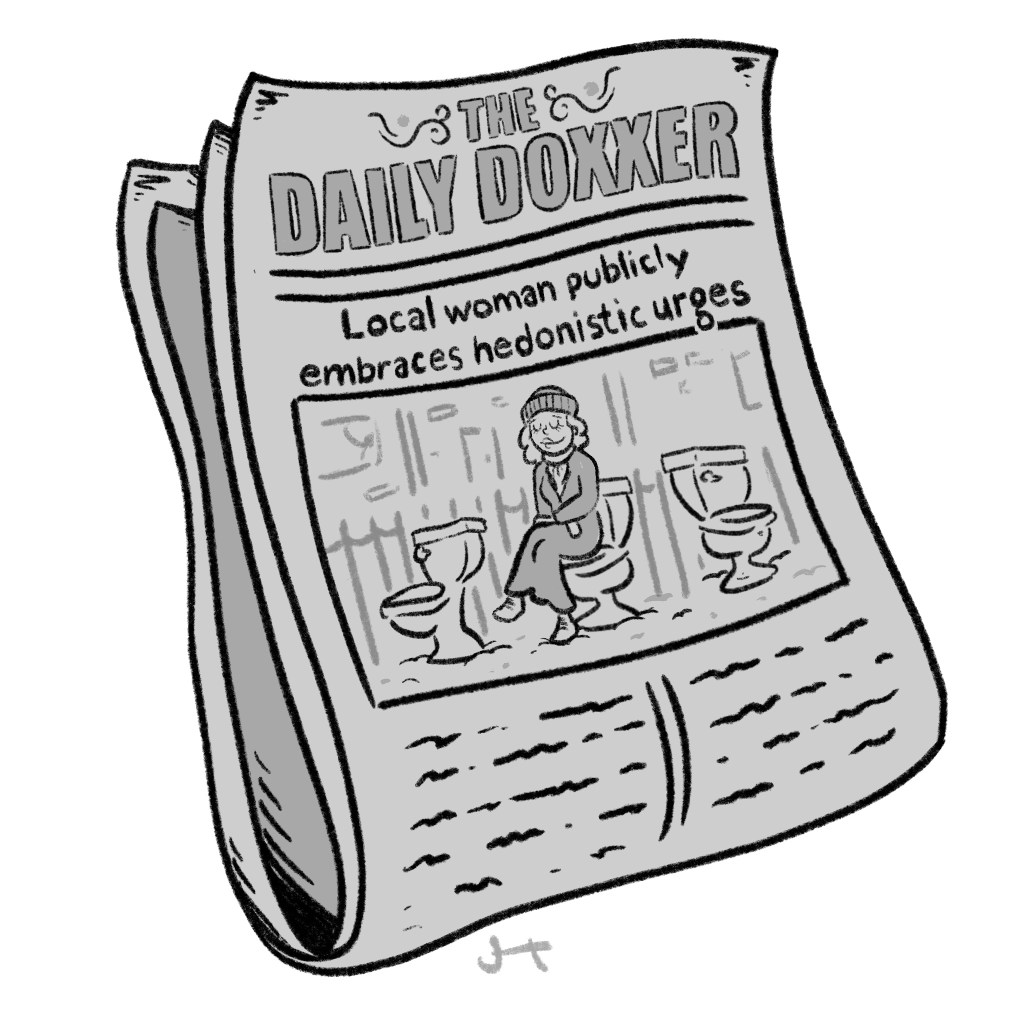
Doris is a woman of some mature years who lives on an established, and still respectable, street in my city. I think you know this kind of street, one where affluent young people buy older houses then totally renovate them. One winter morning, as Doris made her way along the sidewalk, stepping carefully in case she might slip on a bit of ice under her feet, she noticed one of her neighbours’ houses was undergoing what looked to be a thorough renovation. There were boards and tools strewn all around the snow on the lawn and, on the sidewalk in front of the house, the workers had set out three toilets for discard. The toilets were lined up nicely one beside the other, facing outward. They had been cleaned to shining and the lids were all tastefully closed.
As Doris approached the three toilets, a strange notion entered her mind: she felt a strong compulsion to sit on one. The compulsion was so strong that when she got to the toilets, she gently sat down on the lid of the middle one, graced by a toilet on either side. Unnoticed by her, though, a small group of teenagers were chatting their way to school behind her and, upon spotting Doris perched on the middle of three toilets, they were equally compelled to grab their phones and snap some photos. Within mere seconds, their nimble fingers had cropped and enhanced the photos and sent them off to a local newspaper – The Daily Doxxer – that had a reputation for splashing unlikely photos all over its front pages to attract readers and non-readers alike.
The next morning, as Doris bent to pick up the morning paper on her snowy porch, she was shocked to find a photo of herself sitting in the middle of a line of three toilets, right out on the sidewalk, taking up much of the front page of the newspaper. The headline blaring across the top of the photo read, “Local woman publicly embraces hedonistic urges.” The very first sentence under the photo raised the question, “Is it okay for an elderly woman to be sitting in public?” – a blatant play on words that was, of course, distasteful in the extreme to all but those with thoroughly debauched minds.
To say Doris’ jaw dropped in horror would be the understatement of the century.
The photo and the accompanying stories, all highly fictionalized, could not escape the benefit of widespread publication on social media, and even in the real media. Doris’ phone rang all day long, then all week long, with reporters asking questions such as, “How does it feel to sit on a toilet in public?” Some of the less polished ones even asked, “Was there any toilet paper available?” Doris barely knew how to stammer out her answers, and she felt stressed to the limits.
The effects on her street were even more profound. Reporters rushed to the scene, snapping photos, rolling their cameras, and interviewing concerned neighbours and random passers-by. The renovators’ union equally rushed over and set up picket lines in defense of their workers’ right to place toilets on public sidewalks if they wanted to. Groups of neighbours spontaneously sprang up, raising both their fists and their quickly-made signs to protest public toilet-sitting on their street. Other groups of protesters, waving placards and chanting little verses in the winter air, gathered across the street, identifying themselves as the Society for Respectful Toilet-Sitting Rights. Real estate agents sped to nearby houses and yanked out their For Sale signs, as property values on the street plummeted like the rush of a flush. No one wants to move into a neighourhood where an elderly woman might be sitting on a toilet in front of your house.
All in all, it was quite a hullabaloo.
In time, though, calmness and order resumed. The reporters went on to the next sensational scandal. The union won the right, in court, to place toilets on the sidewalk if they wanted to, provided they set up a clearly marked sign that read No Sitting Allowed. The protesters decided to bury their differences and become friends, and they all wandered off in little groups to eat donuts in various local coffee shops. Real estate values rose again and houses sold well to affluent young people, resulting in contractors of all kinds busily renovating this house and that house along the street.
But Doris didn’t trust herself to walk along her own street ever again. She took a taxi wherever she went. Who knows when she might see an old bathtub carefully set on the sidewalk for discard and feel a compulsion then and there to take a bath.
Also published in Medium, The Humor Pub https://medium.com/the-humor-pub/doris-sits-on-a-discarded-toilet-662433af5a79
Elsie Gives New Meaning To New Years Resolutions
by Ivan Brown
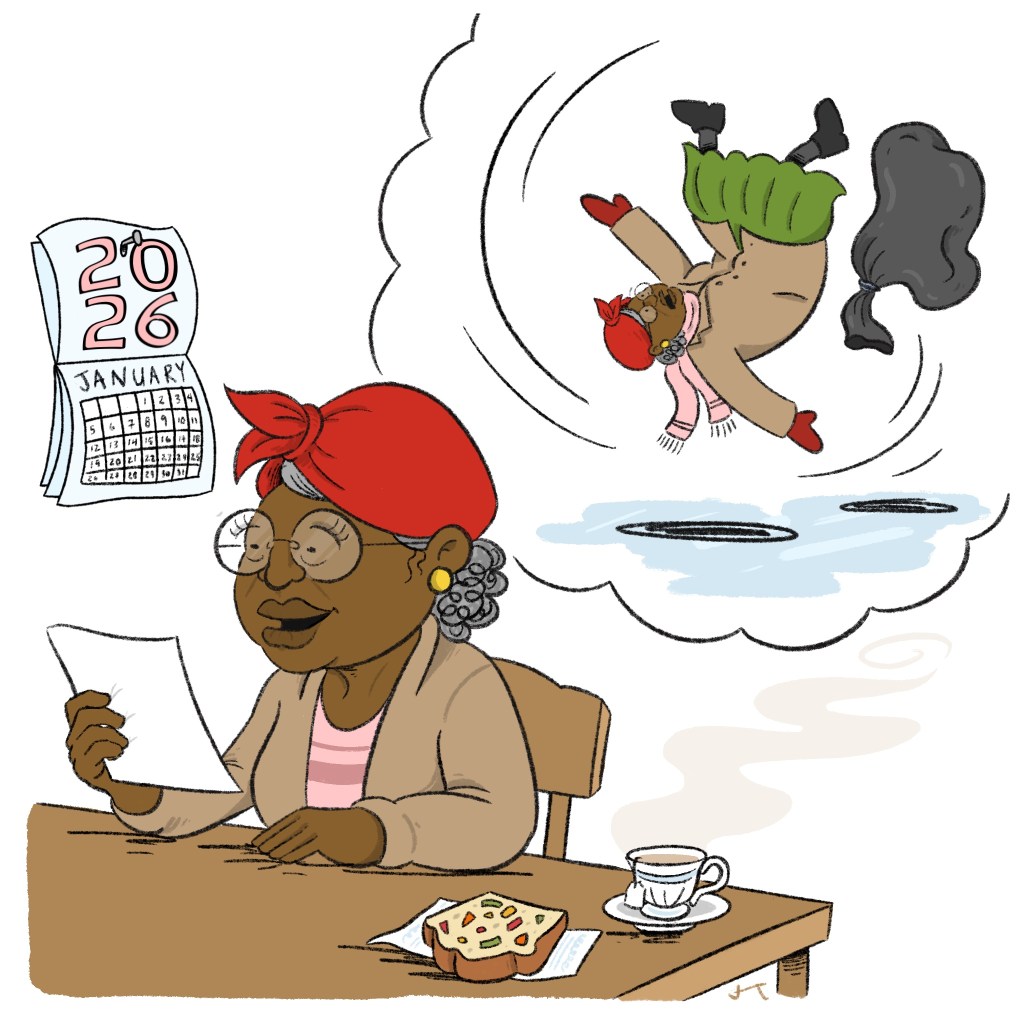
Marj, you may recall, had been able to keep her New Year’s resolutions last year for the first time in her life. She was so pleased about this accomplishment that she decided to start a club this year. She invited a scattering of lady friends and neighbours one Thursday afternoon and served them tea accompanied by slices of fruit cake on fancy napkins. “Welcome,” she announced when all her guests had their mouths too full to talk back, “to the New Year’s Resolutions Club. We will each make several resolutions to carry out this year, and at our next meeting – next week – we will report on what we have come up with.”
She looked around the room at the faces and slightly bulging cheeks. It did not look promising, but Marj, as always, was one to rally the troops. “We will succeed, won’t we ladies.” Some tentative nods and a number of murmurs could be distinguished, although lady after lady quickly downed the remainder of her tea, and it began to occur to them all simultaneously that the time was getting on and their husbands would be wondering what was for supper.
The last one out the door was Elsie, who exited with a notably perplexed look on her face.
You see, Elsie had been having some trouble with her hearing over the past few years but she was not yet anywhere near to admitting that hearing aids might be in order. The result was that she had not fully grasped every word that Marj had said about making several resolutions by next week’s meeting. What her ears did pick up was that over the next week she had to do seven revolutions.
Elsie was not entirely sure what a revolution was or why she would be doing seven of them, so she looked the word up in the dictionary. The first definition said something about overthrowing a government by violent force and replacing it with a new kind of government. Oh my. She was not at all sure she would know how to go about doing that, especially since she only had a week to do it. And why on earth was Marj trying to make her resort to violence anyway?
The second definition had something to do with totally changing the way society worked. The example given was the Industrial Revolution. Well. It had taken her ever so long to learn how to heat up something in the microwave, and she still had no idea what all those buttons on her TV remote were for. So, being able to change the way an entire society works, with only seven days to do it, seemed like a chore that would be just a little beyond her… well, she simply didn’t have time to think about it. That Marj!
Elsie read on. The third definition had to do with turning in a complete circle. Like the earth does a complete revolution around the sun once a year. Or, Elsie thought enthusiastically, like that door in the hospital that goes in a complete circle as you go through it. Okay. This would be easy. Elsie was pretty sure she could master seven revolutions in a week. She would record her revolutions, one each day for seven days. That would show that bossy Marj!
Elsie’s list of seven revolutions
Monday:
As I was taking my garbage out for pickup this morning, I slipped on the ice in my driveway and, as the English say, I went head-over-teakettle. My first total revolution was witnessed by half the neighbours on my street. My, my, my. And the garbage all over the sidewalk!
Tuesday:
I went for my afternoon walk, and circled the block without slipping once. Okay, a couple of near misses, but today I did my revolution around an entire block!
Wednesday:
I walked again, this time listening to a Canadian award-winning audiobook through my earbuds, but I became so disgusted with the author moaning on about her pitiful life that I stopped, did a complete revolution, and headed home.
Thursday:
When taking a nap after breakfast, I half turned over on the couch and was struck with a thought: if I just keep turning, I will have my full revolution for the day. By then, though, I was wide awake. Some nap!
Friday:
When I couldn’t locate my reward card fast enough in the checkout lineup, the man behind me issued a comment that I considered rather unsavoury. I wheeled around, but then I remembered my nap turn. So, I just looked him in the eye and said, “Thanks. If I keep turning, I will have my revolution for the day.” I kept turning and he just stared straight ahead, unable to think what to say.
Saturday:
Nothing happened all day that came close to a revolution, so at 9 p.m. I got down on the floor and did a somersault. It was a full revolution, even if I did take me half an hour to relieve the charley horse I got in my leg.
Sunday:
I was running out of ideas, but I suddenly remembered that the earth does a complete rotation – a revolution – every 24 hours. I actually did not have to do anything at all. I could just sit on my couch, in one spot, and I would have completed one revolution by the time tomorrow rolls around.
Marj called the next meeting to order. Lady after lady, when called upon, had not thought of a single resolution that she would be able to carry out. Marj had nothing to contribute either as she was of the opinion that, given her inordinate success last year, she could take a year off resolving. But there sat Elsie, proudly, with her list in hand. When Marj nodded in her direction, Elsie stood up, held up her paper and read her accomplishments – her seven daily revolutions.
Marj and the other ladies sat there, not able to think of a thing to say,. When she was able to stammer a bit, Marj resigned a Club Presidency on the spot. Elsie was the only one who seemed able to speak, so she thought she should take over as Interim President if they were ever going to get to their tea and cake. Without knowing, she had overthrown the established governance structure with a new order. She immediately instituted new rules that entirely changed the way the club worked: all the ladies would only have to come up with one idea per month and they could email their results to the group. That totally changed the way the club worked. But it would have to be an entire, full, complete turn to qualify as a revolution, she proclaimed. It had to be a real revolution.
It had all worked out so perfectly. Elsie had managed not only to complete her list of seven revolutions, but she had also managed – without even really trying – to carry out all three meanings of revolution.
Marj just stared straight ahead, unable to think what to say.
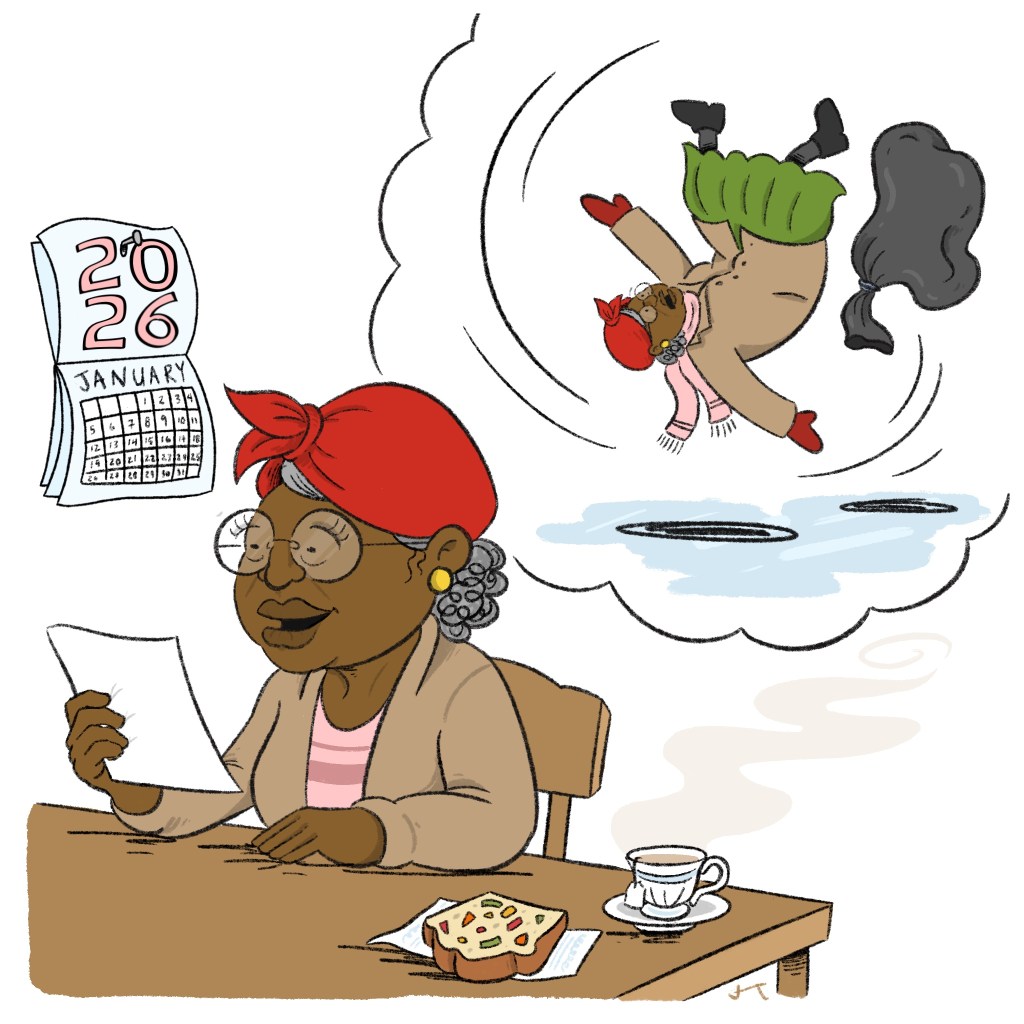
I Expand My Horizons In An Effort To Be 95 Some Day
by Ivan Brown
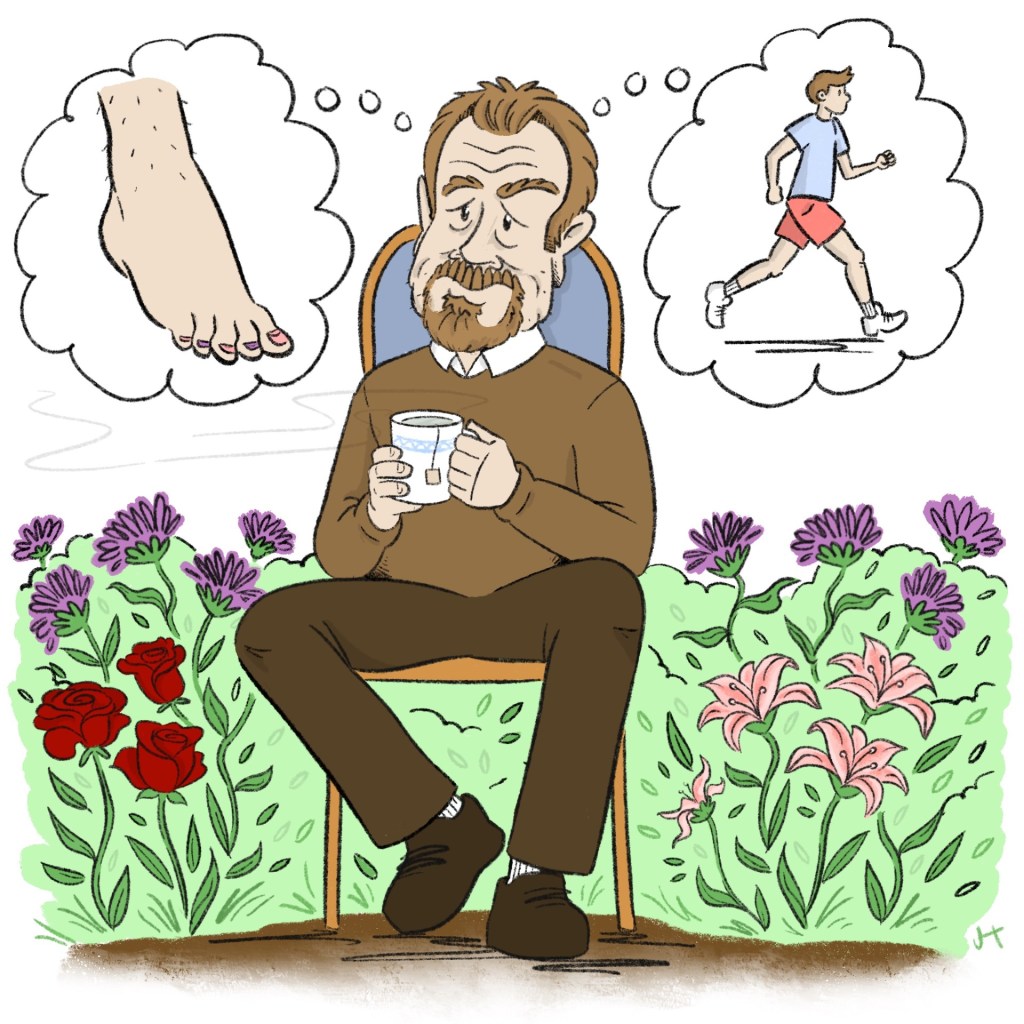
I was inspired today reading about Particia Routledge, known far and wide as Hyacinth Bucket on the television series Keeping Up Appearances. Patricia recently turned 95 and is learning to bake rye bread, following her pattern of learning Italian and watercolour painting, among other things, on her earlier birthdays.
We are now into the New Year, and I am already late for the time when – I am told – we are supposed to think about our future and our goals for the coming year. So I got to thinking that I should take a lesson from Patricia and learn to do something new this year. I guess the idea is to learn to do something that sounds kind of enjoyable but you never thought of doing before to challenge body and mind. I might even live to be 95 some day if I do some positive activity.
My question was, though, what is the best new thing to take on?
My long-time friend Brent suggested I take up jogging and train to run in one of those many marathons that raise money for charities. Fortunately for me, however, I remembered just in time before committing myself that I am too lazy to get up at six a.m. to train, so for sure this was a non-starter, charity or no charity. His sister Joy thought I could learn tree-planting so I could travel to the north and plant trees in the wilderness to help save the environment. Happily for me, though, I recalled at the last moment that my arthritic hips make bending over a bit of a chore, so thankfully I am saved from tree-planting. My friend Debbie suggested, seriously, that I could paint my toenails alternately pink and purple like she does when she feels like doing something “different” for herself. This did not seem to me to be a very manly or humanitarian undertaking and, besides, I would have to bend over. So… no.
Still trying to think of something, I made the mistake of listening to my eccentric co-worker Ann, who is well known to engage in some very unusual activities. True to form, she suggested I enroll in whirling dervish lessons to enhance my spiritual well-being. She had mastered that class beautifully last year herself, she noted, proving her point by motioning toward a framed certificate on her wall. But mercifully for me, I remembered that I get vertigo rather easily so twirling around during whirling dervish lessons was pretty much a no-go. My spiritual well-being would have to wait.
There must be something easier I could learn to do.
Then I remembered something a great aunt once said to me: “The thing I like most in life is to sit quietly in my garden for about two hours and just think my own enjoyable thoughts.” As I mulled this over, I began to realize just how brilliant and profound this advice was. A Ph.D. thesis on the philosophy of life enjoyment could not have put it more clearly or more elegantly: just sit quietly and think your own enjoyable thoughts. As for me, this seemed like a wonderful new idea as – now that I thought of it – I could not remember a time in my whole life when I had sat quietly for two hours and thought my own enjoyable thoughts. Mean thoughts, yes certainly, but enjoyable thoughts? This would be a new venture for sure. And it did seem mildly spiritual.
I strolled out into my garden, chamomile and mint tea in hand, and settled into my cushioned chair among the ample redolence of the roses, lilies, and beebalms to begin thinking my own enjoyable thoughts for two hours. But the first thing that popped into my mind, and thus became the theme of the thoughts I was thinking that day, was, “Can you believe my friends! Jogging? Tree-planting? Toe-nails? Twirling?”
“Seriously?”
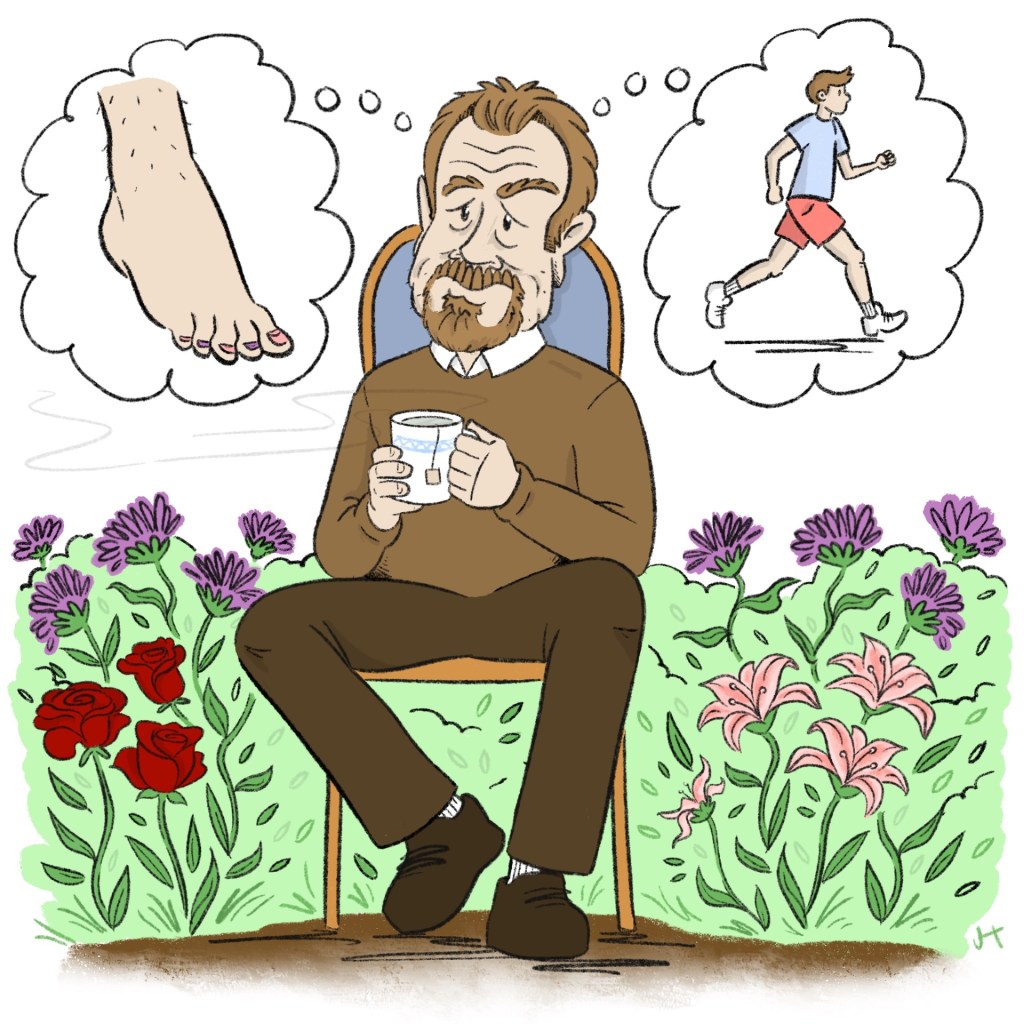
Benny Has Competition For His T-Shirts To Wear In Your Coffin
by Ivan Brown
Louise enjoys cooking on her barbeque, so when a Barbeque Convention opened in her city she thought to prepare for her summer of outdoor cooking by attending. Soon after entering, she noticed an exhibit booth with a large banner across the front that read: Buy The T-Shirt To Wear In Your Coffin. As she got a little closer, Louise realized the vendor was Benny, a man she had met briefly at a party. He made a living by selling t-shirts with slogans that people could wear in their coffins – a bit inappropriate, but cleverly enterprising as she recalled. That particular day at the Barbeque Convention, Benny was selling t-shirts with an image of flames shooting up from a grill and under it the slogan:I guess I got a little too close to the BBQ flames, didn’t I?
Louise wandered over to say hello to Benny, and felt obliged to buy one of his t-shirts. Later at home, Louise tried it on and thought, “That was a clever idea Benny had to start his slogan with the words ‘I guess…’ I wonder if I might be able to make a little money making something like that.” She was not sure what she could do, but she liked the idea of beginning each slogan with the words ‘I guess…’
By Saturday afternoon, Louise had an idea. She invited two friends who liked to laugh and giggle a lot – Lois and Edna – over for coffee and muffins. She was a little nervous to mention her plan, but when her two friends were both busy tucking into their banana and strawberry muffins, Louise said, “See this t-shirt? It says ‘I guess I got a little too close to the BBQ flames, didn’t I?’ A man I know, Benny, makes these to wear in your coffin. What if the three of us think up t-shirt slogans for people who die in really unusual ways and begin every slogan with ‘I guess…’ like he does?”
Lois and Edna both enthusiastically agreed.
The three friends went right to work. They advertised locally, then more broadly, hoping to hear from people who had met their demise in very unusual ways and wanted a smart matching slogan for the t-shirt to wear in their coffins. As expected, they were flooded with requests.
So the next Saturday and every Saturday after that for the whole summer, Louise, Lois, and Edna met in Louise’s living room or on her patio if the weather cooperated. Funny thing, though, the pot never seemed to get put on for coffee again, although the wine bottle always got opened quite handily. The three friends invented catchy slogans and sketched out images to match each unusual death scenario, then had them printed and shipped to the eagerly-waiting families. Benny’s “I got a little too close to the BBQ flames” t-shirt slogan hardly stood a chance by comparison.
The three friends’ t-shirt slogans:
For the student who went to the library and avoided all future classes when a large shelf of books fell on top of her:
I guess I learned that too much knowledge can be a killer!
For the deer hunter who is pushing up daisies because he was charged by an enraged buck who took serious exception to being shot:
I guess I am the Deerly Departed
For the performer who crumpled to his demise from an unknown cause while singing onstage:
I guess I can just say, “The answer my friend is blowing in the wind”
For the woman who somersaulted to her death falling down an elevator shaft:
I guess I should have tried the stairway to heaven
For the young man who was struck by lightning as he stumbled home from a late night date:
I guess I should have listened when my girlfriend said I am electrifying
For the Rocky Mountains hiker who crossed the great divide after being hit on the head by a falling rock:
I guess I was stoned at the time
For the man who met his end by being viciously and inappropriately attacked by a gaggle of angry geese:
I guess I found out what being goosed really means
For the stuttering pedestrian who was flattened by a passing train:
I guess I was not wise to choo-choo-choose that crossing
For the deep-sea diver who chose her own ending by colliding with a sea mammal:
I did it on porpoise
For the rookie matador whose pants fell off just prior to getting gored by a furious bull:
I guess I shouldn’t have worn my red underwear today
For the tourist who toppled overboard when canoeing down the rapids of the Zambezi River:
I guess I heard the tour guide wrong. She actually said, “Free gnu rides”
For the jigsaw puzzle player who choked to death when she tripped and a bunch of puzzle pieces flew into her open mouth:
I guess I am resting in pieces
***
Benny got wind of what Louise, Lois, and Edna were doing and he was not pleased that he now had competition. In fact, he was so displeased that it might even be said that he was feeling vengeful. He organized a late summer barbeque in his back yard and invited several guests, including Louise, Lois, and Edna. At a crucial point, Benny suggested the three might go over and check on the chicken thighs roasting on the grill and, although they wondered why, they did saunter over. Now Benny may have put a little too much fuel in the barbeque that day – who really knows – but for whatever reason, when the three friends crowded up close to the grill to check on the chicken thighs, the whole thing shot up in a huge burst of flames and the three had to jump back like frightened jackrabbits to keep from being charred to their deaths right then and there.
Benny looked on, expressionless on the outside, hiding his true feelings inside. The three women might have “accidentally” been charred to their deaths, eliminating his competition, and that would surely not be a bad thing because, had they been charred to death, they would have been laid out in their coffins and needing t-shirts. Benny grimaced as he realized he had missed out on his chance to make three more sales of his t-shirts that read: I guess I got a little too close to the BBQ flames, didn’t I?
Special thanks to the three real-life contributors: Louise, Lois, and Edna
How My Toothbrushing Problem Restored My Love Of Valentine’s Day
by Ivan Brown
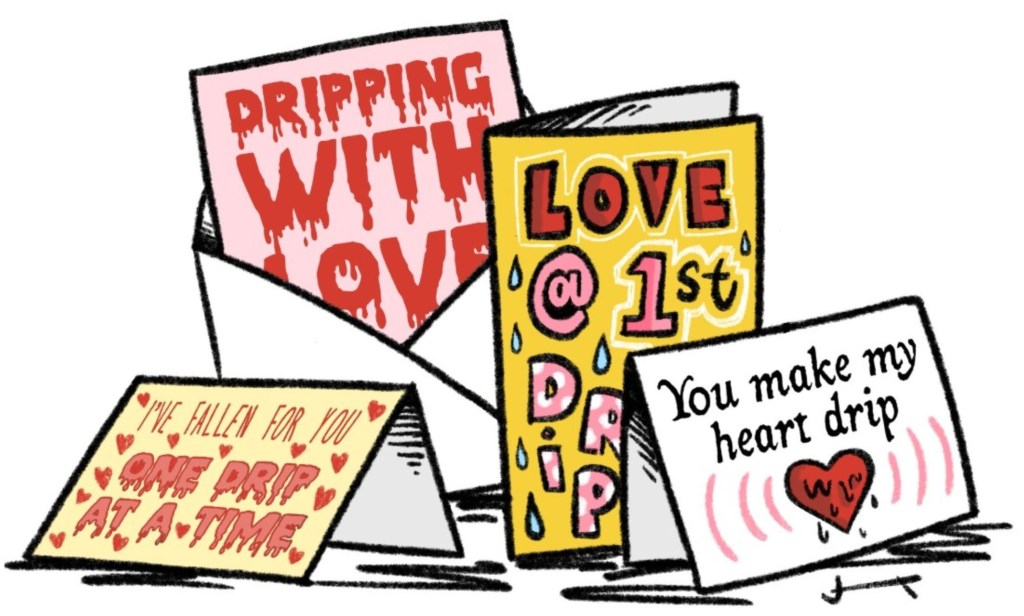
I have a problem when I am brushing my teeth: water keeps dripping down my wrist and arm. I am not really sure why it happens, but I find it really annoying. I have to pause four or five times in the middle of brushing and wipe off the dribbles of water that are slowly making their way down my wrist on their journey to my elbow.
I have tried many times to figure out why this occurs. I tried logic by holding my head back while brushing, and by positioning my arms and torso in various combinations of ways – straight up, bending over, leaning sideways – but the result was always the same. Drips. I tried distracting myself by looking out the window as I brushed, spying on my neighbour sweeping her sidewalk as she does every morning, or by watering my houseplants with my other hand. But no matter what, the little streams of water still trickled down my arm.
Then it occurred to me that I should think like a scientist. I should put my university course in research methods to good practical use. I endeavoured to collect valid data over a three-week period by having my phone take videos of me brushing, then analyzing the data using a variety of appropriate t-tests and analyses of variance. I recorded the results of my analyses on a series of colourful graphs and charts, which I then taped here and there around the bathroom walls. It was no use. They indicated nothing. Science had decisively failed to stop the drips.
Next, I tried self-hypnosis. I found a book on the subject in one of those little libraries that my other neighbour has by the sidewalk in front of her house, and it provided a method that I immediately understood to be sound. Before brushing, I would lie on my bed and imagine myself slowly riding down seven escalators, counting backwards from twenty on each one and brushing my teeth as I went. My mind’s focus would be on my right arm that sported not a single drop of water – as lacking in moisture as the Sahara Desert in a particularly dry season. I followed this regimen assiduously every day for two weeks before actually brushing, but it was all to no avail. The little streams of water continued to dribble downward as usual. And my mind remained, unhealed, at the bottom of seven escalators.
Perhaps I needed a more practical approach. I installed a hook on the wall near the sink and hung the hair dryer there, positioned it toward my arm, and turned it on high. Its job was to dry the drips as they dribbled downward but, sadly, the hefty breeze it produced only succeeded in splattering the toothpaste all around my mouth and, more abundantly, all over my downwind cheek. Disappointed, I retired the hairdryer from its duties, although the hook proved a useful spot to keep a towel handy to wipe away the moist droplets that continued to trickle down my arm.
I obviously needed outside help. Perhaps I should hire an assistant. I thought to advertise for an English-style butler, and a proper English gentleman named Jerome was only too happy to accept the job. He would promptly appear at my tooth-brushing time, and stand tall by my elbow – in that proper English way – with an absorbent white towel draped elegantly over an outstretched arm. When he noticed the slightest drip trying to sneak down my forearm, he would pat it delicately and the thing would be gone. I was so pleased with my English-style butler, but alas it was not to succeed. He kept rushing out, abandoning his duties, to put the kettle on and serve me tea. In his own words, “It is rather difficult, sir, to properly sip a cuppa whilst brushing one’s teeth.”
I gave up. Every method I had tried to stop the drips from running down my arm had failed miserably.
Not knowing what else to do, I returned to that little library by my neighbour’s house and searched for a discarded paperback that might offer a solution. And was I in luck that day! I spotted a book titled Make Your Problem Your Friend and a brilliant idea flashed across my mind. I would make the drips my friends. I would give them names, and I would come to realize how dearly I held them in my heart.
I rushed home and started brushing right away. When four drips formed and started on their downward journey, I named them Irene, Gordon, Clarence, and Rosalie. A laggard fifth drip was, somewhat affectionately, named Jerome after my erstwhile butler. They were my friends, my dearly-loved friends, and I cherished them. I glowed with the joy of having five such wonderful friends in my bathroom with me all at once.
Now, as I have progressed through life, my excitement over Valentine’s Day has been gradually waning. This year, though, on February 14 I was moved to celebrate the day by sending each of my five friends a lovely Valentine’s card expressing my gratitude for their companionship and wishing them well in all their endeavours.
The whole thing has totally restored my love of Valentine’s Day.
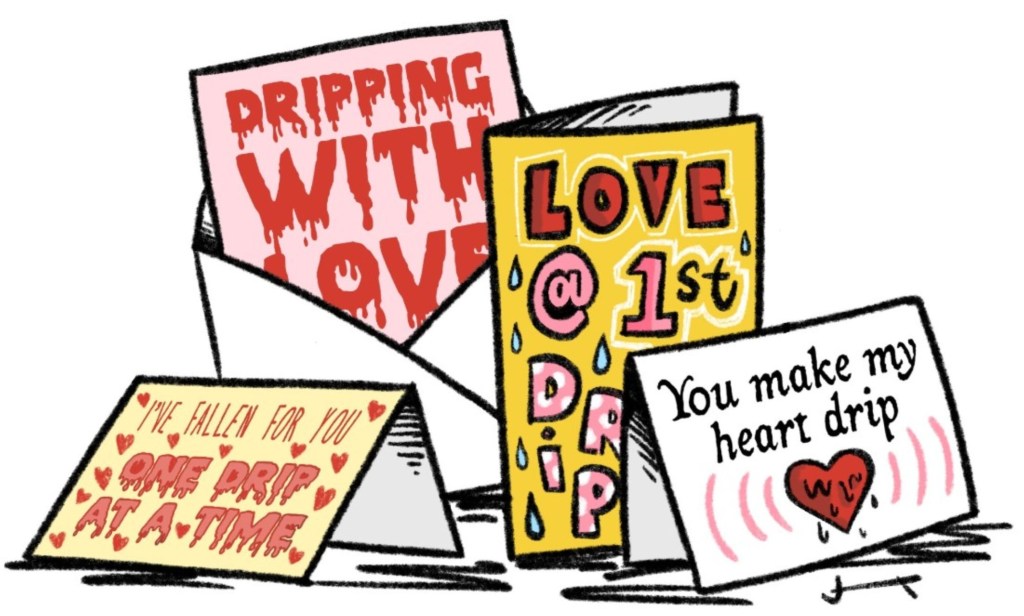
Why Do People Brush Their Teeth In The Movies?
by Ivan Brown
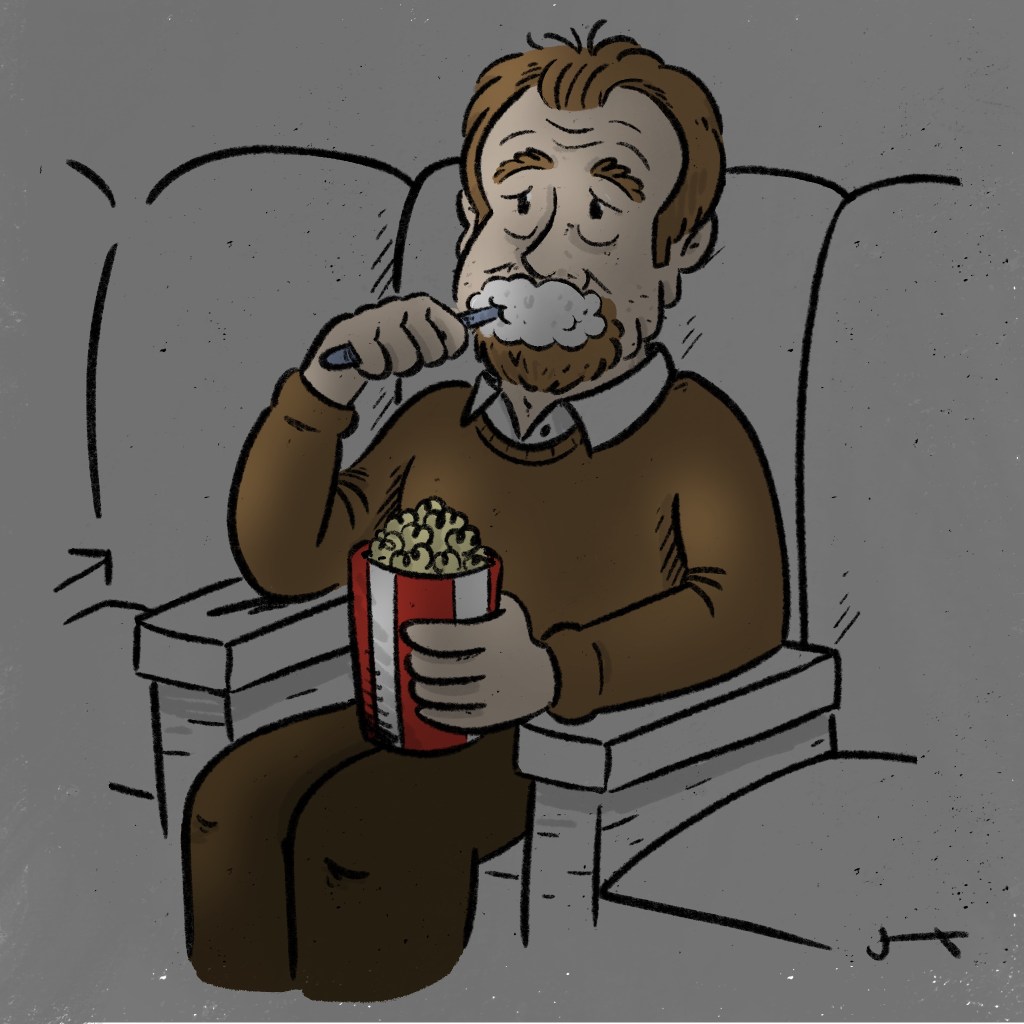
Perhaps you have noticed, as I have, that actors in movies are always brushing their teeth. I keep wondering why. Does the director really think I enjoy watching that? Even in the privacy of my own home, it has never once occurred to me to rush into the bathroom to get some pleasure by looking on as those nearest and dearest to me brush their teeth. And I certainly have never filmed them. So why am I sitting in a dark theatre, popcorn in hand, watching people I don’t even know brush away like there is no tomorrow?
It really baffles me.
A movie set is an actor’s workplace, is it not? I don’t think many of the rest of us brush our teeth while we are working. Speaking for myself, anyway, I get up in the morning, get myself ready, eat my breakfast, then brush my teeth before I walk out the door and head to work. Would I go to my office, sit down at my desk, open my computer to join some colleagues in a video meeting, then brush my teeth right in front of them all? No. That has never happened. I don’t know why actors can’t find the time to brush their teeth at home before they get to work.
It’s not that I object to people brushing their teeth. I do it from time to time myself. But it puzzles me why people brush like mad in movie after movie when I have never seen any other acts of personal care. I can’t think of a single movie where people dried their ears with swabs, where women plucked their eyebrows with tweezers, or where men took a razor to the little hairs that grow on their ears. Or maybe those things just never occur because they are all too busy brushing their teeth.
And I suppose you have noticed, as I have, that they always brush totally the wrong way. I go to the dentist regularly, and have watched those videos that play on the screen in the waiting room about how to brush properly. I don’t think movie actors have ever seen those. They always talk while brushing randomly here and there, and they go back and forth instead of massaging the gums then stroking downward or upward like the video says. To top it off, they never finish brushing most of their teeth, but instead they start arguing with their would-be lover part way through and spit repeatedly into the sink. What kind of romantic impression do they hope to make with toothpaste dribbling out the side of their mouth and only half their teeth even brushed?
The whole idea of brushing your teeth in the movies goes completely over my head.
Still, I got wondering one day if I were the only person in the world who felt this way or if there might be others who share my point of view. I resolved to investigate. The idea I came up with was to go to a movie theatre where I would make a mockery of movie tooth-brushing to see how other people would react. I was not a bit sure anyone would react at all, as sitting in a movie theatre is very much a solitary event and it is a rare thing indeed to interact in any way with other movie-goers. But I would try.
The very next day, I slinked into my local movie theatre after the lights went down with toothbrush and toothpaste in hand. I set my popcorn on my lap, then sat back to watch and wait, fully trusting that the filmmaker would come through. Sure enough, our hero eventually started getting ready for bed and began brushing his teeth and arguing with his wife. I quickly applied the paste to my own toothbrush and began brushing randomly here and there just as he was doing, but completely in sync. I glanced around for reaction, and was I rewarded! Spontaneous clapping and cheering broke out, then grew louder and louder as I continued to brush with more and more exaggerated motions. Much laughing and whistling ensued. We could not even hear our hero spitting in the sink. It seemed everyone else was as annoyed at all the tooth-brushing in movies as I was. I felt so proud as I left the theatre that day, people shaking my hand heartily and clapping me on the back with considerable enthusiasm.
The next week I went back to the same movie theatre and was quite astonished to see that I had initiated a rather major movie-going trend. Almost every single person in the audience held a toothbrush, already festooned with various colours and shapes of toothpaste, ready for the scene that was sure to come. And it did. All together, the audience members joined the actor, shouting with foaming mouths and cheering through half-brushed molars with every stroke the actor made: “Brush! Brush! Brush! Brush!”
The revelry and comradeship among audience members is wondrous, and it continues on week after week – even well after the movies end. We have formed an informal club now over coffee and donuts at a nearby café where we laugh and chat the rest of the afternoon away. And we never brush our teeth afterwards.
Now I understand the true purpose of all that brushing. The directors have finally achieved their goal. They have used a simple cinematic device – tooth-brushing, that most unlikely of social lubricants – to transform movie-going from the solitary event it was in the past to the enjoyable social occasion it has become today.
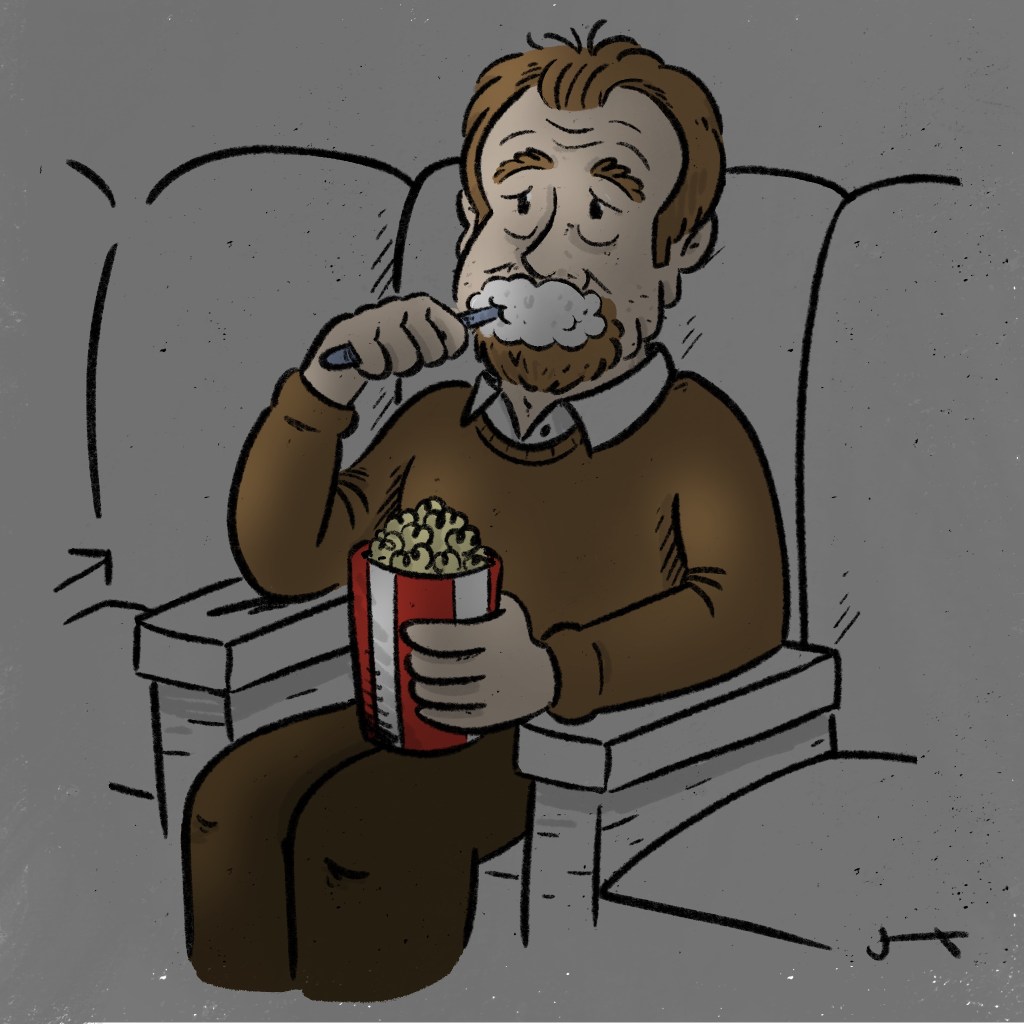
Ann Picks A Name For Her Newborn Son
by Ivan Brown
When Ann learned that her firstborn child was to be a boy, she began – as most mothers do – an ardent search for possible names. She wanted something unique, yet meaningful. Something substantial, classic even. Something that carried with it the weight and grandeur of the ages. In her search, Ann ran across the story of a lowly Greek boy who was so incredibly handsome that he was abducted by the gods to become Zeus’s cup-bearer in Olympus. Perfect. Ann would name her son after this beautiful lowly Greek boy. His name would be Ganymede.
Ann’s husband, whose name was simply Tom, expressed the point of view that Ganymede, as a name, might be a bit too classic. Perhaps, he mentioned casually, another name that was a little more subdued might serve their son better on the playground or on the football field. Perhaps something a little less… historic.
But as most husbands have learned from experience, one does not want to argue too resolutely with a wife who is more than eight months pregnant. There is simply very little chance that he is going to be able to make a valid point to someone who has a belly out to here (and it is all his fault), is cranky from indigestion and swollen ankles, and hasn’t slept comfortably for months now. She is just never going to agree that there might be some downside to a name like Ganymede.
So, Ganymede it was.
As Ganymede grew into his childhood, it became apparent to all that his name had been somewhat ill-chosen. He did not turn out to be the incredibly handsome boy that his ancient Greek namesake was said to be. On the contrary, it seemed that some genetic misalignment during routine meiosis of the egg or sperm resulted in many of his facial features being somewhat askew. His eyes were too wide, his nose definitely off-kilter, his smile quite lopsided, and his ears considerably lower than expected. The other children made fun of him, taunting and teasing him on the playground and on the football field, and his name being Ganymede did not help one bit.
Stigma based on facial appearance is not an admirable human trait, but it certainly existed for Ganymede throughout his childhood. On top of that was the other stigma that constantly bombarded him and was even stronger – one based on having a weird name. All this worried Tom a great deal, but whenever he would raise the issue Ann would just smile as if she possessed some wisdom that he did not.
Sure enough, as Ganymede entered his adult years, he found inspiration from his namesake, the lowly Greek boy who rose to greatness by becoming a cup-bearer to the great god Zeus. He resolved to rise to great heights too and, after some lengthy pondering, he hit upon the idea to make his so-called weaknesses his strength. He did an internet search for people named Ganymede who had experienced discrimination and invited them to join an online fraternity that he called The Ganymede Group. Over the course of the next month, the group quickly swelled to 437 Ganymedes, all of whom had experienced discrimination and stigma, and many of whom also claimed to have facial, body, or mobile issues that were an additional source of injustice in their lives.
Ganymede established a website for the 437 Ganymedes who sprang from 31 nations and spoke 23 languages. Spontaneous translation was installed. The Ganymede Group did not have membership fees, but a Go Fund Me campaign soon saw thousands pouring into a newly-established bank account. A television reporter noticed, and Ganymede was featured on newscasts in this country and that country. Soon he became quite a hot commodity as a guest on various late-night talk shows that were growing weary of making fun of politicians.
Ganymede gained enormous fame. The Ganymede Group organized an international conference in Madrid, and the following year in Tokyo. They established parades advocating for name and appearance equality in city after city – parades that attracted millions and were soon an annual staple in Amsterdam, Cairo, Manila, Buenos Aires, and even Dallas. Ganymede was in high demand as an international speaker, was appointed an ex officio member of the Council of the European Union, accepted an invitation to sup with King Charles, and received honourary doctorates from universities in Dublin, Moscow, Abu Dhabi, and 28 more. He won the Nobel Peace Prize for Human Progress and Enlightenment.
Today, it is clear that Ganymede, although far from being incredibly handsome, has become incredibly rich and famous. He has risen to great heights.
And what of Ganymede’s parents? As time passes and Ann ages, Tom often notices her sitting in her rocking chair, drinking her tea with a quiet smile on her face. He imagines she is thinking of all the good fortune that came from the name, Ganymede, which she so judiciously gave her son. He feels a little pang of regret, yet thankfulness in his heart as he realizes that a woman in her eighth month of pregnancy possesses an other-worldly wisdom that no husband can ever explain.
Edmond Asks A Philosophical Question
by Ivan Brown
COMING APRIL 5
About the Author

Ivan Brown is a retired professor… well, he seems to still be teaching, so… is he retired, is he not retired, what? No one knows. In any case, as he notices his impending dotage trying to sneak a peak over yon horizon, he throws caution, along with his dubitable dignity, to the wind and just goes with his silly side in Oh, the Things I Think About. Ivan lives and works in Toronto, Canada. ivanbrown95@gmail.com
About the Illustrator

Jon Kalvin is a Canadian illustrator and cartoonist, who works predominantly in illustrating children’s books and cartoons. As readers of these stories can clearly see, his images brilliantly capture the essential elements of both people and situations. Jon has produced many “portraits” of people, including these charming ones of himself and the author. Jon lives and works in Toronto, Canada. imjonk.ca


 BK Books & Creatives
Leave a reply to Shirley Cancel reply