By Vern Nicholson
© Vern Nicholson, 2004
Foreword by Ivan Brown
Many people have asked me over the years, “Is it ok to laugh at disability?” My answer is always the same: “Absolutely, as long as the context is absolutely safe.”
By “safe” I mean the context should be physically safe (nobody gets injured), socially safe (nobody gets insulted or feels marginalized), and psychologically safe (nobody gets emotionally damaged). When we ensure this context, we can find and enjoy the humour in almost anything, including disability. Finding the fun and the funny side of something, even something like a disability that requires extra adapting, not only can be therapeutic to the person with disability but also can make the rest of us realize the folly of our past ways and make us think of how to improve life for everyone in the future.
Such is the case here with my friend Vern, a man who was diagnosed in adulthood with Asperger syndrome. In recounting some of the events of his life during his 2004 cross-country tour of Canada, Vern has exhibited the delicate art of interlacing his own bittersweet memories with a perspective that highlights the often-humorous absurdities of living a life with disability in a mostly non-disability world.
In recent years, the academic and professional communities have rejigged their thinking of Asperger syndrome to include it as part of the much broader Autism Spectrum Disorder. We must remember, though, that such categories have been constructed for our convenience but that, ultimately, we need to think of people as people, all with their own sets of unique characteristics and features.
Vern’s stories here clearly illustrate his own uniqueness. They are personal and they are very often touching, but they also make you chuckle in places as you move through his journey with him. This perspective encourages us to enjoy Asperger syndrome while making us keenly aware that there is much we can do to make the world a better place for Vern and the many other “Verns” all around us.
I Am Troubled By Static
Vern Nicholson
It’s my last day in Saint John, New Brunswick, and the breakfast buffet closes at nine. Cursed morning people. Twenty minutes left. I put on my socks. The trip down will take three; lacing up my hiking boots, another two. That leaves fifteen, and they might be locking up by then. I’d better move it.
Shoeless, I bolt out the door and wait for the elevator. Now, isn’t there some silly rule around restaurants and shoes, or lack thereof? Why footwear should be a dining essential is beyond me. It’s like saying you can’t walk your dog without a spoon in your pocket. These humans are crazy. Ground. I sprint down the hall and into the restaurant.
A chunky hostess in a beige uniform greets me at the entrance. “The buffet, sir?”
Panting, I nod. “Right this way, please.” I tiptoe in behind her.
“No shoes today, huh, sir?” Damn! Caught, red-footed. And not once did she look at my feet. How could she tell — electronic shoe detector?
“Sorry, I was in a rush.”
“You do realize, sir, that footwear is required.” She smiles sweetly. “It’s our policy.”
“Yeah, but socks are footwear.”
The McSmile fades. She scurries off. I take the buffet with impunity.
“Besides, the place is empty,” I mutter. After a bowl of oatmeal and a plate of lukewarm scrambled eggs, I leave a $2 tip and slink away.
“Footwear required” … what for? Social conventions baffle me. Until I happened upon Asperger syndrome, I didn’t know why. The discovery came just after my divorce. I’d recently joined an e-mail list for social phobics. A support group in the classic sense, our collective expertise lay in lamenting our pitiful state. But one day a chap from Maryland posted this:
From: Kevin
Subject: Genetic?
Hey gang, Maybe this thing is genetic, ‘cause I have a cousin who’s one of us. You know the deal — 34, awkward, isolated, clueless. But here’s the twist: he reads maps all day. My aunt took him to a shrink and the guy said he has Ausburger syndrome (sp?). It’s a kind of autism, usually diagnosed in childhood. They have narrow, eccentric interests, find social norms arbitrary, and have trouble with intimacy. Sounds like your common or garden nerd to me. Man. Don’t we all qualify?
Kev
Well, I sure did, whatever this “Ausburger” thing was. Okay, I didn’t read maps all day, but the rest sounded a lot like me. Once I discovered that we had a Dr. Hans Asperger to thank for the name, I asked my psychiatrist for a diagnosis.
“My initial response is I’m not a pediatrician,” he said.
“And I’m not a child. Now that we’ve established that —.”
“Don’t get smart with me.”
“Look, if you can’t help, that’s fine. We’ve been butting heads since day one anyway. Can you refer me?”
He sighed. “There’s a Dr. Mendelsohn at Sunnybrook to whom I owe a favour. God knows this isn’t it, but he might see it differently.” He got up and motioned toward the door. “And with that, Mr. Nicholson, I wish you luck.”
CONSULTATION SUMMARY
PATIENT: Nicholson, Vern
CASE ID: 515400116
DATE:29-04-96
CLINICIAN: Mendelsohn, P.T.
Mr. Nicholson presents with a long-standing history of emotional and developmental difficulties, most pertaining to high-order social functioning. Cognition appears grossly intact. Overall language level normal. Difficulty with nuance and figurative language reported, especially in childhood. Socio-emotional gestures, gaze, and facial expression generally appropriate. Evidence of social difficulties and stereotypical interests (maps, train timetables, short-wave radio) noted. Adherence to ritual and routine present, though not as strict in form or duration as typically noted in Asperger patients. Mix of symptoms perplexing but in keeping with a residual type of Asperger disorder of the broader autism phenotype—qualitatively similar to autism but quantitatively not to the same degree as full-blown autism.
P.T. Mendelsohn, MD, FRCP(C)
A diagnosis I’d neither expected to seek nor receive was now mine. I had just turned forty.
I make my way to Île Ste-Hélène and the Biosphere. The museum focuses on the Great Lakes, but that’s not what draws me. It’s the outer shell, the sphere itself. This, the former U.S. Pavilion, is an icon of Montreal’s coming of age: Expo 67.
I remember the buzz, though I wasn’t there. I was five. My parents went on their own; I stayed behind, glued to the TV. The coverage told me Expo 67 was the event of the year, and oh, what a year! You see, as a child I was attached to concepts, not people. I thought 1967 was special — so much so I threw a rare tantrum that New Year’s Eve. Mom and Dad were tucking me in before heading out. Dad tugged on my blanket.
“Well, son, tonight is a very special night. When you wake up tomorrow, it’ll be 1968.”
“You mean it won’t—” I burst into tears.
Suddenly pale, Mom kissed my cheek. “Vern, don’t cry. It’s okay.”
“But Mom, 1967 is the best year ever. It’s our centennial year!”
“I know, son, but a year only lasts twelve months. Then a brand new one takes its place. It’ll be fine. Don’t worry. I’m sure 1968 will be good too.”
“But we’ll never have another centennial year, ever! And 1967 was the Summer of Love! And … and we had Expo 67, ‘Man and His World.’ On CBC, they said there were 113 pavilions.”
“I know, dear. Your father and I were there, remember?”
“At the 113 pavilions?”
Dad grinned. “No, son. We only had time for a few.”
“You went to the Ontario Pavilion, right, Dad? A place to stand, a place to grow, Ontari-ari-ari-o. Why does 1967 have to end?”
“I’m sorry, Vern,” Mom said, “but time marches on. There’s nothing we can do about it.”
“Time marches? Like a soldier marches?”
“Kind of,” she said. I didn’t understand.
“Your mother and I can control some things, son, but the changing of the year is not among them,” my dad said. Nice try, Mr. Logic, but no match for an autistic kid hell-bent on clinging to the dying embers of ‘67.
“NO!”
The more they tried to reassure me, the more hysterical I became. It took them two hours to calm me down, but in my heart I wasn’t convinced. I’m still not. Like the kid said, we’ll never have another centennial year.
Ever.
As a toddler I was every parent’s dream, or so I’ve been told. A placid child, I amused myself by sitting in the corner tracing car logos.
“He’s gonna be a mechanic!” Uncle Phil crowed when he saw my meticulous work. (Uncle Phil, of course, was a mechanic.) The love of design stuck, but the car thing would prove an anomaly.
By age four, I’d moved on to drawing city maps. I was fascinated by where the roads went, why they were straight or curved, and especially where they ended. Apart from Jeremy, a quiet boy down the block, I had no interest in playing with the neighbourhood kids. And truthfully, I could take or leave Jeremy too. No slight on him, but socializing wasn’t my thing. I preferred to work on my maps, watch Jeopardy! and Get Smart — which I swore was an actual spy series — and read the Toronto Telegram.
Yes, from an early age, I loved words. But engaging as they were in print, they sounded even better. I took great delight in reciting TV commercials, inflections and all: “Bayer—it’s gentle as a mother’s kiss. Bayer Aspirin’s single active ingredient is so gentle medical authorities say it is the safest of pain-relieving drugs. Ask for it by name at your pharmacy today. Bayer works wonders.” Thanks to Bayer and other conglomerates, my vocabulary came along smoothly. Comprehension was another matter.
“You want a cookie?” Mom would say.
“You want a cookie,” I’d reply. Seemed reasonable; if Mom called me “you,” why would I call myself anything else? Wasn’t “you” my name? Today, echolalia and pronoun confusion are recognized as telltale signs of autism. Back then, no one had a clue. My parents, God bless ‘em, found my quirks cute … till they couldn’t stop me from using the second person or regurgitating the day’s TV fare.
“You want to go down the street and play with your friends?” Dad asked one summer day.
“You want to go down the street,” I said, walking a ramrod straight line in the middle of the road. Literalism notwithstanding, my verbal abilities were fine.
Non-verbal cues (facial expressions, for instance) gave me trouble. To wit, on special occasions I wondered why my parents insisted on taking pictures but did my best to oblige. When asked to smile, I’d clench my teeth and stretch my lips as wide as they’d go — something akin to your expression when the dentist says, “Now, close.”
If visuals were a challenge, I found movement utterly baffling. For starters, I had poor hand-eye coordination. Dad would drag me away from my maps to play catch, but he gave up when it became obvious I could neither catch a ball nor throw one. More worrisome was my odd gait: with knees bent, I’d place my whole foot on the ground and bounce along like a moonwalker. That’s if I could get shoes on at all. Oh, I could slip my feet into them okay, but tying the laces? Impossible. I’d grab both, fling one across the other — which went over and which went under? — then helplessly let them fall.
“Son, please,” Mom said. “You’ve got to try at least.”
“But you are trying.”
Dad shook his head. “Yes, very trying. Vern, you have to learn tie your shoes. It’s as simple as that.”
“But you can’t!”
Richard, the newborn, wailed in the background. Dad threw up his hands.
“It’s I can’t, Vern. I. And you’re right—you can’t. You can’t and you won’t. Not with a defeatist attitude like that.”
Ooh, “defeatist” — now there was a neat word.
“You want to look at the dictionary.”
An exasperated sigh gushed out Mom’s lips. “After we do a few more bows, Vern.”
When I was eight, my parents enrolled me in Cubs. One July night, we piled in the car and drove to York Memorial Presbyterian Church. Dad turned the key and backed out of the driveway.
“Well, son, are you excited?”
“I don’t want to go.” By then, I’d figured it out: when they say “you,” respond with “I.”
“All we ask is that you try it.”
“It’ll help you make friends,” Mom chimed in from the passenger seat.
“I don’t want to make friends, and I hate these clothes.” Which I did. From the ill-fitting shirt to that goofy green cap, my lifelong aversion to uniforms had begun.
Once we were parked, Dad ushered me into a damp, candlelit basement. Dozens of unfamiliar boys huddled in groups they called “dens.” Some burly guy named Akela led us in a chant, then walked us through a long list of rules. Next came the evening’s featured activity: tying knots. We were to master the first five by next week. The debacle concluded with a series of bizarre, guttural howls that scared the living daylights out of me.
When it was over, I raced outside. Dad met me at the door, beaming. “Well, son, how’d it go?”
“I’m never going back.”
“Vern, don’t be rash,” he said, crestfallen. “You know, when I was a kid, the Pack taught me a lot. I learned how to camp, use a compass—”
“They’re crazy. They have all these weird rules and they howl like wolves.”
“Oh, don’t be silly. You’re hung up on the window dressing.”
“But Dad, the church basement doesn’t have windows.”
Back home, Mom tried to ease the trauma by letting me bake my first batch of oatmeal cookies. She walked me through preheating the oven and preparing the mix, then left me to finish the job. I checked the package to see what came next. “Butter the bottom of the pan,” it said. I pondered the phrase. “Butter” as a verb? Curious, but I thought I understood. What else could one do with butter but apply it to a surface? That must be it. But which bottom did they mean? I couldn’t see how buttering the bottom would help the cookies bake, but the directions were always right. I loved following directions. So, knife in hand, I flipped the baking pan over and slathered away.
That fall, Lucy, a freckle-faced cutie, became my first crush. I told Jeremy I worshipped the ground she walked on. Had no idea what it meant; guess I’d picked it up from the TV. Jeremy turned around and told Lucy, who informed me the next day I was her “third-best boyfriend.” Didn’t know what that meant, either.
Lucy moved away in Grade 5.
Later that year our school set up a cultural exchange program, pairing each of us off with a pen pal from Iceland. I drew a girl from Keflavík named Ingrid Einarsdóttir. Like any eleven-year-old, I was keen to share my passions with my new friend.
November 3, 1972
Dear Ingrid,
Hello. My name is Vern. I am your new pen pal. I live in Toronto, Ontario, Canada. Toronto is the capital of the province of Ontario. Our summers are hot and humid. Our winters are cold and snowy.
I am in my final year (Grade 6) at Keelesdale Junior Public School. Keelesdale Junior Public School is located on Bicknell Avenue between Juliet Crescent and Avon Drive. I enjoy listening to the radio. These are the stations I can get on my radio:
WGR 550 Buffalo
CKEY 590 Toronto
CKTB 610 St. Catharines
CFTR 680 Toronto
CJRN 710 Niagara Falls
CBL 740 Toronto
CHIC 790 Brampton …
And on up the dial I went. Hey, and that was just the daytime reception. On the second page, I gave Ingrid the full tour of the AM band at night. Page three covered FM, and on page four I rhymed off the TV stations I could pull in with our new rotary antenna. I ended with: “Last weekend I got Channel 12, WICU-TV from Erie, Pennsylvania. Reception was fair.”
Like most nerds, I paid little attention to how I dressed. Whatever Mom laid out for me in the morning was fine. Unfortunately, Mom had no fashion sense.
As for me, I fretted over just one point of style: I wanted to grow my hair long like my musical heroes. My parents said no. So, off to Kane, my new school, I went — in a brush cut, chequered pants, orange-and-grey striped shirt, and tan dress shoes. And, for the grand finale, my new braces.
The first week of class, a brawny, curly-haired kid named Pete came up to me during lunch. “I wanna ask you a question. Are you gay?”
“Why, yes.” Pete didn’t seem too bright, so I was amazed he knew this seldom-used word, which meant “lighthearted and carefree.”
He grinned. “Thought so. Queer!” He ran off yelling, “Vern is gay!”
Now, “queer” meant “odd or eccentric.” Why would he think me strange because I was happy? More to the point, why did he want to tell the whole school? I wrote Pete off as a nutcase.
The next day, my classmates all snickered when I passed them in the hall. Okay, make that an influential nutcase. Then again, it might have been the “KICK ME” sign someone had pinned to my back.
Alarmed by my despondency, Mom and Dad met with Mr. Blair, my homeroom teacher. His take? I was a model student who showed no sign of behavioural problems. What’s more, he knew of no incidents arising in his classroom. Out of sight, out of mind. Hey, everything’s groovy.
“We’ll have to go over his head,” Dad told me. I stared at him blankly. “You don’t know what I mean, do you.”
“No, Dad.”
“If you talk to the boss and you don’t get results, you go to the boss’s boss. Mr. Blair’s response is unacceptable.” My parents set up a flurry of meetings with the principal, vice-principal, and school trustee, all of whom felt “deeply concerned” but not enough to do anything.
There was only one move left to make. Mom took me to visit C.R. Marchant, an elementary school in Weston. We didn’t like it. Not only did its layout remind us of Kane; the hallways were noisy and rowdy. Besides, when I told Jeremy where I’d been, he teased me in class. “Hey, guys, Vern went to See Our Martian. With his mother!” A dorky kid in a school with a dorky name? No thanks. See Our Martian was off the table.
Fairbank, the next school we checked out, seemed more traditional. After Mom and I reeled off horror stories from Kane, the principal told us not to worry. “We don’t put up with that sort of nonsense here. And Vern, you can start Monday if you want to.”
“I want to.”
For the rest of Grade 8, the new kid lay low. I fancied Sophie, a dark-haired beauty in my class, but kept it to myself. In late June, Miss Wallace, our history teacher, made an announcement: “Class, the graduation dance is coming up tomorrow. I’ll be your DJ, but I have a small problem. I’m missing a few very special songs we’d all love to hear. First off, can anyone lend me a copy of ‘Bennie and the Jets’? Vern? Excellent. Can you bring it to the gym tomorrow?”
I hadn’t planned on going to the dance, but I nodded.
“Thank you, Vern.”
Friday afternoon, I popped into the gym with the 45. Miss Wallace thanked me again. I wondered if I ought to stay. Maybe Sophie would show up. I took a seat in the corner. Man, I had to hand it to Miss Wallace—she was spinning some big-time hot stuff, like “Jackie Blue” and “The Sound of Philadelphia.” I gazed around the gym, wowed by the pulsating strobe lights. Then Sophie breezed by in an emerald dress, bangs drooping seductively over her eyebrows. I rummaged through my bag and tore a sheet from my notebook.
Sophie, Will you dance with me? Vern. I proofread the note, put it in my shirt pocket, then pulled it out to check it again. Too shy to approach her, I dashed through the crowd in search of her friend, Elena. Miss Wallace put on “Kung Fu Fighting.” Everyone cheered.
“Elena, could you give this to Sophie for me? Don’t open it. Just give it to her, if you would.”
“Yeah, okay.”
I paced by the DJ booth. “Enjoying yourself, Vern?” Miss Wallace shouted over Carl Douglas. “Any requests?”
“Do you have ‘Born to Wander’? It’s a few years old. It’s by Rare Earth.”
“Oh, great song! But I don’t have it with me. Sorry.”
“That’s all right, Miss Wallace. Thanks anyway. I have to go.”
Elena stood by the basketball net tapping her foot, piece of paper in hand. Yes! Sophie’s reply! I raced over. Elena rolled her eyes. “Sophie has a message for you.”
“Can I see it?”
“See it? What are you talking about? She says she wouldn’t dance with you if you were the last guy on earth.” Then, in a mocking, singsong voice: “Here’s your note back …” She shoved it into my hand and walked away.
I ran into the schoolyard. A steady rain pelted my face, adding its tears to my own. Both eyes began twitching as I curled up into a ball and rocked.
Abruptly I got up, checked my watch, and walked to the bus stop. Boy, did I have a great summer in store. Last week, Dad bought me a new radio and a membership in NASWA, the North American Short-Wave Association. The other night I heard Holland and South Africa. The bus pulled up. Good. With any luck, I’d make it home in time to catch the BBC. The Antigua relay signed on at 2130 GMT — my first Caribbean country if I could snag it. I stumbled up the steps, paid my fare, and collapsed onto the nearest seat. No, Antigua would be my second. I think. I logged Cuba yesterday. Didn’t I?
In September 1975, I started Grade 9 at York Memorial, my fourth school in three years. For once, first-day jitters were absent. I didn’t feel a thing. After that harrowing dance, my emotions had shut down one by one. I found life far better without them. I did my homework, got straight A’s, and chased QSL cards. Nine more countries verified and I’d qualify for NASWA’s Worldwide DXer award.
Jeremy and I founded the York Memo Short-Wave Club. Every Tuesday we’d set up shop in Room 105 and go panning the static for gold. After a few meetings with only the two of us, Jeremy dropped out. The Short-Wave Club made no attempt to recruit new members.
One afternoon while studying for a math test, I heard a knock at the front door. “Hi, Vern. Remember me?” It was Lucy, paying a visit to her third-best boyfriend.
“Yes, I remember you,” I deadpanned.
“Can I come in?”
“Come in.”
“I go to George Harvey now. Thought I’d drop by on the off chance you still lived here. It’s been a while.”
“Yes.”
“Make yourself at home, Lucy,” Mom said from the living room. “Have a seat.”
“Thanks, Mrs. Nicholson.” Mom headed for the kitchen as Lucy plopped herself in Dad’s armchair. Dazed, I stood at the door.
“Vern, won’t you come join me?”
“Actually, I was on my way downstairs to check for Radio Cairo. They sign on at 2045 GMT on 9805 kilohertz, though it’s variable. The time, not the frequency. Want to see my radio? It’s a Yaesu FR-101.”
Lucy shrugged. “I guess.”
We went downstairs. I fired up the rig. It let out a squeal as I scanned the 31-metre band. Lucy covered her ears. “Hmm. Heavy QRN today.”
“What?”
“QRN. It’s ham-radio code for static. The phrase in full is ‘I am troubled by static.’”
She stifled a yawn. “Uh-huh.”
“But that must be Radio Cairo. I thought I heard the word ‘Egypt.’ Did you?”
“Beats me.” She placed her hand on my shoulder. “Vern, don’t you think it’s time we got to know each other better?”
“We already know each other, Lucy. Besides, Radio New Zealand comes on at 2100 on 17865, and I need a definitive ID. Boosting my Oceania totals will help me earn my Worldwide DXer award. My propagation table says late afternoon is the best window for 16-metre DX.”
At 2058, Lucy stormed out the back door.
At 2100, I logged Radio New Zealand. Reception was excellent.
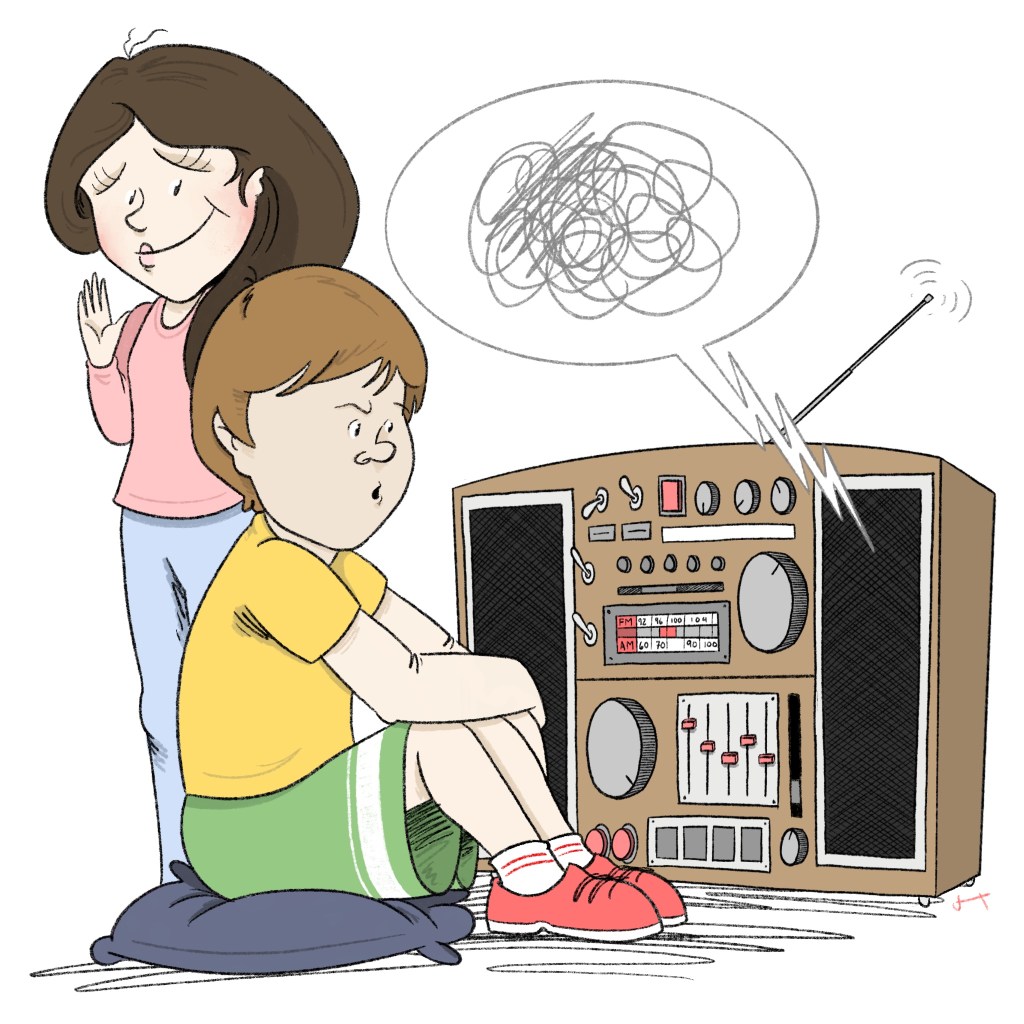
Copyright © Jon Klassen 2023
2 responses to “I Am Troubled by Static: Asperger Syndrome in a Non-Disability World”
-
OMgosh!.right on! My son ( adopted age 4 from Guatemala). Parallel play, no touching!..then the description of growing up..pronoun confusion, rituals
(no Changing!), literal ” butter the pan”.. yep.. been there…confusion of non- verbal ques, difficulty in nuance & figaturative language..he’s now 19..some better..still. he is who he is.. & I love ❤️ him
Thank you for a charming story! Linda Sonnett CarlsonLikeLike
-
Thanks Linda. A kid with autism can be challenging at times, but there are many joys too as you well know. The main problem with our society and our services is that they keep expecting everyone to be like “the norm” and trying to make kids with autism “normal” when we should be enjoying their uniqueness and individuality.
LikeLike
-


 BK Books & Creatives
Leave a reply to williamivanbrown Cancel reply